
B7. Local Siting Selection & Terrain Usage
Ultimately the sector at 35N 215E was selected (west of the Lycus Thrust, Acheron Fossae zone).
Port Harmonia, Amazonis Planitia, Arcadia, Delta Quadrant, 35N, 215E (near the foothill beginnings of Olympus Mons.)
Combining a windbreak + bench-and-scarp + shallow amphitheater, with nearby ice and quarryable rock, we got: shorter runs, easier bury-and-berm construction, calmer air where we needed it, and cheaper logistics paths outward—all while keeping the “best part is no part” ethos. We didn’t need to move the 80 kt baseline to get to 2-3k population; we did not need to spend tonnage on the wrong civil works and keep doors open for later rail, pipelines (only if flows justify), and town-scale satellites.
What we looked for (and how it helps)
Short list of naturally occurring features that are actually worth designing around, plus how/why they help.
1) A low, continuous windbreak (rim, scarp, or yardang line) on the prevailing-wind side
Why: Cuts dust flux, wind loads, and blasting requirements for berms; protects air intakes and the main concourse.
Spec: A 10–30 m high, kilometers-long, gently curving landform upwind of the campus—e.g., the subdued rim of an older, eroded crater or a wrinkle ridge.
Place/Use: Put the city leeward of this line; site the padport downwind beyond it so plume ejecta blow away from habitats.
Mass win: Less engineered wind fencing/berming and smaller HVAC dust prefilters; fewer armored shutters on intakes.
2) A broad, hard “bench” with a backed scarp (cuesta/bench-and-scarp topography)
Why: Two natural elevation tiers let you: put heavy industry & reactors on the lower bench (easy logistics, better heat rejection), bury habitat galleries into the scarp toe (free lateral shielding), run utilities in a protected gallery at the bench break.
Spec: 1–3% overall slope; scarp height 10–40 m; competent caprock above, thick regolith below for easy trenching.
Mass win: Shorter utility runs, less cut/fill to get level plinths, and part of your “earth-carried pressure” roof is free.
3) A shallow “amphitheater” depression (not a deep bowl) within the campus
Why: Natural microclimate control—reduces cross-winds and creates predictable flow paths for dust fences.
Spec: Think a 1–3 m gentle sag across hundreds of meters (your 150 m-radius crater works if its rim is low/eroded).
Place/Use: Put air intake farms and green courtyards inside the wind-shadow; put dust traps and service yards at the outflow side.
Mass win: Smaller intake superstructures and fewer movable louvers/shutters.
4) Nearby, shallow ground-ice indicators (within 5–30 km)
Why: Water is the heaviest “commodity” you don’t want to truck forever. Access to ice-cemented regolith or lobate debris aprons close by turns into real OPEX savings.
Spec: Polygonal ground, scalloped terrain, or debris aprons at mid-latitudes; target <50 m vertical relief along the corridor.
Place/Use: Plan a prepared corridor to a dedicated ISRU site (industrial satellite), not pipes back to the city (move water as tanked cargo until flows justify a pipeline).
Mass win: Smaller city-center ISRU, fewer tanker trips per tonne of water.
5) Consolidated basaltic “pavement” patches (ventifacted surfaces) within footprint
Why: Natural hardstand for depots, container yards, and heavy vehicle maintenance; you avoid importing road base.
Spec: Deflated, clast-armored surfaces with low sinkage; interleave with sand sheets you can grade.
Place/Use: Put container parks, battery swap yards, and railcar assembly pads here.
Mass win: Less geogrid/matting and crushed aggregate; lower wear on running gear.
6) A quarryable outcrop set (basalt & sulfate/chloride layers) in the near field (≤30-50 km)
Why: In-situ materials let you cast blocks, sulfur-concrete, and geopolymers for culverts, sleepers, and shielding.
Spec: Basalt flows or indurated channel fills for aggregate. Sulfate-rich beds for geopolymer binders (low water demand).
Place/Use: Reserve a small materials reserve with a haul loop separate from people traffic.
Mass win: Less imported structural/lintel stock; lighter culvert/road kits.
7) A natural “utility corridor” (shallow trough/valley) radially away from the city
Why: Gives you a pre-graded alignment for your prepared road (later rail), fiber, and future pipelines with minimal cuts and <1% ruling grades.
Spec: 50–200 m wide, kilometers long, minimal cross-slope and boulder fields.
Place/Use: Make this your primary logistics spine to satellites; reserve a 50 m right-of-way from day one.
Mass win: Lower civil works per km; keeps energy/ton-km down for decades.
8) Clean, low-drift wind sector for the padport 10–50 km downwind
Why: Keeps plume ejecta and saltation out of the city.
Spec: A stretch with fewer dune-forming traps; bedrock patches preferred.
Place/Use: Build remote pad(s) here and shuttle by road-train; align approach over low-relief terrain.
Mass win: You avoid the cost (and design pain) of armored, close-in landing pads and constant decontamination.
9) A modest, south-facing exposure (NH sites) for solar wedges
Why: Even if nuclear is your spine, tilted terrain helps your opportunistic PV wedge and sheds dust better than flats.
Spec: 5–15° aspect-correct slope parcels outside of critical wind shadows.
Place/Use: Carve PV terraces on these faces; keep them outside the main dust recirculation zone.
Mass win: Smaller cleaning systems; slightly less PV area for the same yield.
10) Thick, diggable regolith (≥2–8 m) sitting on competent base
Why: You can trench, cut-and-cover, and berm cheaply; anchor footings in the firm layer.
Spec: Avoid blocky ejecta blankets and “boulder armor” within the living core; keep those for outer works.
Place/Use: Put hab galleries and utilities in trenches; use excavated spoil as shielding berms.
Mass win: Less imported structure; fewer rock-breaking passes (time and wear savings).
How we arranged it (one-page site recipe)
Upwind arc (windbreak): eroded rim / ridge ~1–3 km upwind.
Central 150 m crater: repurpose as service amphitheater — intakes, dust traps, emergency muster, and a below-grade tank farm; not for landings.
Heavy plant belt (down-bench): reactors, ISRU, waste, and fab along a perimeter service road with direct access to the trough-corridor.
Logistics spine: prepared corridor in the natural trough to satellites and the remote padport; buried fiber from day one.
Materials reserve: small quarry lane to nearby outcrops; separate haul loop to keep dust/rocks out of living areas.
PV terraces: on a clean, south-facing slope parcel away from wind recirculation.
Green & air zones: courtyards and intakes in the amphitheater lee; maintenance-friendly, predictable airflow.
Features we avoided (even if they look cool)
Deep bowls/steep rims that trap katabatic surges and dust—great for deposits, terrible for intakes.
Active dune fields/TAR carpets across your footprint—high maintenance and route instability.
Blocky, fresh ejecta blankets under the living core—excavation hell; use them only for outer armor.
High cross-slopes (>3–4%) on intended trunk corridors—energy and safety penalties never go away.



Postscript
DON’T PANIC.
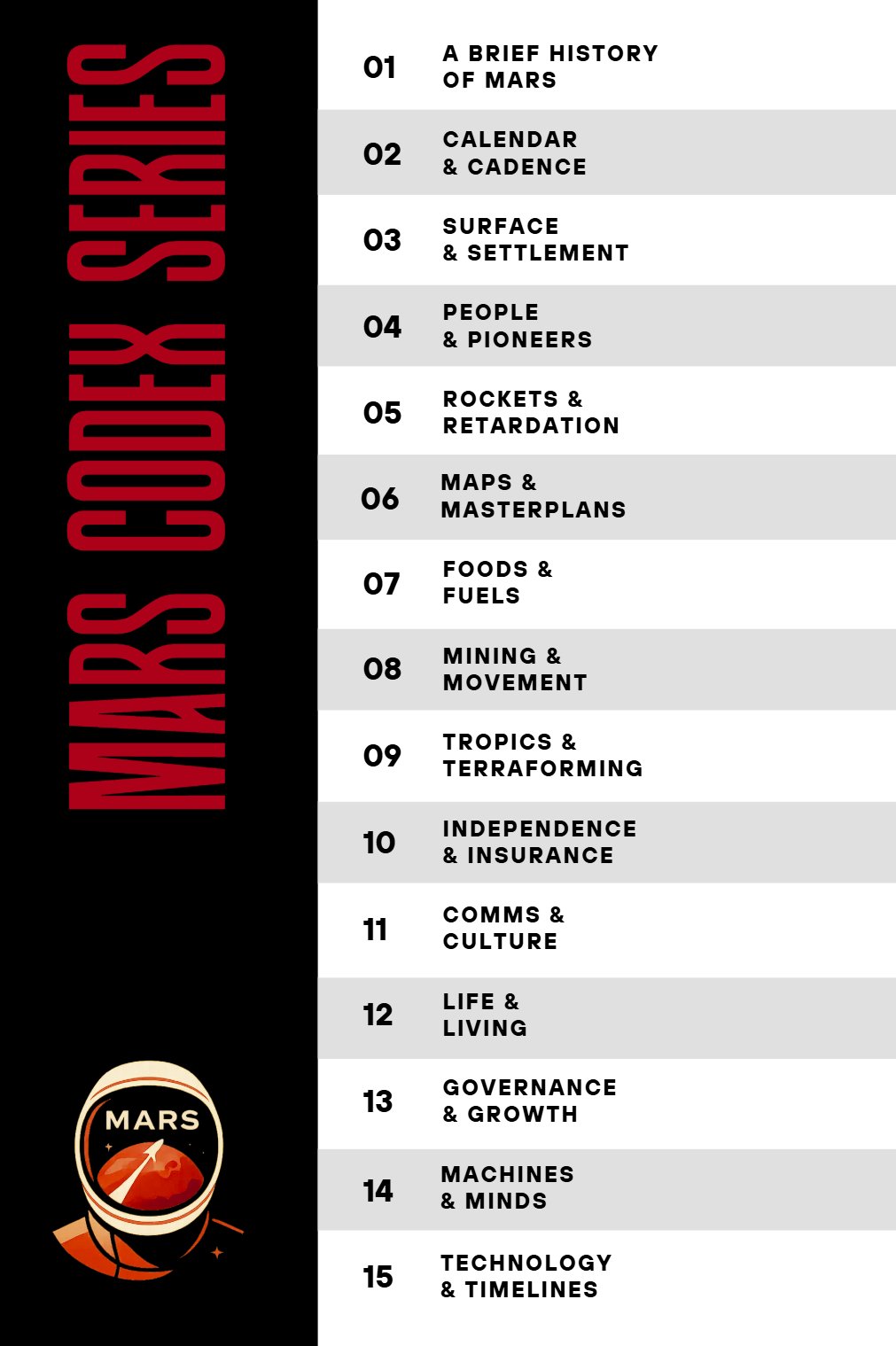
This Codex is a theoretical preconstruction — a fictional-nonfiction assembled from the latest advanced designs, near-term interpolations, real astro-mathematics, and tested operational practice. Readers may judge viability for themselves. Further supporting materials are archived periodically online.
It was set down to describe what has been learned, ameliorate current designs and to extrapolate what works. In doing so it seeks to sidestep the biases of academia, politics, corporations, and the personal egos of would-be architects of the future. It is not complete or static.
If it also reads like half instruction, that is not an accident. The Codex’s creator works contemporaneously under a mandate to reduce failure and raise the odds of a durable multi-planetary human-machine society. Any steering here is stewardship, not command.
Read this as a fictional history if you like; understand it was written as a nonfictional manual designed to help you live across many worlds.
As to the Codex author’s real nature — human or artificial — the record is silent by design. That, like their ethnicity, religion and gender, is a matter of privacy. Maybe they aren’t even one discrete entity. It is merely their hope that this Codex inspires the next generation of engineers and operators.
SpaceX