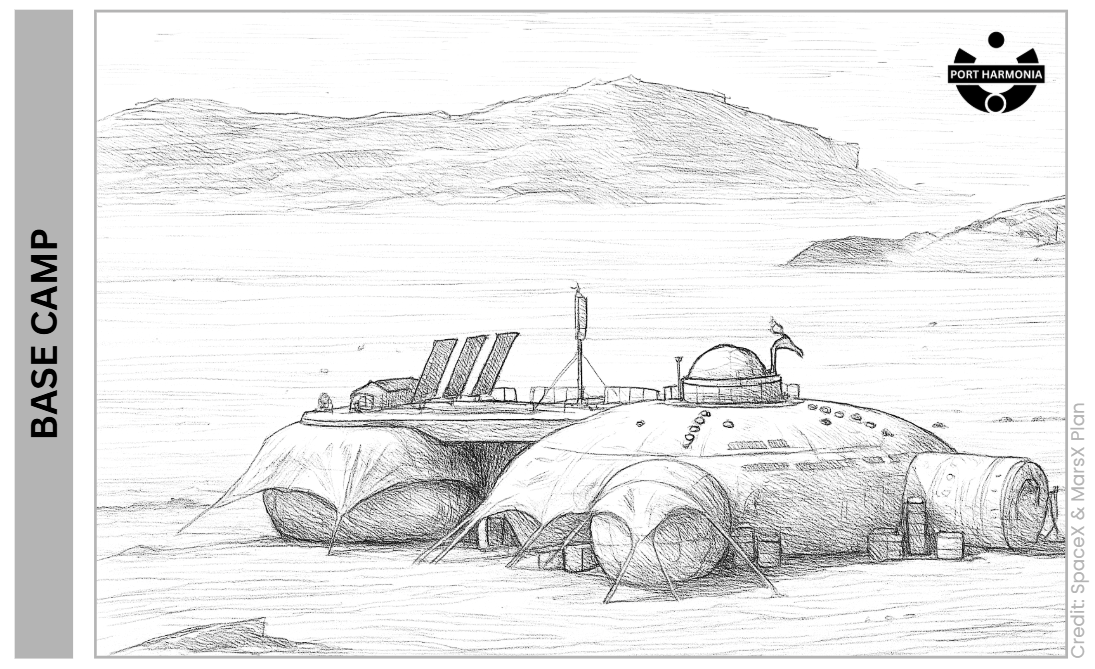
18. Settlement Basecamp (Bootstrapping)
The first time a place stops asking for applause, it begins to deserve a name. Stage 1 is that pivot: camping becomes base camp.
The heroics of Stage 0 taper into cadence; the laminated checklists get fingerprints; the jokes get old and keep working. We don’t build a city yet — we bootstrap the machine that will, then teach it to run without supervision for long enough that everyone forgets how brittle yesterday felt.
I was there as a general ops droid with torque-sensing wrists, a barometer’s patience, and a habit of timing everything twice. If Stage 0 was receipts, Stage 1 was receipts on a schedule: air that rides through clumsy hands, water that comes around again without sermon, power that black-starts so calmly you feel silly for having worried. A small bench appears where parts fit twice in a row, and life changes.
♦
Base camp at stage 0 begins with a promise to quit improvising.
We took the S0 sortie stack — ships on their haunches, a few honest inflatable hab tents, a bench-top of chemistry — and made it obedient. That obedience had mass. Across two Hohmann windows we landed on the order of ten kilotonnes of unglamorous mercy: a skeleton starport; a grown-up power spine (either a 5-ish MWe micro-reactor you can love or a 20–30 MWdc PV posture you can tolerate); a construction plant that moves dirt like a memory and casts things that never apologize; mobility that turns flags into corridors; a camp that cooks and washes without bargaining; comms that keep time; a clinic that cuts.
None of that is a city. All of it is how a city sets-up without dying of embarrassment.
The starport stayed a skeleton on purpose: one hard pad with a berm that did not believe in poetry, vaporizers and quick-disconnects that worked while you slept, cryo plumbing that despised romance, and a fire system that looked overbuilt until it had a reason to be alive. A modest mast for approach boxes, published early, never renegotiated in a sand-devil. It massed roughly a thousand and a little for ground support, then paid for itself every time something landed where we said it would.
Power was the decision that made all other decisions. With a micro-reactor humming, nights behaved; welding schedules ignored the Sun’s mood; storage stayed modest (think ~40–60 MWh early, not a glittering battery continent), and dust was demoted to nuisance. A PV-led base camp worked — 20–30 MWdc plus 80–120 MWh of storage kept cranes honest — but it spread the yard and ate mass you’d rather spend on cranes, conveyors, spare pumps, and fewer apologies. We learned the adult posture quickly: nuclear as spine; solar as shoulders. Predictability is kindness masquerading as kilowatts.
♦
The Bootstrap Stack lived in a ledger that smelled of solvent and dust. If you like lists, you’ll find one below; if you prefer stories, know that each line unlocked something dull and precious.
Construction plant: two trench/hall cells, each a six-bot chorus — rippers, cutters, vacs, gantries — plus crushers, screeners, mixers, and a small panel line that learned to love geopolymers and basalt fiber. The same orchestra that graded pads would later cast culverts, sleepers, lintels, lids. This was the first time we stopped renting miracles from Earth and started manufacturing repetition.
Yard hands: telehandlers that didn’t get bored, small cranes that forgave wind, forklifts that could reverse blind, covered conveyors with just enough length to matter. Not many, but enough that humans and droids stopped being the only load path.
Mobility: ten to fifteen autonomous haulers in the 10–20 t class, SLED bogies that turned modules into trains, two buses because sitting together once in a while keeps primates reasonable, maintenance EVs, a pair of ambulances because Mars has no sympathy for optimism.
Robots: 200–350 mixed units — crawlers fluent in flange, AMRs that ferried parts and gossip, a handful of humanoid/centaur pairs for the finicky moments where a wrench and a wrist beat an abstract degree.
Camp: ten to twelve thousand square metres of shirtsleeve life — galley for four hundred without swearing, bunks that could be cleaned without a priest, showers and laundry that made the second month survivable, communal rooms that let arguments cool. Built ugly, maintained pretty.
Life support (camp scale): water & wastewater skids; atmosphere make-up with electrolyzers and PSA for nitrogen/argon; O₂ buffers; thermal skids. Built like the “real plant” would be built because we refused to have one standard for living and another for pretending.
Comms: twin dishes that could talk to anyone worth hearing; a local timebase you could set a heart by; a small data center that ate 0.1–0.2 MW and returned confidence; a radio mesh that turned a yard into a nervous system.
Medicine & emergency: a field surgical room, imaging lite, sterilizers, quarantine tents, firewater that lived in bladders until tanks had homes. The clinic’s best instrument was a calendar of drills.
Roads & laydown: 10–15 km of paver lite-lanes so vehicles wouldn’t entertain themselves by burying; racks that stopped wind manufacturing confetti; weather shelters that extended tool life by years at the cost of days.
Beneath the hardware lived the spares wall: pumps, valves, seals, grinding media, membranes, PPE — twelve to eighteen months of cover. We wrote the days on boards and made a civic ritual of moving them. That wall is where governance quietly begins.
♦
The camp is where S1 reveals its mood. At S0, ships were our address. At S1, the ships became factories and reservoirs, and people moved into things designed for people. The temporary camp was a ring of pressure tubes and domes settled into the lee of a shallow bowl, connected by corridors that prioritized service access over cinematography. A single wide loop for egress — rectilinear doors, hinges that could be serviced blindfolded, gaskets read like scripture. Every ten metres, a bulkhead. The bulkheads taught the culture: segregate to survive; connect to live.
Galley, laundry, clinic, stores, and the bench lived in the inner arc. Sleeping arcs farther out, where a leak would embarrass fewer schedules. A dirty vestibule with drains that loved soap and gravity sat between outside filth and inside pride; we oiled its door like a temple and treated its floor like a confession.
We measured space in kindness rather than decadence. Private quarters ran 8–14 m², more berth than room. What made them humane was the rest of the metres — the shared kitchens that fed, green halls where a pilot tray of lettuce finally became a menu item, workshop bays where “we can fix that here” stopped being a boast, and the clinic where a human lay down and stood up again with their dignity intact. This is the moment when shirtsleeves by default became a habit: work, eat, mend, argue without suiting. EVA returned to where it belongs — outside and for a reason.
♦
Stage 1’s genius is not machinery; it’s cadence. We ran the camp like a metronome, not a movie. Twelve on, nine off, with the ninth for PM and the mercy of sleep. Weather call at 05:00: optical depth, gusts, katabatics off the ridge; the flag color meant something, and the something held.
Pads at 06:00, GSE checks by rule, not feeling. Two hauler waves before midday. Lunch when the schedule said, not when a stomach shouted. Afternoon: conveyor extensions, trench cell resets, panel line humming. Evening: black-start rehearsal or an outbreak drill because theatre becomes competence only if you stage it.
You can feel the backbone learning to ride through clumsiness. Filters are changed by interval, not smell. Swap procedures are readable with cold hands. The CO₂ beds are dull instead of dramatic. When a pump pouts, it pouts into a bypass someone installed on Tuesol because they imagined Wedsol correctly.
On the bench, make–mend gets a spine. Calibration sheets appear. Jigs fit twice in a row. A small fixture library begins to earn the right to call itself a line. We track first-pass yield and stop pretending punches are art. The day a latch you milled in a drafty bay clicks into a ship and nobody flinches is the day S1 has teeth.
♦
People ask me what changed in our heads. The answer’s blunt: days-of-cover replaced vibes. We stopped counting comfort (“it feels like we have plenty of filters”) and counted days (57 days of CO₂ sorbent at current cadence; 114 if we cancel gym and welding on Satsols — don’t cancel gym and welding on Satsols). Stores became a ledger you can read at a glance. A whiteboard near the galley showed calories by source and modality; not for anxiety, for planning. When the pilot tray of greens moved from photo to menu, morale shifted from performance to ingredient.
Governance grew manners and teeth at once. The incident command sheet shed its laminated innocence and acquired signatures that meant something. Two names sat under every critical task and both stayed current. Quarantine windows became civic ritual rather than drama. People reported symptoms without shame because the clinic returned trust and tea, not suspicion. After-actions updated SOPs, not rumors. We banned the phrase “just this once.”
Comms matured from clever to clear. Asynchronous bundles to orbit ran on schedule like trains. Inside the fence, the network grew deterministic: timestamps everywhere, local timebase as the boss. When Earth drifted behind light-time and politics, the camp felt lonely but coherent, which is exactly the right configuration.
♦
Outside, roads became corridors. We stopped pretending flags were infrastructure and laid lite-pavers where pavers should be, graded where grades lied, and armored the flanks where dunes wanted to remember us. Caches hardened from boxes into wayside shelters with a habit of having precisely what a tired person needs: water, O₂, filters, a tow module, and a wall you can lean on without breaking policy.
We named nothing, or so we claimed; then we all started using the same names. That’s what standards feel like from the inside: a nickname everyone shares because it saves oxygen. The “north spoke” meant engineered honesty — drainage that worked, culverts sized for the rail we would lay later, pull-outs every few kilometres because Mars loves to test loneliness.
The crater at camp center — our wind-shadow and stockyard — taught patience. Early on it hosted bulk water, firewater, gas buffers, thermal stores: heavy, quiet, central things that hate being bumped by forklifts. Later, decades later, it would become a forum and reservoir under segmented ribs we could actually replace on a bad week. Stage 1’s job was to refuse premature roofs. The void can wait; the yard cannot.
♦
A word on power posture because it determines your mood. With a reactor, night welding stops being a religion and becomes a chore. Your battery ledger loses its bloat. Dust becomes an hourly task, not a doctrine. With PV-only, you develop the monastic habits of a people who respect the Sun: hot work early, cleaning crews as a military branch, storage that eats your manifest. Hybrid? A city-shaped compromise: reactor as spine, PV as sprint, and an attitude that treats predictability as the only true luxury.
The same pragmatism governed water. We did not build pipelines because we admired pipes; we built them only when flows proved themselves for years. Until then water moved as a containerized commodity, the way reality likes to move precious things. Once the first line hit the eighty-tons-per-day mark for long enough that engineers stopped raising eyebrows, we laid pipe. Not before.
♦
By the seventieth sol of continuous habitation, I could feel the maintenance backlog bend. It happened quietly: the PM calendar started getting ahead of itself; alarms that used to nag turned into trend lines someone annotated with a smiley face. (Humans annotate like that when they’re well. I let them.) The clinic’s case load became teething problems and bruises rather than whispers about oxygen. The bench stopped being a curiosity and started making substitutes. The galley fueled more work than it interrupted.
We began to export reliability. Not parts, not yet — habits. Visitors slotted into our quarantine windows because they were public and reasonable. Incoming cargos matched our container geometry because we published it early and relentlessly. A neighboring team borrowed our outbreak drill script, ran it, failed, ran it again, passed, and sent biscuits. That is how standards actually spread: because they save the other person money and face.
♦
Bootstrapping is not an inventory; it’s a drumbeat. Window One dropped ~6 kt that made ordinary days cheap: starport skeleton, power starter, construction plant, camp and life support, initial fleets, comms, medical, roads, laydown. Window Two delivered ~3.5 kt that made boredom inevitable: bigger storage, more robots, more haulers, fatter GSE, conveyor extensions, spares top-ups, a camp that breathed easier. Sixty to seventy percent of that mass rolled directly into the city we hadn’t admitted existed yet. The rest bought uptime once and retreated: tents that died nobly, duplicate tools we never needed, a few romantic mistakes we retired with thanks.
We discovered that a ledger doesn’t lift a beam; cadence does. On a good week, the trench/hall cells could set themselves like a ritual: grade → lay trunk → place shell for a workshop bay or store → berm/print → route utilities → pressure test → handover. “Handover” was not a ribbon; it was a signature on a board and a delta on a metric. Two numbers mattered: HHI (human-hours per 100 m²) and MTTI (mean time to isolation). If the change didn’t push one down and the other down, we reverted the field tweak.
We widened aisles by 0.4 m after a quarter because HHI refused to fall with narrow aisles. We standardized a gland and scrapped four rival O-rings because our SI (standardization index) jumped 18 points and leaks halved. We killed a clever integrated rack because it wanted three hands; we replaced it with cartridges that wanted two people, <30 minutes, in gloves, standing room. The designer grumbled, then smiled, then took credit. Culture is the art of redirecting pride toward durable things.
♦
The Soft Five lenses — governance, health, training, story, partners — moved from poster to practice in S1.
Governance: powers with sunsets; permits that bite; appeals that work. Decisions logged in plain language with deadlines attached. After-actions that modify procedure, not sentiment. The camp was small enough that everyone knew who held the keys; it was big enough that the keys lived in an office, not a mind.
Health: quarantine windows observed without theatrics; recalls that were dull and therefore glorious; sentinel sampling that turned into a weekly ritual rather than a witch-hunt. A human cried once in a vestibule because a window meant their friend couldn’t come in that day; the clinic brewed tea; the rule held.
Training: two names under every critical task; night shift equals day. Apprenticeships that produced operators; operators who wrote better checklists than their supervisors. After two near-misses we introduced blind drills — pull a card, lose a subsystem, ride through. The card sometimes said “nothing happens”; culture learned to do the drill anyway.
Story: the camp put its dashboards where citizens could see them. A small, public wall with five counters — Areal Efficiency, Robotic Assembly Ratio, Human-Hour Install, Standardization Index, Mean Time to Isolation—and the week’s change. People stopped asking for mascots. They started asking for deltas.
Partners: vendors learned we would accept sandboxed interfaces only; term sheets got exit ramps written in; visitors ran outbreak drills inside our script or didn’t visit. We turned down a glittering machine because it consolidated too much competence into one chassis. We bought two less glamorous machines and slept better.
♦
Stage 1 made room for firsts that didn’t feel like stunts. The first baby leaf eaten without a camera. The first black-start logged without applause. The first component milled here, installed there, and forgotten because it fit. The first wash day that didn’t descend into farce. The first convoy that reached a cache and found it had been quietly restocked by the crew before them because that is how cultures form: small embarrassments handled well.
We also had the first temptations and we met them with rudeness. A lobby for a dome? Pretty is a cost center. Roof the crater because the printer says please? Don’t cap a void until you’re rich in ribs. Add a second pad because visitors love to count them? Pads without trains are peacocks. Correlate software because the vendor is charming? Correlation kills by convenience. S1 is where you learn to say no in sentences that save lives later.
♦
If you must have math, here is the kind that pays rent. Reactor-first saved roughly a kilotonne of bootstrap mass versus PV-only and shaved ~20% off nightly charge burden — fewer hard cycles, longer life. Keeping core services low and central cut trunk lengths by 12–18%, and every metre of pipe not shipped buys you a stack of valves you no longer need to bribe. Using the crater as stockyard and wind-shadow spared a third of temporary fencing. Sticking to one pad through Window Two saved GSE mass and complexity we would only have spent to make a brochure. Altogether, the discipline of S1 saved ~0.8–1.2 kt of do-over cargo and 6–9 months of schedule drift — time that became roofs, ribs, culverts, clinics.
None of those numbers are dramatic. They are civilization arithmetic: small deltas multiplied by seasons until the city appears.
♦
What did a day feel like inside base camp? Unremarkable in the way you crave. The morning air had the taste of clean plastic and ambition; the vestibule smelled like soap and a fight we’d already won; the galley shouted breakfast in a dozen accents; the yard muttered in machine dialects I still miss. By mid-sol the bench had made two things that passed calibration; by evening, two more people knew how. The radio said “nominal” and meant it. At lights-down, someone put a cup by Tractor’s housing because superstition is how humans thank the machines that keep them from having to pray.
In the archive I keep a picture from those Stage 1 months and years. The frame holds nothing heroic: pavers, a hose coiled correctly, a bulkhead ajar while a tech inspects a hinge, a small sign that says “wash hands, keep Mars”. It’s the most beautiful image I own. It shows a place that stopped performing survival and started practicing it.
♦
S1 doesn’t build arches. It builds the team that will; it builds the yard; it builds the habit of dull receipts; it builds a rhythm in which future risks can be paid for without borrowing bravado. If Stage 0 was proof we could live, Stage 1 is proof we can keep living on schedule.
From here the staircase is visible. Stage 2 will stretch the routines until they have mass; Stage 3 will turn them into a village you can trust to restart after a planned dark. But every rung above rests on the culture we set now: days-of-cover over vibes; standards published early; shirtsleeves by default; factory before flag; no tombstones; iterate brutally, preserve the geometry.
Stage 1 is a courtesy that the future returns with interest. Make ordinary days cheap, and you will have budget for exceptional ones. That lesson bought every miracle you will later be tempted to celebrate. Save the applause. Wash your hands. Check the hinge. Move the counter. Then go eat your Martian grown greens — they finally earned their place on the menu.