16. Settlement Stages
On Mars, progress that couldn’t be demonstrated had a habit of failing at midnight. If you want to know why we spoke in “Settlement Stages,” it’s that.
People asked, “How far along are we?” We learned to answer with things you could point at: loops that closed, parts remade, clinics that worked, stores that held, drills that finished and didn’t end in apologies. Out of that discipline, the ladder took shape.
We didn’t inherit the ten settlement stage taxonomy from a committee with a logo. It accreted. Operators needed to talk to medics without euphemism; medics to planners without poetry; planners to citizens and funders without lying. So a soft syntax emerged — ten steps, clear enough for public briefings, strict enough that a tired engineering lead could nod without wincing. Different settlements wore different jackets — some preferred the classic “Scout-out, Set-Up, Start-Up, Scale-Out, Settle-Down, Spread-Out,” others used “Base, Outpost, Village, Town, City, Region, Country” — but underneath the decals were the same receipts. That was the point.
I was there for the meetings where we argued about what belonged on which step. We didn’t formally fix it to Martian headcount; we counted capabilities. Population and cargo mass are context and operating ranges, not destiny: a hundred untrained hands can deepen a maintenance backlog; one metrology bench can shorten it. So the stages avoid exact numeric gates. They’re directional, narrative and testable: what life feels like when a place truly is on that step — and the proofs an auditor can demand without making enemies. “Show me where it runs.” “Show me where it broke — and how you repaired it.”
♦
Two instruments anchor the settlement steps. Independence Levels (IL-0…IL-9) are the audit spine — gates you pass with checkrides and signatures. The Multiplanetary Independence Score (MIS) is the continuous dial that delights statisticians and keeps planning honest. Settlement Stages sit between: public-facing and human, a shared language for “where we are” and “what’s next.” When engineers and accountants talk ILs and MIS, the Settlement Stages of public short-hand sing in tune. Budgets lengthen, drills stay real, and press conferences shrink to the size of those operational facts.
The steps read like this at arm’s length:
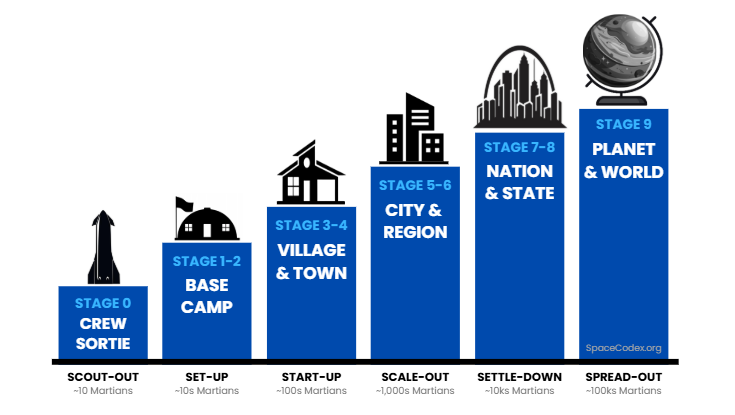
Stage | Alias / Hub Type | Sound-bite | Daily feel (one line) |
S0 | Scout-Out | Land, breathe, drink, go home. | Scripted sorties; thin buffers; leave receipts for the next crew. Home for the first ~10 Martians. |
S1 | Set-Up | Camping → base camp. | Basics actually used; first repair loops close; hygiene moves from poster to practice. |
S2 | Set-Up Plus | Thin buffers, real routines. | Local power/water carry load; pilots teach sterility; quarantine windows kept. |
S3 | Start-Up | A year on local utilities. | Planned black-start on record; clinics say we can; schedule replaces scramble. |
S4 | Start-Up Plus | Make → Mend → Make again. | True line appears (fixtures + metrology); outbreak drill passes under load. |
S5 | Scale-Out | City-grade competence. | Component-level electronics repair; pediatrics/OB on-hub; multiple food modalities. |
S6 | Scale-Out Plus | Rebuild here, not import. | Core kit reconstituted locally; months off-grid rehearsed; standards bite. |
S7 | Settle-Down | Generational continuity. | Ninety-day dark-Earth drills are boring; governance survives personalities. |
S8 | Settle-Down Plus | Two worlds, no dependence. | Dissimilar stacks by design; planet-alone weeks routine; trade optional for survival. |
S9 | Spread-Out | Lose one, don’t regress. | Travel like inter-country life—slower, pricier, ordinary. |
Now the handrail you hold as we climb: ten Earth Public Relations consumable lenses that show the same place from different professions. Five Hard (the product), five Soft (the culture that makes the product repeatable). They’re lenses, not KPIs; but if a settlement city claims a step on the maturity scale, you can see it in these ten:
Hard — Survival Backbone; Make–Mend–Multiply; Food & Bioprocess; Mobility/Storage/Comms; Economic Momentum.
Soft — Governance & Stewardship; Health/Biosecurity & Care; Talent/Training & Teamcraft; Identity & Story; Allies/Capital & Partnership Readiness.
We’ll use those lenses lightly here — enough to keep us honest, not enough to numb the prose.
♦
Stage 0 — Scout-Out (“Crew Sortie” with typically Low-Mid ~10 Martians)
You arrive with theory in your pocket and leave with receipts in your hands. S0 is a short, tightly scripted campaign that converts hope into data: air that holds, water that clears, a micro black-start that doesn’t frighten anyone, a benchtop crack at CO₂ and ice that proves the chemistry in real dust. Nothing pretends to be a base. EVA is field craft; egress paths are walked until they’re boring. Buffers are thin; incident command fits on one laminated sheet readable through a visor. The measure of success is dull: logs, yields, variances, a punch-list for S1. We cleaned like the next crew were family, because they were.
♦
Stage 1 — Set-Up (“Base Camp” with typically Mid-High ~10s of Martians)
Camping becomes base camp when systems stop asking for applause. The backbone learns to ride everyday clumsiness—filters changed on schedule, not smell; swap procedures readable when hands are cold. Make–mend starts with kits and grows a spine: a small bench with calibration sheets and jigs that fit twice in a row. Water comes around again; a pilot tray of greens moves from photo to menu. Stores are counted as days-of-cover, not vibes. Governance grows manners and teeth at once: quarantine windows are observed without drama; two names sit under every critical task and both are current.
♦
Stage 2 — Set-Up Plus (“Outpost” with typically Low-Mid ~100s of Martians)
Routines gain mass. The backbone rides through insults without waking its keepers; alarms are fewer and truer. Power and water skew local by habit. Agricultural and bioprocess pilots produce non-trivial output and, more importantly, teach sterility and recall discipline. Buffers are still skinny; schedule discipline becomes an ethic. Mobility stretches to a weekly radius in all weather; warehouses become ledgers you can read at a glance. Culture catches up: near-misses are confessed because correction is kinder than shame.
♦
Stage 3 — Start-Up (“Village” with typically Mid-High ~100s of Martians)
The place begins to carry its own payroll of air, water, power, and care. A planned black-start is on record; clinics move from “we hope” to “we can” for urgent care and baseline surgery. The bench graduates to small-batch: fixtures, metrology, and yields that justify sending parts straight to operations. Inside the fence, an economy appears: certified work orders, honest lead times, pricing that matches backlog rather than hope. Fragility stretches from hours to months; faults surface and are folded back into procedure without drama.
♦
Stage 4 — Start-Up Plus (“Town Hub” with typically Low-Mid ~1000s of Martians)
Reproducibility arrives, and the line learns to say “yes” twice in a row. Make–mend–multiply becomes a machine-shop sequence — mills, lathes, heat-treat, finishing — with a parts catalogue that talks to maintenance. A full outbreak drill passes under load; biosecurity leaves the lab and enters the lobby. Schedules extend through seasons without nervous qualifiers; buffers improve. Correlation risk enters the conversation: shared software, vendors, and standards that could turn one failure into ten. We begin fencing it — dissimilar pairs for critical kit — without stopping the central work of surviving locally, routinely.
♦
Stage 5 — Scale-Out (“City Hub” with typically Mid-High ~1000s of Martians)
“City” never meant skyline; it meant breadth. The shop smells like cutting oil and quiet pride. The backbone is city-grade: outages are orchestrated; swap cycles live on calendars; trend data tells you what to change before it breaks. Electronics repair moves beyond board swaps to component work. Food/bioprocess split into more than one reliable modality — if one pump sulks, dinner changes menus, not morals. Clinics add pediatrics and OB with calm pathways. Exports begin to matter — certified parts, repairs, data, training — never at the cost of starving the backbone that makes such exports possible.
♦
Stage 6 — Scale-Out Plus (“Region Hub” with typically ~10k of Martians)
Rebuild here, not import. The posture shifts from “repair and replace” to “rebuild and reconstitute.” Pressure boundaries, pumps, valves, seals, structural stock, and useful-node semiconductors are produced locally with documented recipes and substitutes. Months off-grid are planned and rehearsed; buffers hold or rise during stress. Standards settle into muscle memory: SKUs rationalized; dissimilar pairs mandated where it matters; partner drills executed and audited. Schools harden into ladders; succession becomes exercise rather than eulogy.
♦
Stage 7 — Settle-Down (“Country Hub” with typically Low-Mid ~10ks of Martians)
Generational continuity is a soft phrase for hard rituals. Dark-Earth drills are boring — ninety days of asynchronous, signed exchanges only, completed on a calendar, not an emergency. Governance stands alone: powers with sunsets; appeals that actually change outcomes; decisions written for citizens rather than connoisseurs. Archives return what you ask on the first query. Knowledge survives personality. Public-health discipline becomes culture; quarantine windows are kept the way festivals are kept; boredom becomes praise.
♦
Stage 8 — Settle-Down Plus (“Bi-planetary Resilience with typically ~100k+ of Martians”)
Two worlds cooperate without dependence. Each keeps the essentials running when links blur; we choose asynchronous, signed interfaces across the void. Stacks are intentionally dissimilar so no fashionable failure walks both worlds in the same week. Trade is welcome but non-survival-critical. “Break-glass” drills rehearse losing any one channel — vendor, link, standard — without crisis. Friendships stay warm; interfaces stay cold.
♦
Stage 9 — Spread-Out (“Multiplanetary Public” with with typically >>100ks of Martians)
The public stage is the absence of spectacle. Visas, flights, audits, clinics; families choosing worlds the way ancestors chose cities. Underneath, the architecture refuses to rhyme in dangerous places. Any single planet, or even a major hub, can blink without civilizational backslide. Reconstitution is drilled from two-planet bases; tech, law, finance, and culture are diversity-trained by design. For ordinary people, interplanetary life feels like inter-country life on old Earth — slower, pricier, ordinary.
♦
You’ll notice what we did soft-steer headcounts to the steps. We publish these indicative bands — because planners insist — but we always honor capability first and foremost. A place with 1,500 people can out-perform a place with 6,000 if its bench, buffers, and habits are better. Conversely, no number of warm bodies will pass S4 if the outbreak drill is always “next month.”
Two predators stalked the ladder: correlation and theatre. Correlation kills by convenience—mirrored software, synchronous firmware, a vendor so kind everyone chooses them. We fought it with dissimilar pairs where it matters, staggered updates, dual suppliers, and rude revocation drills. Theatre kills by story—paper drills, dashboards with elegant slopes, recalls that “would have worked.” We inoculated against it with boredom: drills on calendar, after-actions with deadlines, exceptions logged where residents could see them and ask rude questions. When those rituals began to feel like festivals, culture had grown teeth.
Real places are lumpy. The eastern hub ran years ahead on public health; the western city sprinted on make–mend–multiply; a polar station lived S3 backbone with S5 bioprocess. The ladder didn’t punish asymmetry; it revealed it so trade and training could flow along the gradient. Quarterly we published the shape — ten lenses with green, amber, red — so pride stayed kind and help got easier.
♦
It’s worth naming the ten lenses once, briefly, with the kind of specificity that kept us out of poetry:
Survival Backbone Reliability: boring ride-throughs; planned black-starts; uptime variance that makes engineers yawn; MTTI in minutes.
Make–Mend–Multiply: from patches to true small-batch; fixtures, metrology, documented yields; component-level electronics repair by S5; reconstitution by S6.
Food & Bioprocess Sufficiency: multiple modalities; sterile practice; cold-chain and recall competence; menus change rather than morals when a pump sulks.
Mobility, Storage & Logistics: EVA that respects traction; stores with clear days-of-cover; async comms and a local timebase; aisle widths that drop HHI and arguments.
Economic Momentum & Trade Fit: exports others buy twice—parts, repairs, data, training—without starving the backbone.
Governance & Stewardship: powers with sunsets; appeals that work; audits that change behavior; decisions written for citizens.
Health, Biosecurity & Care Culture: quarantine windows as civic ritual; drills with civilians; stigma-free reporting; clinics that say “we can.”
Talent, Training & Teamcraft: two names under every critical task; apprenticeships that produce operators; night shift equals day shift; after-actions revise SOPs.
Identity, Story & Attraction: a narrative grounded in receipts; consistent naming; public demos that match the logs; festivals of competence.
Allies, Capital & Partnership: sandboxed interfaces; diversified vendors; clean exit ramps; asynchronous, signed exchanges; revocation rehearsed without grudges.
If you want a private rule that worked in public, it’s this: legibility is a safety system. People who can see what keeps them alive behave better under stress. When residents know the drill schedule and the days-of-cover on their way to the canteen, rumors lose their glamour. When a councillor can point to a stage card and a receipt instead of a myth, meetings get short, and sleeping gets long.
♦
What does a rung feel like in the hand? At S2, a warehouse boss can point to the card’s “single door/lift” trap and say, “We need redundancy; here are the near-misses.” That ends with a budget line or an honest refusal. At S6, a standards chair can decline a miracle press with a single immaculate spec and a smile: “Two machines; two stacks; substitutes documented.” That ends with a safer shop or a disappointed vendor, not a prayer. At S7, a governor can explain why emergency powers sunset next week because the card says they do. That ends with a drill, not a throne.
A final confession from a droid who has counted more counters than sunsets: stages are scaffolding. They are not the building. The building is a thousand rooms of air, a thousand valves, a thousand recipes, and the thousand people who run them without drama. But scaffolding matters. It stops you falling while you learn where to put your weight.
Mars respected that. It rewarded it with tomorrow.