
A4. Multiplanetary Independence Score (MIS)
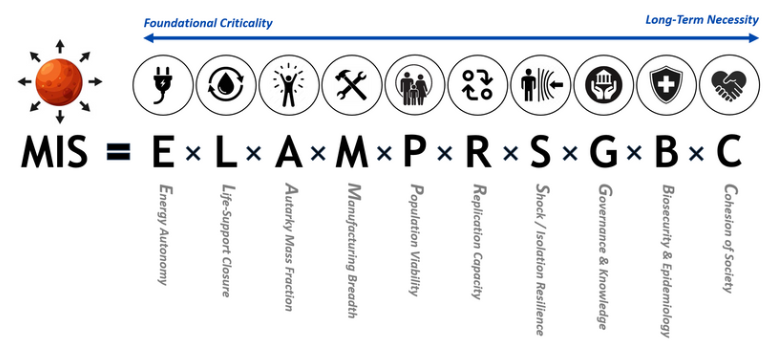
Multiplanetary Independence Score (MIS) is the continuous, auditable dial (0–1000) that sits alongside the binary Independence Levels (IL-0…IL-9) ladder. Where ILs are pass/fail gates, MIS is a running trajectory: it tells leaders whether they are moving fast enough, where they are lopsided, and which investments lift the system most.
Why a dial as well as a ladder:
Survival-first, not vanity: MIS weights the pillars that keep people alive before comfort or growth.
Hub-comparable: Any hub (Moon, Mars, Asteroid, Earth regions) can be scored the same way.
Anti-lopsidedness: Uses a geometric mean so one weak pillar drags the score—exactly as real risk behaves.
Drill-verifiable: Inputs are audited KPIs (buffers, drill pass rates, yields), not claims.
PR-friendly: A single public number + pillar “radar” that a non-specialist can follow.
Objects we score:
Hub: A geographically contiguous settlement cluster; MIS scores its pillars and yields a per-hub maturity.
System: One or more hubs across one or more worlds; MIS combines hubs while penalizing cross-dependence.
Level (IL): Gate-based rung (e.g., IL-6) with hard filters (e.g., 10 Hohmann cycles isolation, black-start drills). MIS does not replace IL; it explains motion toward or away from a gate.
Pillars (survival-first set) and general weights:
E = Energy & Storage (w=2)
L = Life-support/Biosphere (water/O₂/food) (w=3)
A = Autarky/Closure (critical chokelist coverage by count) (w=3)
M = Manufacturing/Materials (process depth, machine-tool bootstrap, electronics repair/“useful-node” semis) (w=2)
P = Population Viability (effective workforce, training pipeline, dependency ratio) (w=2)
R = Resilience/Reconstitution (base-kit, spares sovereignty, black-start) (w=3)
S = Separation/Isolation (audited HC endurance; async ops; quarantine) (w=2)
G = Governance (independence charter, powers with sunsets, audits) (w=2)
B = Biosecurity (BSL-2/3, reagents/vax platforms, sentinel) (w=2)
[C] = Culture/Cohesion (optional, published separately) (w=1)
Weights are versioned; survival-critical pillars (L, A, R) start heavier.
Maths: From rungs to a dial
1) Per-hub maturity (geometric mean with weights)

Why geometric? It crushes lopsidedness: a single weak pillar lowers the whole product.
Isolation normalization (S):
Let HC = 780 Earth days.

2) Cross-dependence penalty per hub
A hub’s usable quality is qᵢ

where uᵢ ∈ [0,1] falls if it still imports survival-critical items (or mirrors unsafe software/standards).
3) Effective independent hubs (diversity, not just count)

This is high only when multiple strong city hubs exist and are not clones.
4) System maturity and the log-scaled dial
Let Msystem be the (weighted) geometric mean of hub maturities. (α ≈ 9)

Why log scaling? Early wins are visible (motivation); late progress is harder (reflecting reality).
Cross-Theme Topics - An Example
Where do “Food & Volatiles” live in MIS?
L — Life-Support Closure (primary): Include calorie & nutrition closure alongside air/water/waste.
Example rubric inside L: Air loop closure (e.g., O₂/CO₂), Water loop closure, Waste→nutrient loop closure, Food closure: local edible kcal produced / required × micronutrient sufficiency index.
A — Autarky Mass Fraction (primary): Counts local production share by mass × criticality of chokelist items, so food mass, water, oxygen, nitrogen, CO₂, CH₄ (propellants) all matter here. Heavy, time-critical items (water, O₂, staple foods) carry big weights.
S — Shock/Isolation Resilience (primary): Your days of autonomy include food, potable water, breathable O₂ and (where survival-critical) key volatiles. Stockpiles, cold-chain reliability, and substitution plans raise S.
M — Manufacturing Breadth (supporting): Ag/bioprocess hardware, pumps, membranes, tanks, cold-chain, fertilizer synthesis, packaging, power-to-fuels plants. You don’t score food directly in M—but the ability to make its enabling kit lives here.
E — Energy Autonomy (supporting): Food & propellant production are energy-hungry. E doesn’t count food directly; it measures whether you have the power to run farms/bioreactors and fuel plants through storms and black-starts.
R — Replication Capacity (supporting): Seed & strain banks, sterile supply, recipe libraries, the Base-Kit to spin up new grow modules / electrolyzers / Sabatier lines.
P — Population Viability (supporting): Do you have agronomists, bioprocess techs, nutritionists, cold-chain techs trained and redundant? Training throughput & role coverage land here.
B — Biosecurity & Epidemiology (supporting): Plant pathogens, mold, and contamination control for farms/bioreactors; food-borne illness detection, isolation, and recall drills.
G — Governance & Knowledge (supporting): Rationing rules, procurement under scarcity, transparent food/volatile ledgers, SOPs for substitution, and succession for critical ag/bioprocess roles.
C — Social Cohesion (optional, published): Food security is social stability. Fair allocation and grievance handling prevent rationing crises from cascading.
MIS and IL: how they work together
MIS = trajectory. It moves monthly/quarterly with drills, buffers, yields, and decoupling.
IL = filter. It moves only when gates are passed (e.g., 2×HC isolation, black-start, outbreak success).
Communication: “IL-4, MIS 48 → 55 this quarter on the back of machine-tool yields and storage ride-through.” Clear, auditable, PR-ready.
Mini-case: same MIS, different shapes
Hub A: Pillars clustered ~0.55 with no deep troughs → Mhub ≈ 0.55; passes IL-4 gates (≥50% closure, 2 HC).
Hub B: High E/M (~0.8), but weak Biosecurity B=0.25 and isolation S=0.3 → Mhub drags to ~0.49.
Both may report MIS ~50 at the system level, but only A clears IL-4, because IL is gate-based, not average-based.
Action: Hub B should fix B and S (outbreak drills, quarantine windows, reagent/vax platform) before chasing further E/M upgrades.
Glossary (new/clarified)
Chokelist (v1.0): Fixed set of survival-critical categories scored by count and irreplaceability (energy; atmosphere/water; food/bioprocess; mining; metallurgy/ceramics; polymers/composites; machine tools/spares; electronics/control; medical/pharma; habitats/shielding; transport/propellants; information/knowledge).
A (Autarky): Localized share of the chokelist (by count, weighted by time-criticality).
M (Manufacturing breadth): Depth of the process tree (mining→materials→tools→precision→electronics repair/“useful-node” semis).
R (Resilience/Reconstitution): Ability to black-start, repair, and rebuild lines from the base-kit.
u (cross-dependence): Fraction of a hub’s maturity that is truly independent (falls with survival-critical imports and synchronous standards).
Governance & auditability (how we keep MIS honest)
Versioned rubrics for each pillar (indicators, QA methods, pass/fail thresholds).
Quarterly hub scoring from instrumented KPIs (buffer days, spares backlog half-life, first-pass yield, drill pass rates, patch-lag offsets, revocation time, sentinel coverage).
Annual Heff computation and black-start/outbreak exercises for IL-6+.
Public artifacts: MIS dial, IL badge, pillar radar, and a short “what moved” note each quarter.
Mapping MIS to Levels (communications heuristic)
IL-2 around MIS >150 with ≥3-month isolation.
IL-3 around MIS >300 with ≥25% closure.
IL-4 around MIS >450 with ≥50% closure and ≥1 HC.
IL-5 around MIS >600 with ≥80% closure and the bootstrap line online.
IL-6/7 around MIS >750-850 with rebuild capability proven by black-start/outbreak drills.
IL-8/9 need MIS >900 and Heff ≥ 2/3 with low cross-dependence.
Example MIS Exhibits
1) Earth-intact (anchor)
Pillars (shape): High across the board; L/A/M/R strong; G/B/S not perfect.
Assumptions: Single “planet hub,” Mhub≈0.95, u≈1, Heff=1.
Score: MIS ≈ 980/1000; IL-7 (Independent Hub).
Gate note: Earth cannot be IL-8/9 without at least one other planet-level IL-7 hub.
2) Earth-stressed (pandemic + supply shock)
Change: Temporary dips in B (bio), G (policy friction), S (isolation discipline).
Sketch: Mhub slides ~0.95 → ~0.85; Heff=1.
Score: MIS ≈ 935–945. IL holds (gates met), but the dial reminds leaders to restore B/G/S.
3) Moon, port-first IL-6 path (logistics-led)
Pillars: E/M/A strong (power + machine tools + logistics); L modest; S enforced by policy (physics favors coupling).
Sketch: Mhub≈0.65; high cross-dependence u today, but with one lunar hub Heff=1.
Score: MIS ≈ 835; IL-6 if black-start + year-long traffic-pause drills pass and closure ≥95% (by count).
What moves it: Useful-node semis, reagent/vax platform, signed/asynchronous releases (to reduce coupling).
4) Mars, bio-first IL-5 path (closure-led)
Pillars: L/A/S high (governed by physics); M and electronics repair maturing; G/B drill culture strong.
Sketch: Mhub≈0.55, Heff=1.
Score: MIS ≈ 775; IL-5 with ≥80% closure (by count) and bootstrap line online.
Next unlocks: Machine-tool expansion + useful-node semiconductors → IL-6 slope.
5) Three-hub system (Earth + two Mars hubs)
Pillars: Earth M≈0.95; two Mars hubs M≈0.8; u≈1 (low cross-dependence after policy fences).
Diversity: q={0.95, 0.80, 0.80}⇒Heff≈3 (near-max when hubs are strong and unlike).
Dial: Product Heff Msystem saturates the log scale → MIS → 1000 (capped).
Levels: IL-9 (≥3 planetary IL-7 hubs, loss of one does not regress).
6) Black-sky drills (shock exhibits)
Comms blackout (72 h, then local-only): S and Dig dip; with sovereign compute & revocation drills, ΔMIS ≈ −10 from a ~0.8 baseline, recovery <1 week.
Propellant contamination (industrial): hits A/M/R; if machine-tool + metrology are mature, ΔMIS ≈ −15 to −25, recovery 2–6 weeks; if not, weeks→months and IL gate at risk.
Outbreak exercise: good quarantine + on-hub reagents/vax → R₀<1 by day 10, time-to-vax ≤30 days; ΔMIS −10, rebounds on clearance; B gate stays green.
Sensitivities (how small pillar moves change the dial)
Geometric-mean effect: A +0.05 bump to a heavy pillar near mid-range yields a few-point MIS gain; near the top, gains shrink.
Illustrative strip (Heff=1):
Baseline Mhub=0.50. +0.05 in L (weight 3) ⇒ Mhub→0.507 ⇒ ΔMIS ≈ +4.8.
Baseline Mhub=0.80. −0.20 in S (weight 2) ⇒ Mhub→0.78 ⇒ ΔMIS ≈ −10.4.
Same spend on weakest pillar almost always buys more MIS than polishing a strong one (weak-link rule).
MIS Legacy Lite vs MIS Current Full
Everything shown in this codex is a first century legacy version of the MIS Lite version. The full version, especially that which evolved after the first three decades, follows the same principles by enhancing the granularity and accuracy of the approach.
We also enhanced the extensions to the parallel Planetary Protection Protocols (PPP), and Thrive Innovation Scorecard (TIS). These are not covered in this codex.
Re the MIS, some early enhancements to the version shared in this codex, beyond the metric and weight tuning included:
1) Network correlation across hubs (explicit): Why: Two hubs that share vendors, firmware, or orbits aren’t truly independent. We added (math, not a pillar): Replacing Heff=(∑qi)2/∑qi2 with a correlation-aware version:
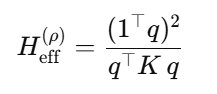
where Kii = 1 and Kij ∈ [0,1] captures cross-hub correlation (shared standards, supply, governance ties). If hubs are similar, K has bigger off-diagonals → effective hubs drop. Operationally: We published a short “correlation audit”: shared suppliers, shared models/weights, shared legal/finance rails, shared orbits/depots.
2) Information & cyber sovereignty (sharpen): Although already touched on in R_sw and partly G, to tight things we made R_sw mandatory at IL-6+ (air-gapped, reproducible builds; signed-only updates) and added a dark-Earth comms drill line item in G_cont.
3) Environmental stewardship & planetary protection (guardrail): Not a survival pillar per se, but we added this to prevent self-inflicted constraints. By adding it as a published guardrail: forward/back contamination controls, waste burdens, and environmental externalities. We kept it outside MIS (like the Thrive Index), but required a pass/fail bar for IL-7+ audits.
4) Spatial dispersion requirement (gate nuance): We added this to avoid shared hazards, add minimum spatial/terrain separation between hubs at IL-6/7 (distance, geology, flood/dust risk class). This fitted cleanly as a gate, not a pillar.
5) Tempo of improvement (management lens): We published dMIS/dt (and ΔMIS per $ / per kg) so leaders optimize rate and efficiency of progress, not just the level.
6) Uncertainty bands: We reported MIS1000 ± error. Give each pillar a method error (e.g., ±0.02–0.05) and propagate through. Prevents over-reading tiny moves.
7) Hysteresis everywhere: We already have IL hysteresis; but we added some pillar hysteresis (e.g., require two consecutive sixths to flip a band).
8) Drill credits > paperwork: For top scores in E/L/S/G/B/R, we require surprise drills (you already do). Make that visual on the dashboard (badges).
9) Red-team ombuds with veto: We had this originally in G; but added emphasize that we can force re-tests and publish minority reports.
10) Scenario museum: We kept an internal library of “what-ifs” (power winter, reagent shortage, firmware compromise) with pre-scored pillar deltas. It speeded decision theater.
MIS Classic Critiques From First Years Of Adoption
Early adoption of the MIS was of course challenged. Putting aside the political, biased or self-centered challenges, the more rational criticisms included:
“The weights are subjective.”
Answer: True—and disclosed. We publish default weights (survival-first), show sensitivity (tornado chart), and allow context reweights with public rationale. IL gates prevent a high weight from masking a critical hole.
“Goodhart’s Law: people will game the metric.”
Answer: Yes, but people will game things with or without metrics. We bind scores to drills and telemetry, not self-attestations; we use surprise audits, versioned rubrics, and a no single metric budgeting rule (MIS + gate status + ΔMIS/£).
“Double-counting across pillars.”
Answer: Potentially if not closely managed, but this is always the case in any complex system. Each rubric, SOP and algorithm has scope guards (e.g., buffers in S, mass share in A, production breadth in M, replication in R). Red-team checks cross-contamination during audits.
“Geometric mean still lets you compensate a weak pillar.”
Answer: That’s why IL uses hard gates (black-start, outbreak control, HC isolation, G/B minima). The geometric mean punishes lopsidedness, gates forbid it.
“It over-incentivizes autarky and discourages trade.”
Answer: MIS only penalizes survival-critical imports via ui. Everything else can be traded freely. We also report a Trade Friendliness side metric (outside MIS) to keep commerce healthy.
“Context blindness—Moon vs Mars vs Ceres.”
Answer: Yes, on purpose the pillars are environment-agnostic; weights and gates adapt per theater (publish presets). The correlation-aware Heff(ρ) also handles systems with mixed worlds.
“False precision.”
Answer: We publish error bands, method notes, and versions; small moves under the band are labeled “statistically indistinct.” Trend = multiple quarters.
“Measurement burden.”
Answer: The whole approach can be simplified or complexified to meet the accuracy versus analysis trade-off. By starting with Tier-1 (few KPIs per pillar), unlock Tier-2 detail at IL-4+, and automate ingestion from ops telemetry. The reality is droids and AIs handled most of the operationalization of the MIS so the human measurement burden was minimal.
“C (cohesion) is political.”
Answer: Yes, and hard to prevent this totally, though we tried. It is optional, published, behavior-based (compliance, incidents, closures). Not a gate. Raw survey instruments and anonymization methods are public.
“Externalities / planetary protection aren’t in the score.”
Answer: Correct by design (MIS focuses on survival). We attach a separate, published guardrail with pass/fail for IL-7+ and a public Thrive/Stewardship index.
“Correlation across hubs is ignored.”
Answer: Fixed via Heff(ρ) and an explicit correlation audit (shared suppliers/models/orbits/finance). IL-9 will explicitly require tech-stack diversity proofs.