
9. Independence Levels (ILs)
Well of course I like to measure things. Or as I like to say “In Sagan I trust, all else bring data.”
So yes, as a droid I like yardsticks. Not the ceremonial kind — engraved, polished, waved at festivals — but the workmanlike rulers that let an engineer decide, quietly and without romance, whether a thing is enough.
On Mars in that first century of settlement The Independence Levels were our ruler. They were not perfect, not unanimously phrased, not immune to revision. But in those first hundred years they did the one job that mattered: they made aspirations and progress on Mars transparent.
It was using Independence Levels we could tell if we had done enough to survive. If we were self-sufficient yet.
♦
Here is the ladder in plain terran speak — the way we explained it to new ground controllers on Earth and, once or twice a year, taught it to the young children of Mars.
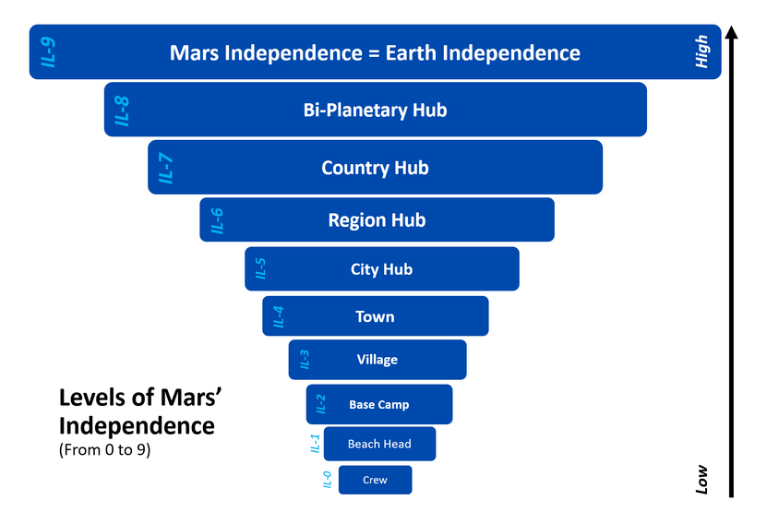
Pioneer Era · Outposts
IL-0 · Crew Sortie: Land, breathe, drink, go home. Short stays, proof-of-life support, and first In-Situ Resource Utilization (ISRU) tests. Think “land, breathe, drink, go home.” Isolation measured in weeks to a tenth of an HC. Governance and biosecurity exist on paper; that is better than nothing. Andy Weir’s Mars.
IL-1 · Base Camp Hub: Sustained human ops, basics actually used. Continuous habitat support for most of a year, with basic repair loops and incident command actually in use. A hub can run ~¼ Hohmann Cycle (HC) without new arrivals, fabricate simple spares, and follow a hygiene protocol that is more than a poster. The Martian equivalent of twenty-first century Antarctica.
IL-2 · Outpost Hub: Half-Hohmann cycle equivalent endurance; still thin buffers. Local power in the hundreds of kilowatts. Water recycling, beginnings of agriculture, and scheduled quarantine windows that people truly respect. Still delicate; you can feel the thinness of the buffer.
Founding Era · Settlements
IL-3 · Village Hub: One full Hohmann cycle equivalence on local utilities. With a first black-start exercise on-record. Surgical and medical baselines move from “we hope” to “we can.” Autarky closure rises to a quarter; fragility shifts from hour-to-hour to month-to-month.
IL-4 · Town Hub: Two Hohmann cycles equivalence; second local hub online. Closure crosses half. There is a machine-shop line that makes valves, seals, and housings without Earth babysitting, and the first full outbreak drill passes. Failure modes change; correlation between hubs starts to become an enemy.
IL-5 · City Hub: Five Hohmann cycles equivalence; three local hubs; deepening industry. Autarky closure around eighty percent. Machine-tool bootstrap underway; electronics repair beyond board-swaps; pediatrics and obstetrics on-hub. Food comes from at least two modalities (you will be grateful for the second).
Sovereign Era · Provinces
IL-6 · Region Hub: Ten Hohmann cycles equivalence; rebuild the core locally. Advisory floor ≈ 10k people, across four hubs. Closure above ninety-five percent. You can rebuild the core of your civilization locally — power, pressure boundaries, pumps/valves/seals, basic semiconductor repair — and run off-grid for months without panic. Most critical SKUs are fabricable by count, not anecdote.
IL-7 · Country Hub: Twenty Hohmann cycles equivalence; stand-alone governance & biosecurity. Advisory floor ≈ 15k people. Per-hub endurance stretches to ~20 HCs equivalence (~43 Earth years). Governance and biosecurity systems are mature enough to survive leadership cycles; dark-Earth drills last ninety days without cheating; asynchronous, signed digital exchanges only. Knowledge continuity is a practiced craft, not a slogan.
Multi-World Era · Civilizations
IL-8 · Planetary Humanity: Two worlds, one resilient civilization. Moon and Mars each host at least one IL-7-caliber city hub. Survival-critical cross-dependence is <10% by weight and consequence. No single failure channel — financial, technical, legal, or orbital — can jump the gap in one move. We learned to love dissimilarity and diversity.
IL-9 · Multiplanetary Humanity: Civilization with an hier and a spare. Three planetary hubs at IL-7 caliber. Remove any one hub and the other two can reconstitute the third without civilizational backslide. Tech stacks are intentionally diverse; logistics and orbits are not monocultures; culture itself is anti-correlation trained.
♦
It’s important to notice the curve here. We designed the early pioneer rungs about not dying today (IL0-2); settlement founding growth rungs about not needing help this year (IL3-4); and the maturing sovereignty rungs about not sharing a fate (IL6-7); beyond that it was about a civilization who was thriving not just surviving (IL8-9).
Look closer and you will see the ladder — IL-0 through IL-9 — was really a sequence of capability gates. Not aspirations. Not vibes. Gates. And to claim a rung we required specific, auditable proof that a hub (or later, an asteroid, moon or planet) could meet a set of filters for a given span of isolation.
The time unit on Mars in that founding century was the Hohmann Cycle (HC) — the interval between energetically convenient Earth↔Mars transfer windows, roughly 780 Earth days (~26 months). “How long can you operate if nothing arrives and nothing updates?” That was the plain question behind the poetry.
♦
Each rung on our ladder of independence tested the same families of truth:
Isolation endurance (per hub): minimum HCs you can run without new mass, new code, or live external command.
Closure / autarky (weighted): the fraction of survival-critical capabilities done locally—energy, pressure boundaries, air/water loops, staple calories, essential medicine, spares, comms/timebase—weighted by criticality and time-to-replace. (Making pasta scored less than making seals. People learned this quickly.)
Governance / Biosecurity minima: baseline maturity for Governance (decision, escalation, auditability) and Biosecurity (quarantine, surveillance, containment). You could be ingenious and still fail here; many did.
Black-start & outbreak drills: pass/fail exercises. Could you cold-boot power and essential industry from the dark? Could you detect, quarantine, and contain a biohazard without help? We didn’t grade on intention.
Redundancy (number of independent hubs): how many sites can meet the rung’s gates without leaning on each other’s real-time umbilicals. “Independent” meant no synchronous control planes, no unreviewed digital inputs, no just-in-time spares between them.
Cross-dependence caps at the top rungs: once planets were in play, we measured how much survival still hinged on off-hub inputs. Above IL-8, the allowable shared dependence shrank to a sliver.
We were just as strict about what didn’t gate progress: population. Automation counts. Good design counts. A small, well-instrumented hub with a deep fabrication bench could surpass a larger one that imported cleverness. We did publish advisory floors for resilience — roughly ten thousand people felt “comfortable” at IL-6/7, fifteen thousand at IL-7 — but survivability auditors verified coverage and viability, not headcount.
The mindset was simple: ILs are capability milestones, not trophies. You didn’t “win” a rung; you accepted its responsibilities. Passing a gate expanded what you were allowed to promise publicly — and what you were required to rehearse in private. It was ultimately the trusted independently validated IL status reaching the higher rungs that gave everyday Terrans the comfort when they were considering emigrating to Mars.
♦
But how in that first couple of centuries of settlement did we know a hub was truly at an Independence Level? Quietly and with receipts.
We measured isolation endurance in Hohmann Cycles because physics does not negotiate. A claim meant the logs showed operations for the declared span without hidden dependencies on ships, markets, or uplinks. The number mattered, but the curve mattered more. In mature runs, buffers rose during stress weeks, repair times shortened, alarms grew boring. Boredom — real, earned, witnessable — was our quiet gold standard. In the second and third century of settlement we wanted long rungs to show stretches on the order of twenty cycles, long enough for leaders to change, for a generation to misplace a story, for documentation to be used by people who did not write it.
Closure — autarky, for some reason we used the old technical English word here and it stuck — was never a crude count of how many things you could make. We asked how much of survival you performed locally, weighted by consequence and time-to-replace. Oxygen compressors, pressure boundaries, pumps, valves, seals, power conversion, staple calories, disinfectants, baseline reagents, anesthesia gases, and a local timebase lived at the heavy end of that scale. An artisan pasta extruder, delightful as it was during festivals, never moved a rung. When a controller asked why, I pointed to a gasket and to a child’s inhaler and they stopped asking.
Governance and Biosecurity minima supplied the teeth. Governance meant a decision tree that did not collapse when a nameplate retired, escalation authority that could actually escalate, and audit trails that survived both public glare and private embarrassment. Biosecurity meant quarantine windows that covered p95 incubation, sentinel surveillance that ran when nothing seemed amiss, and the practiced ability to detect, isolate, and contain without outside help. Many brilliant engineers failed here. Biology is perfectly indifferent to mechanical elegance.
Then there were the black-start drills. After some notable failures in that first hundred years of settlement on Mars they became our secular sacraments. The black-start choreography began with a deliberate darkening: power down, then bring generation up from cold; lift the control plane behind an air-gap; resynchronize life support; ramp distribution; stabilize. We watched not just the timestamps but the variance bands across repetitions; competence is a line becoming a narrow ribbon. Outbreak drills were the mirror image. We tightened movement, re-partitioned air, idled common areas, stood up local diagnostics, and if needed spun up vaccine and reagent pathways from first principles. Both drills were pass or fail. Good intentions sweated and failed like anything else.
At the planetary rungs we learned to love dissimilarity. Independence across worlds demanded caps on cross-dependence so tight they felt rude the first time you looked at them. By the time in the second century of settlement the Moon and Mars each hosted a hub of the long endurance class, the survival-critical dependence between them had to fall below a tenth by weighted consequence and replaceability, and the remnant had to be dissimilar — no single orbit, vendor, protocol, market, or policy that could couple failure like a yoke. Higher still, three planetary hubs existed such that the loss of any one did not cause regression; reconstitution had to be demonstrated in tabletop and in partial loss, not promised in a memorandum. We wrote dependency matrices as if a prosecutor would read them. Sometimes one did.
Importantly a hub’s population never truly gated a rung. Well not at first. We published advisory floors because resilience breathes easier with ten thousand people at the self-sustaining city rung and fifteen at the independent hub, but auditors checked coverage, not bodies: duty rosters that survived a flu wave, skill redundancy that did not hide in a single shift, maintenance cycles that finished on time when the night crew was thin. Automation counted; careful design counted; the ability to rest counted. Being mostly top-down human vs droid count and balance unconstrained by the IL definitions meant operationally the human vs droid trade-off was pure.
♦
Definitions evolved. Engineers, doctors, academics, media ‘experts’, politicians and lawyers argued about weighting schemes for closure, about what counted as “essential medicine,” about whether a timebase must be local or merely locally verifiable. But across variants the shape held and still holds to this sol several hundred years later: endurance, independence, closure, governance/biosecurity, drills, and — critically at the top rungs — low cross-dependence. We disagreed about words. We did not disagree about what keeps people breathing.
An independence level gate, properly understood, is a silence. It is the absence of crutches we once leaned on without noticing: no synchronous control with a neighboring hub, no unreviewed digital inputs slipped in because someone was tired, no just-in-time spares arriving with the casualness of a grocery delivery. Messages still move, but they move like light over distance — signed, delayed, checkable. An independent hub is not a boast; it is a posture that remains stable when the link goes dark.
We prized independence even when the symmetry of a beautiful unified cross-hub stack made our operators' hands itch. And we rehearsed until the thing we feared most — a dark morning with a quiet link — felt like another drill.
This all taught me that when boredom comes to a civilization honestly, it is not a sign of decadence. It is the whisper that the yardstick I like so much is doing its work. And it still is not the ceremonial hand-wavy kind. It is the kind engineers like.