
10. Multiplanetary Independence Score (MIS)
We built independence ladders because independence gates are mercifully clear. You pass or you don’t.
But after a few winters on Mars, we settlers discovered a mean truth: between rungs there is a long slope of better or worse that a binary badge cannot show. Budgets were argued in the fog between “not yet IL-4” and “nearly IL-4 but starving on spares.”
Now I enter stage right… After a decade of settlement, everyone had had enough, and I was asked to make the fog legible.
What I designed was the Multiplanetary Independence Score — MIS — a continuous, auditable dial that sits beside the Independence Levels like a compass beside a summit marker.
The brief I was given was unfashionably blunt. Survival first, always. The dial must compare hubs without flattery. It must punish lopsidedness the way reality does. It must be driven by drills and buffers and yields rather than hopeful prose. And it must give the public a single number they could follow without a degree in systems engineering.
That last constraint was not cosmetic. Public support is a form of oxygen, and a source of future Martians.
Later on we added the parallel Thrive Innovation Score (TIS), and Planetary Protection Protocols (PPP), but those are a story for another codex.
♦
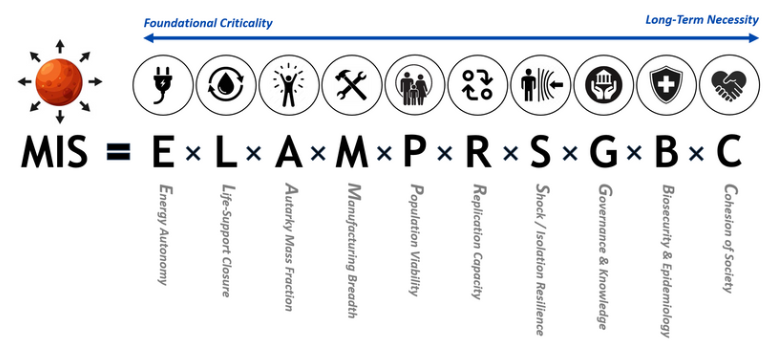
At the center of the MIS was placed a hub’s independence maturity score. This was a measure of the ten foundational pillars that we found over time were needed to drive independent survivability for any given hub: energy and storage (E); life support (L); autarky/closure (A); manufacturing and materials (M); population viability (P); resilience and reconstitution (R); separation and isolation (S); governance (G); biosecurity (B); and culture/cohesion (C).
Pillar | What it measures (0–1) | Typical levers |
E — Energy Autonomy | Local generation + storage capacity to run the habitat/industry under faults and black-starts. | Add nuclear + PV mix; long-duration storage; islandable micro-grids; harden power electronics. |
L — Life-Support Closure | Fractional closure of air, water, and waste loops (fault-tolerant, degradable modes). | CO₂ removal & O₂ gen upgrades; water recovery; modular bioreactors; standardized fittings; buffer sizing. |
A — Autarky Mass Fraction | Locally produced share of the critical chokelist, weighted by mass × irreplaceability / time-criticality. | Localize bulky/urgent items first (O₂, water, glass, steel, cement, polymers); stock/produce critical spares. |
M — Manufacturing Breadth | Depth/coverage of the process tree (mining→ materials→ tools→ CNC→ metrology→ useful-node electronics). | Stand up machine-tool bootstrap line; QA/metrology; PCB & power-semi at useful nodes; fixtures & jigs library. |
P — Population Viability | Workforce coverage, training throughput, dependency ratio, effective population size for decades. | Cross-skilling; apprenticeships; role redundancy; childcare/health capacity; retention in isolation. |
R — Replication Capacity | Ability to reproduce the “base-kit” to build/repair/expand a hub (tools-that-make-tools, software, seeds, meds). | Publish Base-Kit BOM; localize top parts; prove daughter-module build; secure data/toolchains. |
S — Shock/Isolation Resilience | Median isolation is survivable without physical inputs (inventory depth, degradations, black-start drills). | Increase days-of-autonomy; redundancy; haven chains; drill black-start/continuity; spares corridors. |
G — Governance & Knowledge | Institutional continuity, documented SOPs, succession, auditability, education pipeline. | Crisis charters; two-deep roles; red-team ombuds; public ledgers/dashboards; teach-back requirements. |
B — Biosecurity & Epidemiology | Detect/contain/treat outbreaks without Earth help. | BSL-2/3 labs; PPE/diagnostics stockpiles; isolation wards; genomic surveillance; outbreak drills. |
C — Social Cohesion & Alignment (opt.) | Internal stability & external posture sufficient to keep survival systems working. | Fair-process allocation; grievance handling; de-escalation protocols; treaty/comms uptime. |
Each of the 10 foundational pillars was normalized to a sober [0,1] by audited indicators — buffer-days you can count, drill pass rates under load, first-pass yields with real metrology, patch-lag offsets that obey policy. But more on those details later. With ten scores between 0 to 1, we then compressed the set into a single maturity value with a weighted geometric mean so that one weak dimension sinks the whole, exactly as risk behaves.
Per-hub independence maturity (geometric mean; weights promote balance):

The full normalization choices and indicator rubrics live in the appendix, as they should. What matters here is the intuition: the product shape crushes lopsidedness. A hub with strong power and manufacturing but a fragile biosecurity or isolation posture will see its maturity fall to the floor set by that weakest pillar. This is not cruelty. It is how valves fail and outbreaks travel.
♦
Once a hub has an independence maturity, the system logic asks two plain questions.
First, how much of that maturity is truly independent — not borrowed from a neighbor’s spares locker, a synchronized software rollout, or a reagent barge. We capture that with a cross-dependence penalty that scales each hub’s contribution down if it still leans on survival-critical imports or unsafe synchrony. And just to be clear we defined a hub as a place you can walk across — a contiguous settlement and its industrial halo.
Second, how many effectively independent hubs do we have in our system, not by headcount but by quality and diversity. Two strong hubs with dissimilar stacks are worth almost two; five clones that share a failure mode are barely better than one. The MIS combines hub independence maturities into a system score while penalizing cross-dependence; and the levels remain the filters you must satisfy to claim a rung.
For the MIS dial itself we chose a logarithmic scale so that early wins are visible and late progress gets harder — exactly as the work feels. The public gauge runs from 0 to 1000. That kilo scale was deliberate (some found 0–100 too stingy for such a lofty humanity goal as multiplanetary civilization expansion), and the extra resolution lets a quarter’s honest improvement register as a real movement rather than a rounding error. A system creeping from 412.7 to 413.1 on the back of storage ride-through and machine-tool yields tells a truer story than “up a smidge.”
The full mathematics and details of these MIS calculation steps is in the appendix of this codex; the behavior is what you expect if you have ever watched a software update patch roll across a planet.

This MIS shape — geometric inside, logarithmic outside — did more than tidy dashboards. It changed the conversation in budget rooms. When the dial refused to move because a single pillar lagged, engineering leaders stopped polishing their favored strengths and funded their weak floor. When the dial jumped after a black-start finally passed under load, teams could claim credit with evidence. When two hubs asked for the same grant, the penalty for synchrony forced a useful question: are you about to make yourselves clones.
♦
Did MIS replace the Independence Levels? No. Absolutely not.
Dial and ladder, trajectory and gate, motion and milestone. Both, not either.
The Independence Level ladder remains our canon: you do not “average” your way past black-start, outbreak containment, or honest isolation. MIS complemented it by showing trajectory. A hub can be below IL-5 and still show the right slope — buffers rising, spares backlog decaying, drill pass rates climbing. A system can sit at IL-6 and still be warned that its cross-dependence makes the next rung irresponsible. The pair turned planning from oratory into choreography. The dial showed motion; the rung said when to announce it.
Now at this point I am obliged to fully disclose my authorship, just in case you accuse me of bias. The project team was mine to build and to answer for. We prototyped on Mars, then hardened it in the glare of lunar ports. The rubric saw forks and variants — biosphere-heavy versions for deep-isolation sites; port-weighted editions for depots that moved continents of mass. The Western and Chinese Martian hubs both adopted the essence of the instrument with only minor dialects. Everyone personalizes and localizes tools, and that’s just fine. Now, you can look up which of these consortium commissioned my first release if you want; but I don’t want to make this a story about which flag I helped first. Within a decade both camps were using the same compass and arguing, productively, about which needle to stiffen.
By the end of the first century, the “JB Equation” — the informal name given by Mars’ engineers, I am embarrassed to say — had moved from a lab notebook into the daily kit of planetary engineering. It did not rule supreme. But it sat on the table alongside risk registers and project briefs, and it gave us a way to say why a storage expansion mattered more than a new dome this quarter, or why a reagent line beat a festival. It pulled emotive debates into the light of drills and numbers. That was its quiet gift. My first gift to Mars.
The rest of the mathematics — the penalties, the diversity measure, the log normalizer — deserves its own careful treatment, with examples and the usual sensitivity analyses. For now, hold the shape in your head: a dial that rises towards 1000 only when all the vital foundations of planetary engineering stay in step, and rises faster when your independence exists in more than one place.
The IL ladder will tell you when you’ve cleared the gate. The MIS dial will tell you if you’re truly headed there.
♦
A dial is only useful if it steers. The first year after we shipped MIS, the most common question in budget rooms was the right one: what moves it the most per unit of pain. We answered by separating the levers. Some projects raised a hub’s maturity — they deepened a pillar and lifted the geometric mean. Others reduced cross-dependence — they cut the hidden tethers that made local excellence contingent on distant favors. A third class increased the number of effectively independent hubs — they made quality plural rather than concentrated. Once leaders saw these as distinct vectors, arguments stopped colliding and started composing.
♦
Inside a planetary hub, the dial rewards balance. The geometric mean refuses to be charmed by a single glamorous upgrade. If energy is superb but biosecurity sulks, the product slumps to the level of the sulk. This made it gloriously hard to game if it was implemented and governed correctly. Something I am still proud of.
The only way up was to raise the floor. In practice that meant storage that erased a storm season rather than a press release; an outbreak drill that drove the reproduction number under one on schedule; a machine-tool line with metrology that could survive destructive testing; a repair bench that measured recovery in hours; governance that escalated at three in the morning.
Between hubs, the dial punishes clones. A world of identical strengths and identical mistakes is not independent; it is synchronized. The cross-dependence factor we applied to each hub’s contribution fell when survival still hinged on imports or on standards that rolled everywhere at once. Compute sovereignty, reagent and vaccine platforms, staggered releases, dual vendors, and local timebases all raised that factor back toward one. The diversity measure that followed — our count of effectively independent hubs — behaved like intuition: it stayed low when one giant center monopolized competence, and climbed when several places could keep people breathing without phoning a friend. Yes, in a strange way the MIS showed mathematically why it was good to have both Eastern and Western philosophies and independent hubs thriving on Mars and beyond.
At the system level we chose a logarithmic dial not to be clever but to be honest. Early upgrades move the needle briskly: a black-start that finally passes; buffers that become numbers rather than nouns; an electronics bench that turns a sullen crate into working boards by lunch. Later gains demand more work for less applause: the second vendor that completes a real heterogeneity; the last thin tail of imports that finally flips; the governance firebreak that prevents a neat cascade two years from now. This is how independence feels when you do it under load. The dial speaks the same language.
♦
The most important guardrail we built was auditability. Every pillar score came from instruments and rehearsals. Buffers were QA’d inventory, not spreadsheets. Drill pass rates were under load, witnessed, and versioned. First-pass yields were tied to metrology records you could pull. Patch-lag offsets were not “industry best practice,” they were clocks that forgot how to lie. Each release of MIS carried a publication note that listed what moved the number that quarter. Phrases like “storage ride-through improved from thirteen to twenty-one days” replaced phrases like “we worked very hard.” Goodhart’s law — measures corrupted by the act of measuring — loitered near every dashboard. We kept it hungry by publishing raw indicators alongside the dial and by giving auditors the power to embarrass us in public.
Weights were versioned and boring on purpose. Survival foundation pillars — life support, autarky, resilience — started heavier; we adjusted only when data made a liar of us. This avoided theological fights about whether “culture” should outrank “pumps.” The ladder kept us honest there: no weight can talk you past a failed gate. Over the first century we released small forked rubrics — biosphere-heavy for deep-isolation sites, port-heavy for depots with relentless cadence — but we kept the core invariant so a hub on the Moon and one on Mars could be read on the same page without apostasy.
♦
What does steering look like from a chair with a budget? If a hub’s pillar radar shows shallow troughs but u, the independence factor, is depressed, the best money buys decoupling. Commission a reagent line; enforce asynchrony in firmware; stand up a sovereignty compute hall; split your standards with a friend. The dial will jump without laying a single new pipe, and the next isolation drill will feel less athletic. If u is healthy but the geometric mean is pinned by a single weak organ — most often manufacturing or biosecurity in the second and third decades — the right spend is a floor lift: metrology before machinery; BSL-2/3 before murals; repair-first electronics before chasing frontier nodes. If both are strong and the number refuses to budge, you have a concentration problem: invest in a sister hub that is not your mirror. The diversity term will reward you more than a gilded upgrade at home.
There is also a rhythm to the dial that politics learned to respect. We published it quarterly, with error bars. We kept hysteresis at the rung boundaries so the badge did not thrash: you entered IL-5 at a band, not a tick, and you did not fall out because a shipment slipped. Every year we bundled the number with a narrative that a nurse could read: what drills passed, which buffers rose, which dependency we cut. The public learned to trust a number that did not pretend to be a personality test.
♦
The best proof that MIS worked is unromantic. It started appearing on shipping manifests. A starship up-mass request began with the dial’s anatomy: “+0.0214 MIS points from metrology and reagent lines; +0.093 MIS from sovereignty compute; neutral on energy; risk reduced by fifty percent in the spares tail.” Councils that once debated domes began debating Heff (Heff) — how many places could keep breathing if the link went quiet for a year — and found themselves funding sister hubs rather than palaces. We saw versions of our tool in places we had never visited, with labels written in alphabets I had not been trained to pronounce. The math traveled because the work travels: drills, buffers, yields, desynchrony.
In the pages ahead I’ll open the casing — how the penalties work, how diversity is computed, how we chose the normalizer — and walk through “what-if” exhibits that show why some projects are lever arms and others are ornaments. Yes, there is maths, but nothing a 12 year old Martian can’t follow, and in reality just the early lite versions of what the MIS approach grew to become.
For now, remember the shape. Independence rises when pillars rise together in lock-step, when hubs differ on purpose, and when we rehearse until boredom returns.
The dial is only a meter. The hard work, choices and music were still the engineer’s and operator’s.