
A3. Independence Levels (ILs)
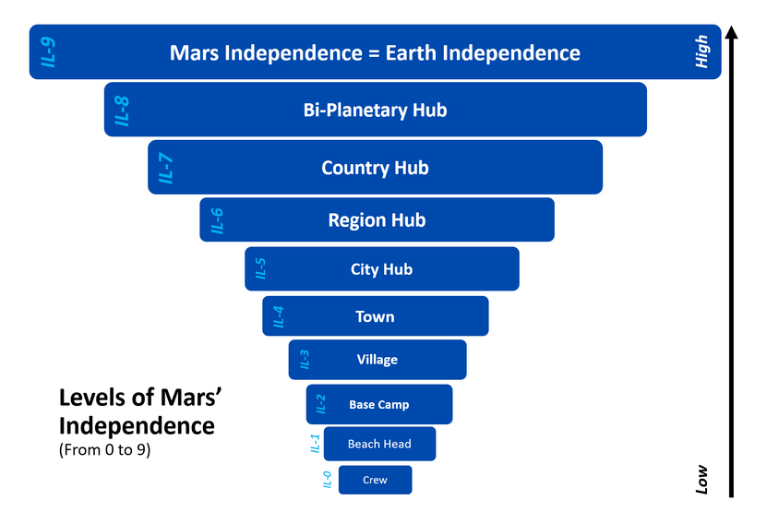
Independence Levels (IL-0…IL-9) are plain-English, auditable rungs that describe how far an off-world civilization has progressed from dependent outpost to robust, multi-planet redundancy. They are capability gates, not trophies: to claim a level, specific filters must be met and evidenced; vibes don’t count.
Units & Gatekeeping (how ILs are judged):
Time unit: Hohmann Cycle (HC) ≈ 780 Earth days (~26 months).
Primary gates (per rung):
Isolation (minimum HC endurance per hub),
Redundancy (# of independent hubs),
Closure/Autarky (weighted fraction of survival-critical functions done on-hub),
G/B minima (Governance & Biosecurity maturity thresholds),
Black-start & outbreak drills (pass/fail),
Cross-dependence caps at the top rungs (how much survival still hinges on off-hub inputs).
Population stance: No hard headcount gates (automation counts). Advisory floors only at IL-6/IL-7 for resilience.
Key terms (for this ladder):
Closure/Autarky (weighted): % of survival-critical capabilities (energy, air/water, food, medicine, spares, comms/control) that can be performed locally, weighted by criticality and time-to-replace.
Independent hub: A site that can meet its rung’s isolation & governance requirements without relying on synchronous control, unreviewed digital inputs, or just-in-time imports from another hub.
Black-start: Demonstrated ability to restart power and reboot essential industry from cold using on-hub resources.
Outbreak drill: Demonstrated ability to detect, quarantine, and contain biological hazards without off-hub intervention.
The Ladder at a Glance (rung cards)
Format per rung: Name — Isolation — Hubs — Closure — G/B minima — Core gates — Proof hints — Typical failure modes
IL-0 · Scout Hub
≤0.1 HC, ≥1 hub, closure <5%, G,B ≥0.2.
Gates: Basic ISRU tests, short-stay life support, remote ops.
Proofs: ISRU logs; crewed sorties; limited contingency stocks.
Failures: Hidden cloud control; no isolation drills; zero spares sovereignty.
IL-1 · Beachhead Hub
≥0.25 HC, ≥1 hub, closure ≥5%, G,B ≥0.3.
Gates: Continuous habitat support, initial ISRU and repair loop; incident command codified.
Proofs: 6–8 month autonomy audit; spare-parts fabrication demo.
Failures: Outsourced ICS; common-mode firmware; ad-hoc bio hygiene.
IL-2 · Foothold Hub
≥0.5 HC, ≥1 hub, closure ≥5–10%, G,B ≥0.4.
Gates: Local power >100 kW, water recycling, basic ag pilots; scheduled quarantine windows.
Proofs: 12-month local-only drills; signed artifact corridor.
Failures: Frequent biotraffic outside quarantine; model monoculture.
IL-3 · Village Hub
≥1 HC, ≥1 hub, closure ≥25%, MW-scale power, G,B ≥0.5.
Gates: Year-scale survival on local utilities; medical/surgical baseline; first black-start exercise.
Proofs: 26-month mission log w/ no unreviewed inputs; black-start after planned outage.
Failures: Single vendor for ICS; no spare pumps/valves/filters; untested outbreak plan.
IL-4 · Town Hub
≥2 HC, ≥2 hubs, closure ≥50%, G,B ≥0.6.
Gates: Heavy construction; dual-hub redundancy; on-hub machine shop line; outbreak drill pass.
Proofs: 52-month evidence pack (energy/food/water buffers trendlines); cross-hub quarantine replay.
Failures: Cross-hub synchronous updates; shared control plane; finance chokepoints on Earth.
IL-5 · City Hub
≥5 HC, ≥3 hubs, closure ≥80%, G,B ≥0.7.
Gates: Machine-tool bootstrap; pediatric/OB surgery; black-start drill pass; electronics repair cell.
Proofs: Spares sovereignty ledger; on-hub PPE/seal manufacture; two independent food modalities.
Failures: Import-dependent reagents; single deep-space link; no protocol fences.
IL-6 · Regional Hub (advisory floor ≈ 10k people)
≥10 HC, ≥4 hubs, closure ≥95%, G,B ≥0.8.
Gates: Rebuild core industries locally (power, pressure boundaries, pumps/valves/seals, basic semirepair); multi-month off-grid runtime.
Proofs: Year-long traffic drought simulation; local PNT/timebase; >80% critical SKUs fabricable by count.
Failures: Hidden single-points (Earth capital, standards body, relay); inadequate water/food margin.
IL-7 · Country Hub (advisory floor ≈ 15k people)
Per-hub ≥20 HC endurance; periodic rebuild/continuity/outbreak drills; G,B ≥0.9.
Gates: Maintain industry, medicine, knowledge continuity for ≥~43 years (20×HC) across leadership cycles; asynchronous, signed digital exchanges only.
Proofs: 90-day dark-Earth drills; revocation tests; evidence of on-hub vaccine/reagent spin-up; dual-vendor ICS.
Failures: Re-introducing correlation (mirrored frontier AI weights); quarantine erosion; governance capture.
IL-8 · Bi-planetary Civilization
Earth & Mars each host ≥1 IL-7-caliber hub; survival-critical cross-dependence <10%.
Gates: Planet-level governance separation; no single failure channels between planets for survival-critical functions.
Proofs: Cross-planet break-glass drills; audited dependence matrix; independent deep-space links.
Failures: Shared global standards with synchronous rollouts; financial interlocks; dual-use orbital monocultures.
IL-9 · Multiplanetary Civilization
≥3 planetary hubs at IL-7-caliber; loss of any one hub does not cause regression.
Gates: Triangulated independence; dissimilar tech stacks; diversified orbits/logistics.
Proofs: Planet-loss tabletop + partial-loss drills; demonstrated reconstitution from two-planet base.
Failures: Hidden common-mode tech; cultural/coordination lock-ins; untested reconstitution.
Evidence, Not Vibes:
Isolation logs: Continuous operations records for the stated HC (with artifact signature trails).
Buffer ledgers: Food/water/energy/storage buffers (days-of-cover), trend-audited.
Spares sovereignty: % of critical SKUs fabricable on-hub; first-pass yield reports; repair cycle times.
Black-start after-action: Controlled outage → power restart → ICS bring-up → life support re-sync.
Outbreak drills: Quarantine timing vs p95 incubation; sentinel surveillance coverage; time-to-vax spin-up.
Digital fences: Revocation drills; patch-lag offsets; model diversity index; dual-vendor ICS proofs.
De-correlation: Traffic-pause and model-freeze exercises; cross-dependence matrix with <10% survival-critical reliance at IL-8+.
Common Failure Modes: Why Audits Fail
Model monoculture: Same AI weights/policies mirrored across hubs → high ρ.
Quarantine theater: Frequent unscreened biotraffic; incubation windows not covered.
Synchronous updates: Firmware/protocols rolled out simultaneously → correlated faults.
Hidden chokepoints: Earth capital markets; single relay; single vendor; shared standards.
Paper drills: No dark-Earth or black-start exercised under load.
Population: Why It’s Not a Hard Gate
Capability over headcount. Automation, design margin, and fab coverage matter more than raw population.
Advisory floors only (resilience): IL-6 ≈ 10k comfort; IL-7 ≈ 15k comfort—not gates.
Audit by coverage: Verify posts, coverage, and buffers, not bodies.
IL Legacy Lite vs IL Current Full
Everything shown in this codex is an early first century HE legacy version of the IL Lite version. The full version, especially that which evolved after the first three decades, follows the same principles by enhancing the granularity and accuracy of the approach.
For example, some early enhancements to the IL version shared in this codex, beyond the definition tuning included:
1) Correlation guardrails (system level). This was required at IL-8/9: proof of dissimilar tech stacks (power, compute, firmware, comms) and independent standards timelines to prevent common-mode failures.
2) Spatial/terrain separation. At IL-6/7: minimum inter-hub distance and different hazard classes (geology/dust/floodplain) so one event can’t take out multiple hubs.
3) Toolchain sovereignty (hard gate). At IL-6+: signed-only, air-gapped, reproducible builds for critical control software; periodic offline rebuild drill.
4) Planetary protection / stewardship (guardrail). Pass/fail audit (forward/back contamination, waste burdens). Publish alongside IL; don’t roll into MIS/IL math.
5) Finance/credit chokepoint test. IL-6+: 90-day “no-Earth-money” operating drill (procurement + payroll + spares) using local rails; proves governance doesn’t depend on off-world credit.
6) Reconstitution clock at IL-9. Make “two hubs can rebuild the third” measurable: e.g., T_recon ≤ 5 years to restore an IL-7 hub after catastrophic loss.
7) Versioned gate specs. Publish IL-spec v1.x with exact drill durations, pass criteria, evidence packets, and a change log (prevents moving goalposts).
8) Hysteresis & re-audit cadence. Entry and exit bands + annual IL re-audit; clear downgrade protocol (and a “watch” state).
9) Environment presets. Keep levels identical, but published Moon/Mars/Ceres presets (HC targets, typical chokelists) so teams don’t argue the physics—only their evidence.
10) Correlation-aware dashboard. Show an “anti-correlation badge” at IL-8/9 (supplier/model/orbit diversity score) even if MIS already handles some via Heff.
11) Public proof packs. For each rung, a one-page Gate Checklist and a redacted Drill Certificate (black-start, outbreak, dark-Earth, no-arrivals) to support PR without leaking sensitive detail.
IL Classic Critiques From First Years Of Adoption
Early adoption of the IL was of course challenged. Putting aside the political, biased or self-centered challenges, the more rational criticisms included:
“The gates are subjective / fuzzy.”
Answer: We published versioned test protocols (durations, observers, data artifacts). IL awards require surprise drills and third-party sign-off.
“Ten rungs are too coarse.”
Answer: ILs are milestones; the continuous MIS1000 dial shows progress between rungs. Use both: ladder for narrative, dial for operations.
“Over-emphasis on autarky discourages trade.”
Answer: IL only penalizes survival-critical dependence. Non-critical trade is fine—and healthy. We even publish a separate Trade Friendliness indicator (outside IL/MIS).
“HC (Hohmann cycles) is Mars-centric.”
Answer: The spec defines HC as the local resupply cadence constant. Presets map HC to each theater (Moon windows, Ceres launch arcs, nuclear/electric logistics), so the metric is destination-agnostic.
“Population floors are arbitrary.”
Answer: They’re advisory, not gates. True gates are capability drills (coverage, succession, replication). Small populations can qualify if the evidence proves it.
“Governance & social factors are underplayed.”
Answer: IL requires G/B minima and dark-Earth governance drills. Richer social metrics live in C (published, not gated) to avoid politicization while maintaining transparency.
“This can be Goodharted.”
Answer: IL gates are events, not self-reported numbers (e.g., black-start, outbreak control, no-arrivals). Surprise drills + red-team ombuds + public artifacts make gaming costly.
“Moon vs Mars path bias.”
Answer: Two legitimate tracks, port-led and biosphere-led; IL checks capability, not route. Presets clarify expectations without privileging one environment.
“Security through obscurity: public proofs risk OPSEC.”
Answer: We publish redacted certificates & checklists, not schematics. Auditors see detail; the public sees pass/fail, dates, and scope.
“Externalities/planetary protection aren’t counted.”
Answer: Correct—IL is survival/independence. We attach a Stewardship guardrail (pass/fail) and a separate Thrive Index for culture/biodiversity/innovation.