
Era 9. Facts – Encyclopedia Galactica
The Belter Era | 2177-2190 | 137-150 HE
TLDR: The Belters era is the hinge between “First Horizon” (Earth↔Mars) and “Second Horizon” (Mars→Ceres/Belt/Beyond). Fusion drive moves from rumour to schedule item. A first crewed Mars–Ceres mission (~145 HE) flies and returns. Training programmes, standards and institutions pivot toward deep-system operations, but daily life for most Martians still happens under stone in PH, YG, and their tubes. The culture tilts outward; the map’s frame slips – yet Mars remains, for now, the centre of its own story.
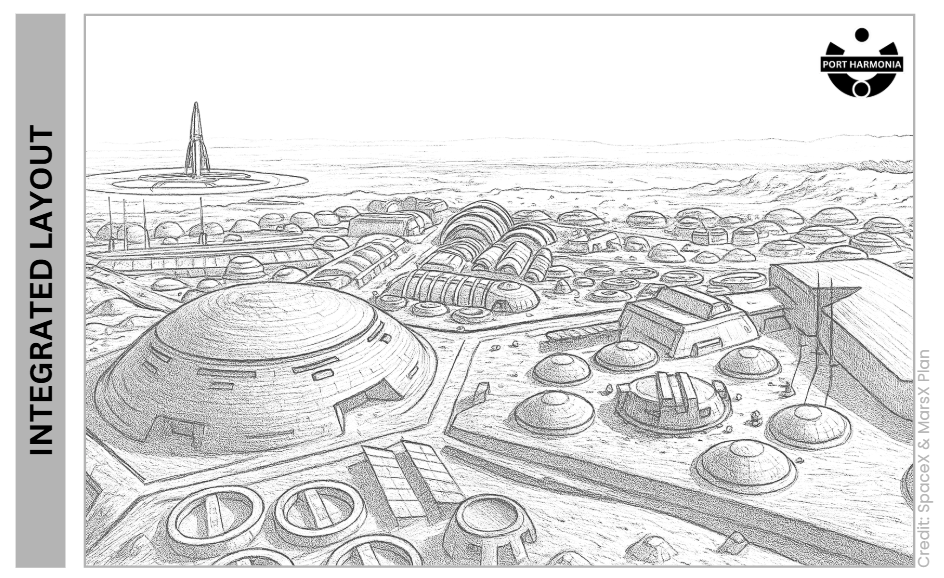
Main location: Port Harmonia, Yínghuò Gate, Phobos Harbor, Mars–orbit fusion yards, early Ceres staging zones and test ranges in the inner Main Belt
Stage (internal): Robust S7 “City-State” (IL-7) in practice, with S8 “bi-planetary resilience” defined and treated as the next design target rather than current state
Population: Peak ≈ 40,000–45,000 at once by late era
Era soundbite: Mars is normal
Core question: How does a newly sovereign, still-small Mars absorb constant-thrust fusion – technically, politically, culturally – and begin to project itself toward the Belt, without destabilising the hard-won Martian city-state or turning itself into just another origin world that forgets where its air came from?
Core result: Lose one planet, don’t regress civilization. Travel feels like going to another country; tech, law, finance, and culture are diversity-trained by default.
Daily feel: Travel like inter-country life — slower, pricier, ordinary. But there is hope that will change soon.
Era Challenge: Absorb the shock and opportunity of constant-thrust fusion – mentally and institutionally – while: i) Mars is finally stable and sovereign, ii) almost all real life still happens between Earth ↔ Mars ↔ PH/YC spokes, and iii) the first credible paths to a second frontier (the Belt) appear on drawing boards and in training brochures.
This is a transition era, not an “Asteroid or Outer Solar System Settlement era” yet: the culture tilts, but hasn’t moved.
Era Accomplishments: Era 9 is civilization with a spare and a spare’s spare. Multiple planets each host long-endurance hubs, and the system is engineered so any single planet or major hub can blink out without civilizational backslide. Tech stacks, supply chains, standards, and cultures are intentionally dissimilar; interworld links are many and revocable; reconstitution is drilled, not theorized. For ordinary people, interplanetary life is public: visas, flights, commerce, and careers work like inter-country moves on Earth—slower, pricier, but normal.
Survival Backbone Reliability: Each world’s utilities are boringly independent; planet-loss and partial-loss drills prove continuity of life support elsewhere.
Make–Mend–Multiply: (Local Production & Repair Depth): Core kit can be rebuilt from two-planet bases; process recipes have triangulated variants so common-mode failures don’t propagate.
Food & Bioprocess Sufficiency: Each world runs multiple modalities, independent seed/strain banks, and public-health grade cold chains; interplanetary food trade is optional.
Mobility, Storage & Logistics Resilience: Diverse orbits, providers, and routes for comms and cargo; buffers sized to live through missed windows; local navigation/timebases independently verifiable.
Economic Momentum & Trade Fit: Trade is resilient and non-existential—specialty parts, data, culture, science services—priced with substitutions and planet-alone clauses.
Gov. & Steward: Planet-level sovereignty with narrow, auditable crisis compacts; no body can impose synchronous change on all worlds’ survival systems.
Health, Biosecurity & Care Culture: Interplanetary biosecurity is routine: through-journey quarantine, genomic surveillance, mirrored reagent/vax platforms; drills span worlds with sealed interfaces.
Talent, Training & Team: Redundant talent pipelines per world; knowledge moves, not single points of failure; exchanges enrich but never single-thread roles or institutions.
Identity, Story & Attraction: Shared story is plural: many worlds, many ways; dashboards show what’s traded and what’s proudly local; travel and migration feel ordinary.
Allies, Capital & Partnership Readiness: Partners, capital, and standards are multi-home, revocable, asynchronous; no synchronous rollouts; vendor/model diversity enforced; revocation tested.