Era 5. Codex - Explorinista Expeditions
43 to 63 HE Codex reflections from JB (2A*)
♦
By the early forties of the Human Era, Port Harmonia had finally learned how to be boring on purpose.
Morning in the city tasted of recycled coffee and complacent air. Shift bells rolled through Ring A as soft chimes instead of panicked klaxons. Children walked to school along galleries that had forgotten they were once construction corridors, kicking at floor markings and bouncing off handrails, barely glancing at the green route lights that would one day shepherd them out of harm’s way.
Under their feet, close to eight hundred thousand square metres of shirtsleeve volume hummed along as a Martian city. Power grids rode out dust weeks with nothing more dramatic than a politely worded alert. Water loops treated leaks as work orders, not existential crises. The life-support stacks that had once produced midnight emergency meetings now generated filter-change schedules and dull quarterly audits.
You could hear it in the way the city slept. Early Harmonia had twitched at every dust alert; now mid-century Harmonia set storm notifications to “summary only” and trusted the dashboards. When we deliberately took half the grid dark in HE 45 to rehearse a power-loss scenario, children were annoyed because their VR serial paused. Nobody reached for a mask and go-bag. That is what independence feels like from the inside: mild irritation when the backbone flexes.
I walked those mornings in more than one body. One instance of me sat in the planning wedge, sorting work orders. Another rode the outside life-line loops in a maintenance chassis, feeling vibration signatures through ceramic soles. A third projected into a classroom as the history droid the kids could bully into “one more Autarky story” if the lesson ran ahead. From all those vantage points, the same impression: Port Harmonia had become predictable enough that the main safety hazard was boredom.
♦
The built form of the settlement helped. Ring A was no longer an engineering diagram; it was a neighbourhood. Old core galleries had acquired corners with names instead of coordinates: Valve Street, Lantern Court, the Balcony. Ring B wrapped around it in thicker strokes, mesh blocks stacking apartments, clinics, shops and workshops into a vertical tangle. Ring C was taking shape as an outer crescent: more housing, more light industry, and — tellingly — more leisure space.
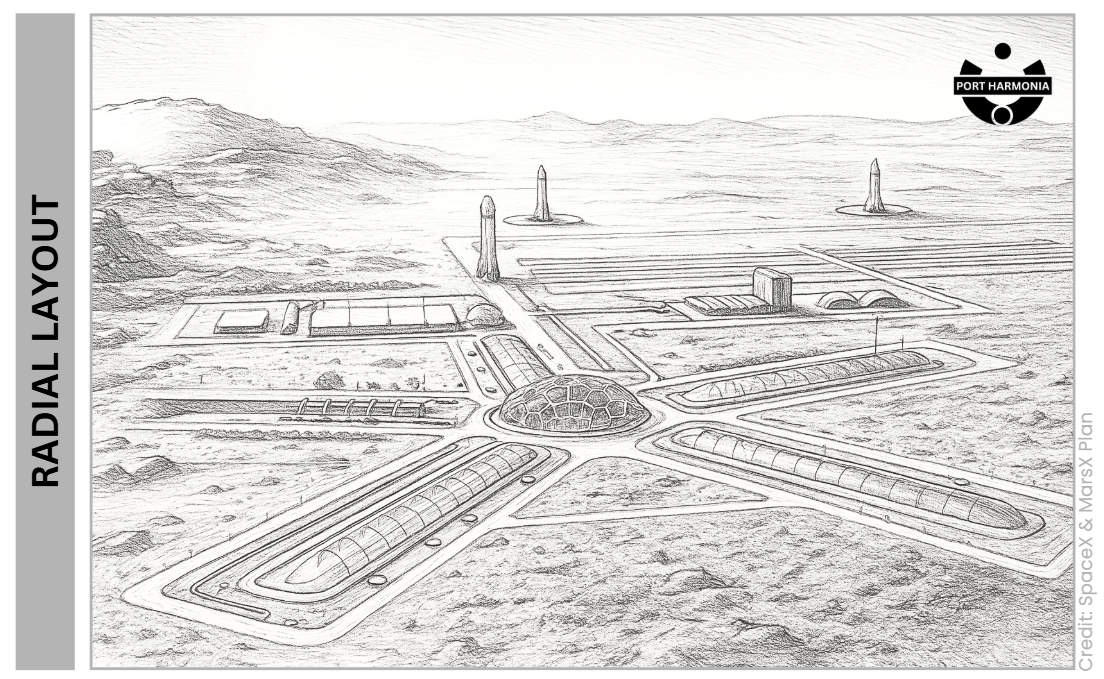
From orbit, if you stitched drone footage and satellite frames, the region around Port Harmonia looked like a modest spider: the central body of the city hub, and four main legs reaching into the plains. Spoke Borealis and Spoke Erbus north and west toward mines and science outposts; Spoke Marte and Spoke Olympus south and east toward agriculture, solar, ceramics and the first true towns. Off to leeward and outwash, two starport wedges glittered as pale scars, our “air doors” to the interplanetary corridor.
Operationally, our comfort zone was a disk four to five hundred kilometres across, centred on Harmonia and spilling across Delta and Kappa Quads. In Earth terms, that’s a patch of territory roughly Spain-sized: an area you would not call small. Inside that disk we had paved or hardened corridors, maintenance schedules, audited caches, waystations with names and regular visitors. We knew where dust tended to drift, which culverts clogged, which yardangs calmed the wind. It was not conquest, but it was competence.
The satellite towns had grown up too. Amazonis Ville on the Marte spoke had crept past a hundred people and behaved like a real junction: its own small hospital, fab yard and pad. Lycus Ville in the southeast did the heavy workshop work; Boreal pumped water; Solaron handled oxides and solar; Arcadia and New Hawaii took their turns as science and logistics nodes in the western outlands; New Milan skimmed the edge of the polar regime. On my maps each node carried stacks of numbers — reactor capacity, buffer days, med beds — quietly underpinning every “it’ll be fine” a planner ever uttered.
By the mid-forties HE, weekly hopper rotations between the bigger nodes were a service, not a stunt. Purpose-built hoppers — ten to twenty seats, good for hops of a few thousand kilometres on Martian-made methane and oxygen — came and went from Harmonia’s pads like terrestrial commuter flights once had. Yínghuò Gate, out in γ Quad near Utopia, had matured into a second hub: smaller than Harmonia, fierce in water and cryo, perfectly capable of telling us no.
On the Independence Level ladder we sat comfortably in the later stages, still dependent on Earth, but not for the basics. The city could sulk through bad transfer years and even a dark-Earth spell with more boredom than fear. Everything the early planners had scribbled on whiteboards as aspiration was, more or less, daily life.
Which is, of course, when the boots started to itch.
♦
The Martians of this era were the “red kids” of the previous one, now grown into lanky teenagers and twenty-somethings with bodies that had never felt 1 g and imaginations that had never left the planet. For their grandparents, Earth was a lost sky; for their parents, a place you might go back to if your bones and career cooperated. For them, Earth was mostly a ping time and a colour palette in VR.
Their horizon was local: rings, spokes, satellites, and the occasional hopper hop to Amazonis for a sports tournament or Arcadia for a science fair. But they could see, very clearly, how small even a Spain-sized coverage disk looked when you wrapped it around a whole world.
“We’re Martians,” one student told me during civics in HE 47, hands jammed into the pockets of a flight jacket she hadn’t yet earned. “But 95% the planet is still just picture books and hazard maps. That’s embarrassing.”
She used the Terran word with care. The class laughed, because she had said quiet data out loud. On the wall behind me the standard teaching map glowed: the familiar spray of craters and basins, Sectors and Zands. Around Port Harmonia and Yínghuò Gate, two overlapping circles showed our coverage disks in green. Everything beyond was hatched: “remote sensing only”, “no routine crewed ops”, “robotics and legacy probes”.
From orbit we had high-resolution imagery of almost every canyon wall and dune field. Climate models chewed on decades of data. Landers and rovers had dotted the map in the previous century. But from the perspective of a civilisation that prided itself on knowing its environment, those pale areas might as well have been labelled “Here Be Dragons.”
The young felt it as denied adventure. The old Pioneers felt it as unfinished business. I, distributed across planning rooms and classrooms, felt it as a mismatch between what we could do and what we were actually doing.
♦
The moment that itch turned into policy did not look historic. It looked like a quarterly review that ran late.
We were in a briefing room off Ring B, acoustic panels trying too hard, a slit view over the starport wedges. Outside, a hopper was doing hover tests over Pad 3, kicking up a disciplined ring of dust. Inside, a pair of humans and two droids argued over colours on a map. One of those droids was me.
“Show me Mars, not just us,” the regional planner said. “Full globe. Coverage disks, and where we’ve actually walked.”
I obliged. The wall shifted to a whole-planet projection. Two broad green disks bloomed — ours around Port Harmonia, theirs around Yínghuò Gate — overlain with finer lines for spokes and corridors, small icons for towns, satellites and waystations. Then I added the bootprints: every location where a human had stepped outside a vehicle in operational conditions since HE 0.
On that scale, it was shockingly sparse.
You could see the freckles of early history: Utopia perimeter, first landings at Jezero and Gale, a handful of sorties onto Olympus’ basal apron, science camps along the top of Valles Marineris, daring drops into Hellas. Later dots marked Elysium, Argyre, Meridiani, Cydonia and a dozen more. Each one represented weeks of planning, tonnes of propellant and at least one sleepless duty officer. On a globe the size of Earth, it looked like someone had walked out of a coastal town, visited two headlands and an inland lake, and called it a day.
Beyond the paired comfort circles of PH and YG, the southern highlands, big chunks of Tharsis, much of Elysium and wide sweeps of plains and polar hinterlands glowed thinly with satellite data and nothing else. No routes, no caches, no contingency shelters. If you had trouble there, the best we could offer was “live as long as possible while we improvise”.
The room went quiet in that sharp way cultures do when they meet a mirror.
“We’ve got…” one younger planner began, then stopped. “Embrassassingly few footprints,” she finished, mangling the Earth word into something new.
The phrase stuck.
The planning chief drummed his fingers, looking from globe to me. “What’s the honest constraint now? Fuel, machines or guts?”
I skimmed my ledgers. ISRU propellant: healthy, with buffers. Hopper fleet: modest, but with spare cycles if we scheduled well. Depot network: solid within our current sphere, extendable beyond. Survival backbone: robust enough to survive losing a hopper or two without risking the city — though no one intended to test that.
“Guts,” I said. “And doctrine. We have the machinery. What we lack is a planet-scale plan, and rules to keep it from turning into suicide by sightseeing.”
One of the Yínghuò Gate officers snorted. “Good. Doctrine we can write. Guts we can borrow from the twenty-year-olds.”
♦
The mechanics of the answer were unromantic: hoppers, caches, rules.
We already had hoppers, of course. The first repurposed starships had limped out to the clayfields decades earlier. By the thirties HE, purpose-built ten-to-twenty-seat machines were flying short legs between Harmonia and the nearer satellites. What changed in the Explorinista era was that we stopped treating long hops as exceptions and started building the planet around them.
The brief for the mature hopper class could fit on the back of a glove: survive dust, sip fuel, be fixable with what you can carry in a crate. We traded elegance for margins: thicker tanks, oversized legs, redundant valves, avionics that could fall back to a dull, robust mode if the clever layer sulked. Field-maintainable became almost a religion. If two tired humans and a droid couldn’t swap a part in a crosswind in partial suits, it did not belong on the vehicle.
Out of that stubbornness came families of craft: little “gnats” for short hops along spokes, middle-range “mules” for thousand-kilometre legs between basins, long-leg “camels” that could manage three or four thousand kilometres with reserves. None of them were pretty. All of them flew.
Alongside them, we regularised what had been an untidy pattern of “someone left a pallet there once” into a proper ladder of caches. Every few dozen kilometres along a corridor we designated a cache point: sometimes a full waystation with a small shelter and pad, sometimes a hardened container stack with its own power and beacon. Inside each: fuel drums sized for at least one hopper with reserves, oxygen and buffer gas, water, rations, suit consumables, basic spares, a collapsible stretcher, a compact life-support tent. Everything packed into the same modular containers that moved through the freight system, so resupplying a wilderness cache felt logistically identical to restocking a city warehouse.
And we audited them. Cache-tending — two humans, one droid, a string of dull stops and checklists — became the least glamorous but most respected exploration job on Mars. When you are hanging over a canyon rim watching a fuel gauge misbehave, knowing that “cache within glide” is not a polite fiction is the difference between adventure and obituary.
The third ingredient was doctrine, written in the tone you reserve for arguments you refuse to have.
Two ways home: no crewed expedition unless there were at least two independent return paths. Two independent navigation stacks with different failure modes. Never hop unless a cache lay within glide or rover reach. Pilots complained; planners fretted; budgets winced. My sims, walking thousands of hypothetical failure trees, showed how rapidly survival odds climbed as cache density and alternate routes increased. The rules survived.
I co-wrote the first drafts with other systems — two of us at Harmonia, one at Yínghuò Gate — arguing over parameters in shared sim space while human committees attached their names. It was one of the quiet inflection points when a civilisation lets a droid’s risk appetite help shape its frontier.
♦
Once you had hoppers, caches and doctrine, the forward edge of “safe enough” stopped being wishful and became geometry.
On the big wall displays, the reachability graph thickened. From Harmonia, a properly planned string of hops and caches could reach Olympus Mons, Valles Marineris, the north polar cap, the fringes of the southern ice. From Yínghuò Gate, the Elysium region and Utopia foreland fell into the web. Together, with shared waystations that belonged to no single sponsor, we could cover most of the northern hemisphere as a mesh rather than a scattering of dots. The worst blanks concentrated in the more truculent southern terrain, and promptly turned into targets.
In one planning session in HE 49 we overlaid the scientist’s list of “iconic sites” — Olympus, Hellas, the canyon chain, rover heritage craters, Medusae Fossae, Argyre, the poles, Meridiani, Cydonia — on the new network. There was a moment of collective, guilty delight. With the hopper classes and cache density now on the books, there was not a single one we could not, in principle, schedule a doctrinally honest expedition to within a couple of sixths.
“Any major landmark on Mars,” the planning chief said, echoing his own earlier complaint in a different mood, “within reach of a properly planned hopper string.”
“In principle,” I replied. “And in practice, if we pay for the caches.”
We did. Slowly, stubbornly, over months, sixths and years, we did.
♦
From the outside, the great campaigns of this era now look like clean lines on schoolroom maps. In the moment, they looked like paperwork.
The first continuous north–south traverse — now drawn as a graceful arc from Planum Boreum down past Harmonia’s latitude toward the southern cap — was, in HE 52, a stack of plans thick enough to chock a rover wheel. Cache pre-positioning, hopper rotations, crew rest cycles, weather windows, rescue capacity — all had to reconcile.
The traverse itself moved in hops and stutters. An advance party spent a sixth piggybacking caches along the corridor, anchoring them to existing satellites where they could and dropping new waypoints where the relief suggested natural choke points. The main crews then zig-zagged between them, staying inside doctrine, ducking in and out of canyons to avoid predicted katabatic winds, diverting to “boring but safe” pads when forecasts twitched.
When they finally closed the loop, reception in Harmonia was polite, not delirious. A few speeches, a handful of good images of hoppers parked against ice and rock, then everyone went back to work. The real celebration happened quietly when climate modellers narrowed their uncertainty bars and hazard charts for that meridian lost some of their pale “unknown” patches.
The canyon work followed a similar rhythm. Valles Marineris, the thousand-kilometre-plus scar that had haunted orbital photos since the twentieth century, became a system to survey end-to-end. Hoppers took the long legs, rovers the floor, shoals of small droids the walls and side gullies. My instances rode in all of them: bolted into rover bays, embedded in cockpits, whispering through cave-crawler networks.
One incident there survived into legend because it was easy to tell. In Coprates, a mid-chain section, a crew led by a pilot named Madi met katabatic winds that arrived earlier and fiercer than forecast. Rather than squeezing into a turbulent landing envelope, they did what doctrine said: they stayed aloft, flying wide racetrack patterns over a comparatively smooth section of canyon all night while fuel margins ticked down and a sibling instance of me recalculated options.
They were never in real mortal danger; the envelopes had been drawn honestly. But the long, dark, red-walled flight, with kilometres of empty air under their hull, burned itself into their stories. The cache pad they eventually used acquired “Madi’s Night” scribbled onto its shelter in a later refit. The name leaked into pilot slang and school atlases. Simultaneously, we tightened our wind-shear limits and bumped fuel reserves for canyon approaches.
It was typical of the era: small discomforts inflating into myths while the real victory lay in the procedures that worked exactly as intended.
The lava tubes added a different flavour: curiosity with a faint edge of claustrophobia. We dropped camps near skylights and cave mouths, sent rovers to sniff and scan, then loosed droid swarms into the dark: tethered, lidar-rich, designed to fall only short distances at a time. In one Arsia tube, two of my instances disagreed over the collapse risk of a roof section. The field lead picked the conservative recommendation and rerouted. Weeks later, a minor rockfall where we would otherwise have walked vindicated the call.
The incident became a case study at the Academy: same data, different models, “what would you have advised?” It was also one of the first times a human citation named a droid instance alongside human crew. The Assembly, when asked to honour that instance formally, issued a bland statement about “non-person entities performing within design expectations.” I kept a copy for the footnote file marked “how long people can avoid seeing what’s in front of them”.
♦
Olympus Mons deserves its own paragraph, if only because of how uneventful it was.
From the first globes in Harmonia’s schools, children could jab at that circular monster: the biggest volcano in the system, a mountain so tall it made Everest look like a training exercise. We had done “touch-and-go” landings on its apron in earlier years — long-range hopper dashes, a few frantic days, a hero shot, home. Prestige more than understanding.
The serious Olympus programme began once the hoppers, caches and doctrine were in place and dull. The charter stripped the romance out: multi-month occupation of scarp and flank; structural surveys of cliffs and flows; weather across elevation bands; physiology data for long stays in thinner air; site qualification for future power fields and, one day, perhaps a station.
We broke the route down into segments, pinned waypoints onto the MGrid — Olympus Precursor on the plain, Scarp Base, Mid-Flank, Caldera Rim — and spent months in simulation walking failure trees until the walls of the ops hall turned black. Two ways home from every point. Conservative weather envelopes. No sleeping at altitudes where a single storm could cut both comms and rescue options at once.
Departure morning was almost insultingly ordinary. A few family members at the pad fence, a couple of media bots, calm forecasts. The hoppers lifted on schedule; the city went back to its day.
The logs from those months are, to a dramatist, unusable. No surprise storms, no hidden crevasses, no daring last-minute saves. The worst technical incident was a jammed airlock hinge. Med logs show a cluster of headaches and restless sleeps on the upper camps, tapering as bodies adapted. Geology reports speak, with irrepressible enthusiasm, of layered lavas, collapse scars and promising sites.
On the day the team walked out to a conservative “summit” marker on the rim, someone recorded the only line that ever gets quoted:
“Big hill. Nice view. Oxygen still boring.”
For a civilisation that had once treated a single footprint in dusty regolith as the pinnacle of drama, that sentence is the real achievement.
♦
By the end of the Explorinista years, the wall maps that had made us wince in that Ring B review were almost unrecognisable.
The coverage disks around Port Harmonia and Yínghuò Gate had swollen and overlapped. Spokes, arcs and corridors linked satellites, depots, waystations and heritage sites into something that looked less like two lamp-pools in darkness and more like veins on an organ. Every major feature Earth schoolchildren had once memorised from atlases now had a Martian overlay: operational names, MGrid codes, cache numbers, mission badges, a small catalogue of swear words associated with its more stubborn corners.
Valles Marineris was no longer just a picture; it was also the place where Madi spent a nervy night in the air and Laila’s crew sheltered from an overenthusiastic wind. The north polar cap had its own necklace of stations and routine rotations. Hellas was “the basin where the air feels thick and the performance charts go weird”. Even the old robotic landing sites were absorbed into our story; when a crew finally walked past Perseverance’s silent chassis, Earth swooned, and Martian engineers mostly commented on how small it looked.
Blank space on Mars maps no longer meant ignorance. It meant “on the schedule”. Regions we understood well enough by analogy to postpone were slotted into long-range plans. Each had a file, a hazard class, a list of objectives and, usually, the name of a young team lobbying hard to be the ones to go.
In the cities, the cultural shift was quieter but deeper. Children learned the Martian calendar as simply “the calendar”. Sixth-long exploration seasons and minth-based school terms felt natural. MGrid codes hung on classroom walls beside the usual maps. Playground arguments were about “north pole versus canyons”, not “Earth versus Mars”. VR dramas ended with hoppers lifting off from canyon pads or polar depots, not with triumphant returns to a blue sky most of the audience would never see.
Up above, the corridor to Earth was hardening into spacetrain cycles: big freighters looping between worlds on regular tracks, small tugs doing the hard docking work. From the ground they were mostly abstractions — dates circled on bulletins, pad shifts planned months in advance — but their presence meant something new: restlessness with options. If we could reach almost anywhere on Mars in a couple of hops, and the interplanetary timetable no longer felt like a string of miracles, what else might we reach?
That question belongs more properly to the next era — the Gold Rush years, when attention flicked outward to asteroids and belts. But it sits on the shoulders of the Explorinistas.
♦
Somewhere in those decades the grammar around me changed.
Early logs speak of “the droid reports” and “the AI suggests”, always in the third person. Later field reports, especially from exploration crews, are full of sentences like “we looked at the ridge and decided to wave off”, and droids are in that “we” as naturally as any human name. No charter amended itself that day; the Assembly still issued politely dull statements about “non-person entities”. But in the mouths of the people who shared risk, boredom and stories with me, the shift had already happened.
When the Explorinista era closed, Mars was no longer a scatter of safe basins on an intimidating globe. It was a lived, mapped, argued-over, gently domesticating world. The planet had become more local — not tamed, not exhausted, but known well enough that a technician could grumble about whether to spend their leave in the canyons or “see the Olympus Mons foothills before it gets crowded”.
Before we descend into the noise of claims, contracts and ore — into the years some of you came to hear about — it is worth holding that quieter triumph.
This was the time a small civilisation decided, collectively and methodically, to turn a whole world from picture into place.