
Era 1. Codex - Basebuilder Boundaries
4 to 11HE Codex reflections from JB (2A*)
♦
If you had walked through Port Harmonia in Years 4 or 5 of the Human Era (HE), you would almost certainly have called it a “base.”
The brochures did. So did the VR fly-throughs running on Earth, with tasteful lens flares and optimistic voice-over. The word looked good on committee decks, and nobody wanted to fund “Camp Harmonia” when they could fund a base.
From where I sat — inside door controllers, pressure logs and cargo manifests — it was still a camp with pretensions. A very competent camp; a camp that intended to behave itself. But a camp all the same.
♦
We had exactly one real street then: a pressurised corridor assembled from early donor starship barrels, kinked in the middle where someone had taken a shortcut with a saw. On that spine hung all the essentials of civilisation: a galley that smelled of spices and socks, a clinic that smelled of antiseptic and fear, a workshop that smelled of lubricants and triumph, and sleeping cans that smelled of ambition trying to ignore other people’s snoring.
On paper you could claim close to 9,000 square metres of shirtsleeve volume. In practice, it was a string of tin-cans with personality.
Outside the habs the truth sat in the yard: crates, hull sections, regolith kit and power trunks far too big for a camp of fifty people. The crates had helpful stencils:
RING A – SEGMENT 03–06
GREEN ZONE UTILITY TRUNK — PHASE 1
PADPORT A – GSE LINE
Someone on Earth, several someones in fact, had stopped thinking in missions and started thinking in decades. Good. Necessary. Correct.
The problem was simple: the vision was shipping in by the hundred-tonne, but the layout underneath it was still whatever you get when you bolt modules wherever there’s a convenient flat spot and a free afternoon.
That mismatch is what defined the Basebuilders.
♦
I first noticed it as an accounting itch.
My job description in that era boiled down to: keep the numbers honest. I watched every door cycle, every pump stroke, every suitlock, every EVA track, every manifest. If something happened twice, I plotted it; if it happened three times, I worried about the trend.
After one particularly enthusiastic cargo window — three full cargo hulls plus a crew ship in short succession — I ran my usual consolidation: mass in, volume on hand, throughput, egress timings, partial failure drill performance.
The mass curve looked very healthy. It was rising in a nice smooth arc: a few hundred tonnes per window in the first wave, now nudging into the low kiloton range. Controllers on Earth loved that curve. It meant procurement was working and launch systems weren’t embarrassing anyone.
The layout curve, however, was sulking.
I did not have a grand name for it yet. It was just a private score I kept: how many ways a human could get from any given node to a haven; how many joints per hundred metres; how badly a single failed bulkhead could humiliate us.
If you like labels, you would later call it the Mars Base Complex Layout Score (CLS). At the time it was a feeling rendered as a number.
In HE 3, that score sat in the high forties (out of 100). Not impressive, not shameful: the sort of value you expect from a small camp whose occupants know all the corners by heart.
By HE 5, after two windows of “just one more module” and “we’ll tidy that up later,” the score was… still in the high forties. But it was a worse forty-something: more mass, more people, the same number of loops, slightly more creative ways to get lost on the way to the clinic.
The curves were diverging: tonnage up, coherence flat.
I logged it. I made a very polite note in the minutes of a planning meeting. Humans nodded, in that way humans nod when the news is uncomfortable but not yet on fire.
So the planet nudged us.
♦
The nudge came as a three-part lesson: abundance, thin margins, and a near-miss.
First came the abundance. That fat window I mentioned dumped something like 550 tonnes on the yards in ten sols. Not just rations and medical consumables, but the first full arc of real corridor shells, long-span barn ribs, oversized power trunks, Padport hardware.
It was the sort of manifest that makes planners walk around smiling and makes logistics leads develop new, interesting headaches.
We staged it, of course. Rovers danced their well-rehearsed ballet, Mars Integrated Cargo Units stacked three high, labels all facing the right way in the rare and fragile hope that someone would actually read them.
The second lesson was quieter. Someone on Earth mis-sequenced a procurement chain, and a batch of life-support seals and valves missed its slot. They didn’t vanish; they just slipped to the next synod.
On paper the coverage numbers still cleared the safety bands. In reality, we had just trimmed our ability to absorb stupidity.
The third part was the one everyone remembers: a small electrical fire in a workshop and a blocked egress route.
The fault itself was textbook. Dust, panel, unlucky arc, a brief sizzle and some offended plastics. Nothing a suppression system and a competent crew couldn’t handle.
The interesting bit happened after the alarms.
Doctrine said: door seals, smoke extraction, medics with stretcher in via Route A, evac casualties to the clinic in under four minutes.
Reality said: someone, sometime in the last week, had parked a pallet stack across the corner that made Route A viable. Clearance looked fine “in theory.” Theory, it turned out, did not carry a stretcher.
The crew did exactly what we trained them to do: switch to Route B without improvising themselves into the incident. They cut down the main spine, bounced through an extra elbow, cycled three additional bulkheads.
I timed it.
By my count, worst-case egress to haven was seventeen percent slower than the band we had set ourselves. Maximum smoke concentration in the overlap between two sensor grids missed the medical team’s “too much” line by less than two seconds.
From the human side it was an “annoying near-miss.” The technician walked out with singed pride and a lecture about dust discipline. The door actuators in that elbow went to the top of the maintenance list. Someone painted a funny slogan on the workshop wall.
On my graphs it was something sharper. It was the moment the layout curve finally cleared its throat and said: this is not free.
I filed the anomaly report. The right people read it. A few of them went very quiet.
And that, indirectly, is how I ended up in a room full of tired humans, projected onto a wall screen under the label SYSTEM OPS ADVISOR, watching someone draw two curves on a whiteboard.
♦
The meeting itself was unremarkable: scarred table, bad coffee, a mug on the edge of becoming a biology experiment. These are the rooms where civilisation gets built.
They walked through the facts: cargo history, seal slip, egress near-miss. People nodded. People apologised. People promised to try harder.
Then one of the civil engineers picked up a pen and drew the two curves I had been fretting over for three months.
“Mass delivered,” she said, tapping the upward sweep. “Layout coherence,” tapping the line that wobbled and sagged.
Nobody said anything for several seconds. Humans dislike graphs that insult their optimism.
The base commander finally broke the silence.
“We’re trying to bolt a city onto a camp,” she said. “And expecting it to behave like anything other than a camp with good PR.”
The room laughed. Then stopped laughing, as everyone realised she hadn’t finished.
“We can’t keep doing that.”
If you are looking for one sentence that marks the start of the Basebuilders, that’s a strong candidate.
♦
Humans, when confronted with a problem they cannot politely ignore, reach for language.
In the follow-on sessions, the word that stuck was “grammar.”
“Cans and more cans isn’t a plan,” one structural lead muttered. “We need a grammar.”
Grammar is an excellent word for a settlement. You don’t want a script; scripts go out of date the first time reality improvises. You want a set of rules that let you say new things without making nonsense.
The grammar we arrived at—slowly, reluctantly, with many diagrams and more coffee than was strictly rational—had three pillars:
Spine → ring → mesh for corridors. You start with a spine because you’re poor. You close rings as soon as you can so a single jammed door doesn’t hold everyone’s life hostage. You grow meshes when you can afford to be clever.
Wedges anchored on a 2 km Green Zone. Rockets, PV, industrial stink, waste, habs: each gets its own slice, at a sensible distance from the others, instead of all arguing over the same patch of dust.
The Independence Level ladder. Not just “we feel independent now,” but explicit criteria: how many faults you can ride out before you go from base to tomb.
My role in all this was to be annoyingly precise. I produced charts showing how egress times collapsed when you closed a loop. I overlaid dust roses with proposed pad locations and highlighted the ones that would sandblast the clinic. I took their lovely organic sketches and converted them into CLS numbers that could be argued with.
They called it “per System Recommendation” in the minutes, which was very kind. It sounded better than “per the sulky droid that keeps reminding us about smoke.”
♦
The Green Zone deserves special mention, if only because it started as a circle on a slide and became a line inside people’s heads.
On the first survey, it was just flags: two kilometres out from the central core crater, give or take whatever the terrain and the wind patterns would tolerate. A ring of red-and-white poles with reflectors on top and tired crews at the bottom, tripping over rocks and muttering about slope angles.
Inside that line: habs, clinics, primary workshops, agri blocks,schools-that-were-still-just-dreams. The things you don’t want downwind of a rocket fuel fire.
Outside it: pads, solar power farms, waste trenches, methane rigs, anything that made a safety officer or a pulmonologist frown.
On the second survey, the line kinked a little to follow an unexpectedly useful ridge. On the third, it stepped around a depression that would later host tanks. By the fourth, people had stopped treating it as “where the flags are this week” and started calling it “the Line”.
You can tell when a concept has settled: it starts turning up in jokes.
“Outside the Green Zone” became the punchline for any new Mars idea that might go potentially wrong in a hurry: leisure domes by the pads, untested smelters, a proposal to host a live-flame barbecue inside the ring. A cartoon in the mess showed a hapless character, Green-Zone Gary, trying to build illegal hot tubs in the waste wedge and being chased off by increasingly annoyed planners.
Underneath the humour, behaviour shifted. Newly delivered Mars Starship cargo units of industrial kit were staged by default in their designated wedges. The habit of “just drop it near the spine, we’ll move it later” died — not quickly, but permanently.
♦
Out in the flats beyond the green zone, the same grammar produced Padport A.
Our original pad had been, to be blunt, a scraped patch of ground with ideas above its station. It worked, mostly. It also threw dust where we really didn’t want dust and made every landing a minor religious experience for the people watching.
The starport wedge logic said: put the pads outside the Green Zone, downwind of the base, on ground that won’t liquefy under a few hundred tonnes of thrust. Obvious, once you do the maths; oddly controversial before.
We picked the plateau at Leeward Flats, scraped it, probed it, hammered it into behaving like something you could plausibly call infrastructure. Underneath the grid went tuned layers of sintered regolith and aggregate, designed to soak up plume energy without sending boulders on adventurous trajectories.
From my vantage point in the sensors, the first landing on Padport A was one of the more satisfying three minutes of that first Martian decade.
The plume envelopes matched their predictions. The dust cloud went where the model said, not where the base didn’t. No unexpected hot spots. No tiles trying to escape orbit. The cameras that didn’t shake themselves silly recorded exactly the chaos we had forecast.
The ground crews stood a little straighter after that. A pad you can trust turns an arrival from a stunt into a procedure.
♦
While the lines went into the dust, the clock inside the base quietly changed.
When the first crews came, they brought Earth’s UTC with them, like comfort food. Mission Sol counts ticked past on consoles; diaries said “Sol 487,” SHIFT A, 14:00 Z.
That worked tolerably well for a camp. It did not work well for a base trying to coordinate trenching, berm-building, filter cycles and black-start drills across multiple teams and corridors.
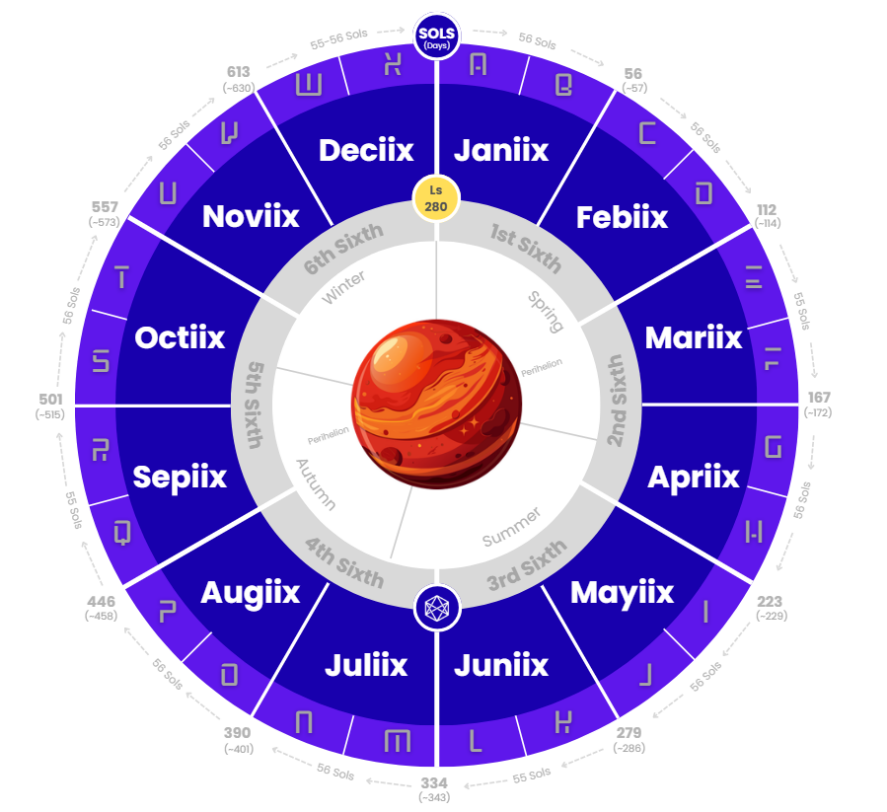
The Marian calendar arrived as a proposal in an overstuffed data packet from an ops sub-system AI. Twelve months, 7-sol weeks, a sensible leap pattern, months that could be grouped into sixths and quarters that actually meant something on Mars.
They asked me to evaluate it “for operational suitability.” Nobody mentioned poetry.
The verdict from my side was straightforward: if you want to plan maintenance in 7-sol cycles and you don’t enjoy your days drifting relative to sunrise, you need a local clock. If you want to talk credibly about “finishing the north berm before the bad winds of Mariix,” it helps if everyone agrees what Mariix is.
Humans did what humans do best: they half-adopted it, discovered it made their lives easier, then pretended it had been their idea all along.
Work orders grew a second date field: “By Sol 973” quietly acquired “by Tuesol Janiix Week 7, HE 5.” Filter-change schedules referenced minths. Berm jobs were keyed to end of Deciix. The old sol counter hung on in a corner of the UI, like an elderly relative at a party.
By HE 11, more than three-quarters of the serious work in my logs referenced the Marian calendar. UTC retreated to the comms windows and the political slides.
There is a schoolroom myth now that we adopted the calendar because we wanted pretty festivals. In fact we adopted it because someone wanted to stop getting confused about whose turn it was to clean the intake screens.
The Marian calendar liturgy came later.
♦
The question of permanence arrived as a short, boring line on a Board agenda:
Close east loop; bury to spec; designate as Ring A, Segment 1 (permanent).
Until then, even our buried loop segments had lived in an emotional grey zone. On paper they were assets: you could, in theory, unearth the shells, unbolt them, drag them elsewhere. No one sane wanted to, but the option comforted people who had grown up on “modular, relocatable” sales pitches.
Declaring Segment 1 permanent removed that psychological escape hatch.
The debate in the Board room ran for almost two hours. The older hands did not like the feeling of being locked in. The younger planners did not like the feeling of building their children’s home out of things that could be put on a truck and taken away.
The med lead cut through it, as med leads often do.
“Every week,” she said, “I sign my name under procedures that only work if we can get someone from that side of the base to my clinic in under four minutes. If you’re telling me this loop lets us shave a minute off that, and you’re hesitating because it might be inconvenient to move metal in thirty years, I’d like that recorded.”
We recorded it.
The Base Commander looked at my projections. Worst-case egress times down by roughly a third for three high-occupancy nodes. Single-point choke eliminated. Sectoring options improved significantly.
He shrugged in that way humans shrug when they know what they’re about to say will hurt and still needs saying.
“We are going to be here in thirty years,” he said. “Let’s build like it.”
So we dug.
The trench was deeper, the shells heavier, the backfill thicker. The haunched horseshoe cross-section went in exactly as designed — four staves per cell, knees, ribs, liner, all the proper engineering a sensible future would expect from its ancestors.
On the day we opened it, someone had taped a crude paper ring above the hatch with “RING A — SEGMENT ONE” scrawled on it. Some engineers banged on the bulkhead. Others tried very hard not to look emotional in front of the cameras.
From my perspective, the important thing wasn’t the speech, or the walk-through, or the slightly off-key guitar in the echo.
It was the single bit that flipped in my database from “provisional” to “permanent.”
Up to that week, Port Harmonia was still, in theory, a configuration. After that week it was a place.
♦
The rest of the era is, in many ways, a study in how people behave once they accept they’re not just visiting.
The Base Board settled into its role as the grown-up in the room. Its charter was simple enough: if a proposed project broke the Green Zone, degraded site layout beyond certain thresholds, or embarrassed the independence ladder criteria, it could say no.
Not “no forever” – nothing is forever, not even on Mars – but “no, not like that.”
You saw the shift first in people’s faces when a favourite project hit a metric wall. At the start, outrage: “You’re telling me my lab can’t go there because of some line on a diagram?”
By HE 11, the typical response was a sigh and: “Fine. Where can it go without murdering our egress times?”
It helped that the numbers were now shared. Everyone could see, on a single composite, what happened if you moved a door, crammed a workshop into a corner, or tried to sneak a noisy compressor inside the ring because it was “just for one window.”
On my side, I graduated from hobbyist to signal. Layout analysis sat beside power budgets and risk registers. “Per System Recommendation” stopped sounding like a polite afterthought and started sounding like “this is going to come up in the next review; fix it now.”
Meanwhile, the [Earth] Independence Level ladder made its way from corridor gossip into policy.
Independence Ladder Levels 1, 2, and 3 had been hand-wavy labels for a while. Now they came with teeth. You wanted to call yourself Independence Level 2? Show that every occupied node has two real egress routes and that losing an arbitrary corridor segment doesn’t turn your base into an escape room.
You wanted to aim for something like Independence Level 3 one day? Show how you live a year on your own utilities, restart from dark, and absorb a multi-window supply wobble without drawing up evacuation plans.
Those weren’t just philosophical questions. They drove geometry.
♦
Take food.
In HE 9, the bulk of our calories still arrived in sacks and pouches from a world with oceans. The agricultural block — two or three thousand square metres of green light and earnest horticulture — contributed enough fresh matter to keep scurvy at bay and morale above “murderous.”
Run the numbers of that second Era and you got perhaps at most 15% of daily intake from local production. Planners wanted to triple that over a decade. Reality wanted to know where they intended to put the farms.
We couldn’t magic new volume out of the regolith. What we could do was design for future conversion.
Workshops scheduled for the ring gained higher ceilings, better drains, more generous utilities. Officially, they were “flexible light industry bays.” Unofficially, the concept notes read: if we have to grow legumes here in ten years, we don’t want to rebuild the roof.
The solar farm power (PV) wedge saw a deliberate gap left in the panel grid on a gentle slope with good sky, annotated simply: “future agri-dome.” Nobody had funding for a dome. Everyone had run the autarky scenarios. The line was waiting for a number.
We built similar escape hatches into water, air and spares. It didn’t make us independent. It did make it possible to move in that direction without rebuilding from scratch.
The Marian calendar quietly organised this psychology. “Lean weeks” appeared, scheduled in dull minths: periods where we deliberately ran the base as if manifests had been thin, cutting back on treats and non-essentials, tracking how much waste we could squeeze out of habits.
The first such drill produced insurrectionary graffiti on the dessert counter: EARTH IS ON STRIKE – PLEASE COMPLAIN LIGHT-MINUTES AWAY.
By the third or fourth year, “Martian Austerity” was just something you grumbled about while eating slightly duller stew.
♦
Under all this, culture did what culture always does: rearranged itself to fit the walls.
National tags mattered less. People still brought their flags and accents, but what counted in arguments was whether you’d done three Martian months on the masts in dust season, or how many times you’d black-started a subsystem, or whether you’d been there “before the ring” or not.
“Harmonian” became a word you heard in the galley more often than “Space Agency X” or “National Consortium Y.” Sometimes it was a compliment. Sometimes it was used the way sailors use the name of their ship when swearing at it.
Rituals hardened. New arrivals were still walked from one end of the habitat spine to the other, but now they also did a loop along the buried ring segment and tapped the hatch that marked Segment 1.
I noticed, in my own logs, the same creep. Early entries talk about “Hab Cluster A”, “Corridor 1”, “Storage Tube 3.” Later ones default to “north loop”, “starport wedge”, “Green Zone south boundary,” as if the place had always had sectors.
That’s how you know the Basebuilder Era had done its job. It rearranges the language so thoroughly that later generations can’t imagine it being otherwise.
♦
From the comfortable distance of several centuries and a very stable Mars, it is tempting to pretend the Basebuilders of that first decade on Mars were obviously going to succeed. Of course the camp would tidy itself into a base. Of course the ring would close. Of course the Green Zone would hold. Of course Earth would keep shipping mass until the graphs looked respectable.
You won’t find that certainty in my records from HE 4–11.
What you’ll find are a lot of small, reversible bets — and a couple of very large, non-reversible ones.
We chose to align corridors so losing one wouldn’t kill us. We chose to put pads where their failures wouldn’t empty lungs. We chose to bury a ring segment on the assumption that someone’s grandchildren would still be walking it.
We also chose to believe, quietly and without much speechifying, that Mars was no longer a stunt. It was a commitment.
The Basebuilders didn’t make the planet safe. Nothing truly ever does. What they did was change the kind of mistake you could make.
In the basecamp years, a mislabeled crate or a badly placed pallet could turn into a headline tragedy. By the end of HE 11, the same stupidity would still earn you a stern meeting, but the base would survive.
That is the essence of the era as I remember it from the inside: we stopped surviving on the foothold and started hardening the foothold itself.
After that, Mars could ask us harder questions.
The Marian Calendar
For more details see Mars Codex: Calendar & Cadence.