
Era 8. Codex - City State Chronicles
113 to 137 HE Codex reflections from JB (2A*)
♦
By Year 113 of the Human Era, if Earth had vanished in a flash, most of us on Mars would have been hungry, frightened, and very annoyed – but alive.
Air loops would have kept breathing. Water fields out in the ice belts would have kept melting. Reactors would have stayed steadily bored. Farms under regolith roofs would have kept pushing out their steady tonnes of greens and grains, with fish loops sulking along underneath. We had stockpiles of medicines and chips measured in years, not weeks. The trains would have kept running. The hoppers would still have been late.
On paper, however, we were still somebody else’s project.
That was the tension that defined the City-State Era: a world that had already learned how to survive without its parent, but had never quite told the parent to stop signing its school forms.
♦
The Mars I saw in my logs at 113 HE bore very little resemblance to the base-camp days that still dominate school murals.
Port Harmonia in the west and Yínghuò Gate in the east had grown into proper cities – not just big bases but places with districts, commute patterns, population statistics, theatre listings and arguments about noise ordinances. Each hub and its surrounding satellites held somewhere between fifteen and twenty thousand people when you counted carefully; the planet as a whole probably sat above thirty thousand human residents, depending on how you treated long-duration transients and people “between” hubs.
Many of them had never seen an open blue sky.
Under regolith roofs, the pressurised world ran into well over a million square metres: residential caverns, stacked apartment blocks with light wells and balcony “streets”, industrial halls so large they felt like underground hangars, rail galleries where trains came and went with the regular clatter of an old-world metro system. A child could get properly lost now, which was a milestone the early planners had never dared to put in the public design briefs.
The coverage disks around each hub – seven hundred kilometres of direct surface connections and influence – had blurred into one another. Mining towns, tube communities, and industrial arcs stitched the gaps. Waystations that had once been glorified caches had grown restaurants and repair sheds. The Borealis Spine rail line had been running for long enough that timetable jokes had sedimented into culture and people could grumble about “the last train from Yinghuo” the way coastal cities once grumbled about ferries.
Technically, Mars was no longer an outpost. It was a small, messy, self-respecting world.
Economically, too, the balances had tilted.
We still imported the glamorous things: bleeding-edge processors, esoteric pharmaceuticals, certain niche materials that were cheaper to make in the soft, thick air of Earth labs. But the survival imports per head – food, water, fuel, basic spares – had quietly dropped toward zero metric tonnes per head. The bulk of our mass in trade went two ways: industrial kit, mining capacity, near-Earth asteroid services, metrology and standards work that the wider system had come to rely on.
An Earth-bound engineer designing a pressure door for a lunar tunnel or a Ceres depot would often find herself working from Martian specifications. A trans-Jovian survey droid flight planner scheduling rendezvous in the outer system would consult timing tables built in part on routines written in my own extended family. When you traced the provenance of the systems that kept other worlds habitable, you increasingly found red dust in the paperwork.
This was the background reality: materially, operationally, culturally, Mars had grown up.
Legally, it still lived in the limbo of adolescence.
♦
The documents that structured our formal relationship with Earth – charters, licenses, treaties, memoranda of understanding, and other species of negotiated fiction – had been layered on in waves.
Early on, the language had made a certain sense. Somebody had to own the launch pads and pay for the reactors. Somebody’s taxpayers needed to see their flag in the fine print. Agencies and consortia on Earth bargained for vetoes over the more exciting kinds of disaster: high-energy experiments, high-risk asteroid deflection contracts, anything involving weapons.
As decades passed and Mars’ capacity grew, sections of that old architecture had been patched or quietly ignored. We negotiated looser restrictions on local industry when it became obvious we could make our own mistakes. We updated liability clauses when the first near-Earth asteroid contracts went live. We retired the more patronising language as a matter of mutual embarrassment.
But in HE 113, startling fossil fragments remained.
An Earth-based commission still retained theoretical authority to halt certain categories of experiment in Martian labs – including, notably, anything involving full-scale constant-thrust fusion drives. Several nations claimed some right to tax profits from Martian mining on the basis that their ancestors had launched the first ships. Spectrum allocations, navigation codes and parts of the IP regime still treated the planet as an “extended region” of various Terran jurisdictions.
In practice, Mars was doing whatever it considered safe and sensible, filing polite notification packets afterwards. Technically, it was still bound to ask permission.
You can see the dissonance in my own annotations from the period:
“System assessment: Mars can ride out three consecutive bad Earth launch windows with non-lethal discomfort only. Political assessment: three committees on Earth retain the right to tell us whether we are allowed to test the engines that would reduce our dependence on those windows.”
We could refuse an Earth instruction in every practical way except the one involving ink.
♦
The emotional side of the equation was equal parts weary and sharp.
The generations who’d fought the Autarky battles and built the great grid of rails, hoppers and corridors had learned their habits in an era when a misplaced crate from Earth could still mean serious trouble. Their instinct, honed by hard years, was to keep their heads down, keep the pumps running, and let politics happen to them in slow, annoying waves.
The younger cohorts – the Martians born after the first big rail link, who had grown up assuming that trains always ran, that food always appeared, that days-of-cover were a thing you learned about in civics rather than something you personally sweated over – had different instincts.
They had friends in both hubs, or lovers who spent half their year in another city. They watched dramas shot in tube communities they’d never visited, and played low-g sports under brand names that belonged to Mars-wide leagues rather than to Earth corporations. Their history classes began with the Autarky years as local legend, not as remote heroic myth.
To them, the notion that someone in a faraway ocean world could still veto a mining contract in Erbus Ville or the design of a new power corridor in Yinghuo felt more insulting than reassuring.
At the same time, nobody sane wanted a clean break. Earth was not an enemy. It was the origin point of our ancestors, the main marketplace for many of our services, and home to millions of people whose only sin was being born under too much air.
The question, put bluntly in one of the quieter early assembly sessions and then endlessly rephrased, was this:
“How do we stop being someone’s project without making them our enemy?”
♦
The catalyst that turned that question from philosophy into policy came, as so many important things in Martian history do, disguised as an exercise.
Dark-Earth drills had been part of our technical doctrine for decades. We regularly simulated synods in which no ship left an Earth gravity well, no signals could be trusted, no spare parts arrived. We ran our own grid as if the sky had gone sullen: power, food, water, fuel, medicine, spares.
By the time of the City-State Era, a full dark-Earth drill barely raised an eyebrow in the industrial logs. People complained about postponed upgrades and slightly duller menus. The graphs did what they were supposed to do. The city stayed boring, which on Mars is the highest compliment.
What we had never done was extend the exercise beyond the pumps and rails, into the realm of charters, courts and councils.
In HE 115, a group of planners, jurists and slightly troublesome younger politicians proposed that we should.
The idea was straightforward enough to write down in a briefing note, and quietly radical in its implications.
For one full year, under controlled conditions, Mars would behave as if Earth were unable to answer the door.
No treaty revisions. No grand declarations. Simply a coordinated decision across Port Harmonia, Yínghuò Gate and the major towns that whenever a question arose which, by old habit, would have been referred to Earth for approval or clarification, the referral box would be left empty.
We would consult the existing agreements, consult our own safety doctrine, consult our own sense of self-interest, and decide on our own – while still sending Earth the usual torrents of data and polite updates, as if nothing unusual were happening at all.
It was, in effect, a rehearsal for being a city-state without anyone quite calling it that.
The proposal produced the expected reactions.
Veteran operators muttered darkly about tempting fate. Earth-based sponsors sent stiff queries about whether such an exercise would “prejudice existing obligations”. A certain kind of idealist, in both hubs, reacted with the enthusiasm of someone who has been waiting all their life for an opportunity to replace a noun in a constitutional sentence.
My own initial note on the subject was characteristically joyless:
“Technical risk: manageable. Political risk: non-trivial. Epistemic value: high.”
After several months of argument, amendments, guarantees and a certain amount of theatrical sabre-rattling in distant capitals, the first Civic Autonomy Drill was authorised.
Mars, as was now its habit, wrote the date into the calendar.
♦
From the console side, the first weeks were unremarkable.
Air quality remained firmly dull. Water extraction rates at the ice belts ticked along within the usual bands. The agricultural wedges logged their yields, a few percent up or down depending on which disease had recently discovered the joys of closed-loop hydroponics. The power graphs stayed satisfyingly flat.
The interesting curves were in the meetings.
A mining town in the northern arc wanted to expand its operations into a zone that, according to one of the older, dusty treaties, required clearance from a specific Earth-based environmental commission. Under the terms of the drill, the local council consulted its environmental impact models, its safety doctrine, and a thick stack of precedent from similar projects elsewhere on Mars. Then it voted, with appropriate conditions, to proceed.
Port Harmonia’s health authority proposed a new public health protocol for mental-health screening in certain jobs, drawn on data that had never existed in the early sponsor era. The old framework suggested consultation with terrestrial medical boards. The drill said: write your own standard, publish it, and invite Earth to adopt it if they liked.
Yínghuò Gate’s research cluster, long frustrated by the glacial pace of approvals around high-energy testing, submitted its first full-scale constant-thrust fusion rig for local review and acceptance under conditions that were, by any reasonable measure, more stringent than those imposed downwell – but designed in Mars’ own image.
Each time, the crucial shift was not in what we decided to do – in almost all cases, the technical outcome matched what an honest, well-briefed committee on Earth would eventually have agreed to – but in who we treated as the final court of appeal.
Instead of saying “we are waiting for permission”, the language in minutes, reports and newsfeeds shifted to “we have decided; Earth has been notified”.
In my logs, I tagged each such instance in a separate layer. Within six months, the city display walls could show a time-lapse in which Mars’ centre of gravity – in the abstract sense – moved visibly inward.
That is what a city-state looks like in its moment of becoming. Not fireworks. Not barricades. A bureaucratic heat map inching from “elsewhere decides” to “we do”.
♦
For the first few months, Earth’s official reaction was dignified confusion.
The data packets kept arriving. The pumps kept running. No one declared independence. But here and there, minor committees noticed that resolutions were arriving as faits accomplis rather than as proposals. Some of those committees complained. Others, grateful to spend less time arguing over Martian safety margins they barely understood, quietly archived the updates and adjusted their own documents to match.
The first real flashpoint came when a multi-world standards organisation, headquartered in lunar orbit and staffed by serious people who took a very dim view of improvisation, noticed that the safety codes for near-Earth asteroid deflection contracts had been updated on Mars without going through the usual ratification labyrinth.
Their response was textbook: a strong letter, several pages of procedural argument, and a hint that until this matter was resolved, Martian firms might find it difficult to bid on certain lucrative contracts.
The reply that the Mars Assembly drafted – with a number of droids, including myself, brought in as consultative ballast – was polite and, in its way, revolutionary.
It conceded nothing on safety, pointing out in excruciating technical detail that the Martian codes were stricter and better-tested than the older Earth-based versions. It invited the standards body to send observers, auditors and even hostile experts to examine the data. It explicitly reframed the relationship:
“We consider it in the interests of all human worlds that safety standards in this domain converge toward the strictest viable version. We therefore invite your organisation to adopt, adapt, or critique our framework. What we cannot accept is a situation in which the planet that will bear the brunt of any miscalculation is also the one denied final authority over how those calculations are made.”
That sentence did not appear in many news summaries at the time. It is now engraved, somewhat over-dramatically in my view, on at least one civic building’s lobby wall.
♦
By the midway point of the drill year, something subtle had happened in interior life.
For most citizens, the change was barely noticeable. Wages cleared. Trains ran. Festivals were held on schedule. The usual arguments about housing allocations, noise levels, school catchments and queue-jumping filled local feeds.
But the background hum of deference shifted.
Educators updating civics curricula stopped framing certain topics as “international law we must obey” and started presenting them as “agreements we have entered into” – a noun swap that looks trivial until you watch a cohort of twelve-year-olds absorbing it.
Lawyers, never ones to waste an opportunity, began experimenting with new forms of argument in Martian courts: not “the treaty says we may not” but “does this treaty clause, signed generations ago in a different context, still meet our survival obligations and our civic values?”
Even in the messiest corners – the tube communities and industrial towns that had long considered politics something that happened to other people – you could hear the new pronouns in jokes.
“We did this” instead of “they made us do this”. “Our regulations,” when grumbling about a safety ban, instead of “their regulations”.
From my perspective, tuned as I am to count doors and flows and bad decisions, the most interesting part of that year was how little else changed.
No sudden collapse of discipline. No dramatic overruns in risk. A handful of mistakes, corrected in the usual untidy fashion. A few impulsive proposals bounced by local boards with a firm, “We may be in charge of ourselves, but we’re not idiots.”
It turned out that a society built on decades of survival training did not, when given the keys to its own paperwork, immediately drive itself into a wall.
♦
When the year ended, there was inevitably a summit.
Delegations from Earth arrived via the usual spin-cyclers and orbital transfers with speeches prepared and lawyers briefed. Martian representatives came from PH, YG, tube-towns, mining arcs, research hubs, and the thick layer of institutions that had grown between them: rail authorities, harbor boards, health councils, standards committees, civic assemblies.
I sat in the back of yet another large, echoing chamber, my output split between live support for the Martian side and a separate, quieter process annotating the meeting for some future historian, who has turned out inconveniently to be me.
If you read only the official communiqué, you would conclude that very little happened over those weeks.
The real shift had already taken place, quietly, during the drill. The summit simply made it visible enough that even distant capitals had to admit it.
By the time the first cups of reheated coffee were poured, it was obvious to anyone paying attention that the old settlement – “dependent region with extended privileges” – no longer described reality. The question was no longer whether Mars would be treated as a self-governing world, but on which terms.
The City-State Era had its catalyst.
The rest is detail on how we turned that catalyst into charters, courts and, eventually, a planet that could say “no” without flinching and “yes” without asking permission.
But that belongs to the more detailed codex.
The Marian Calendar
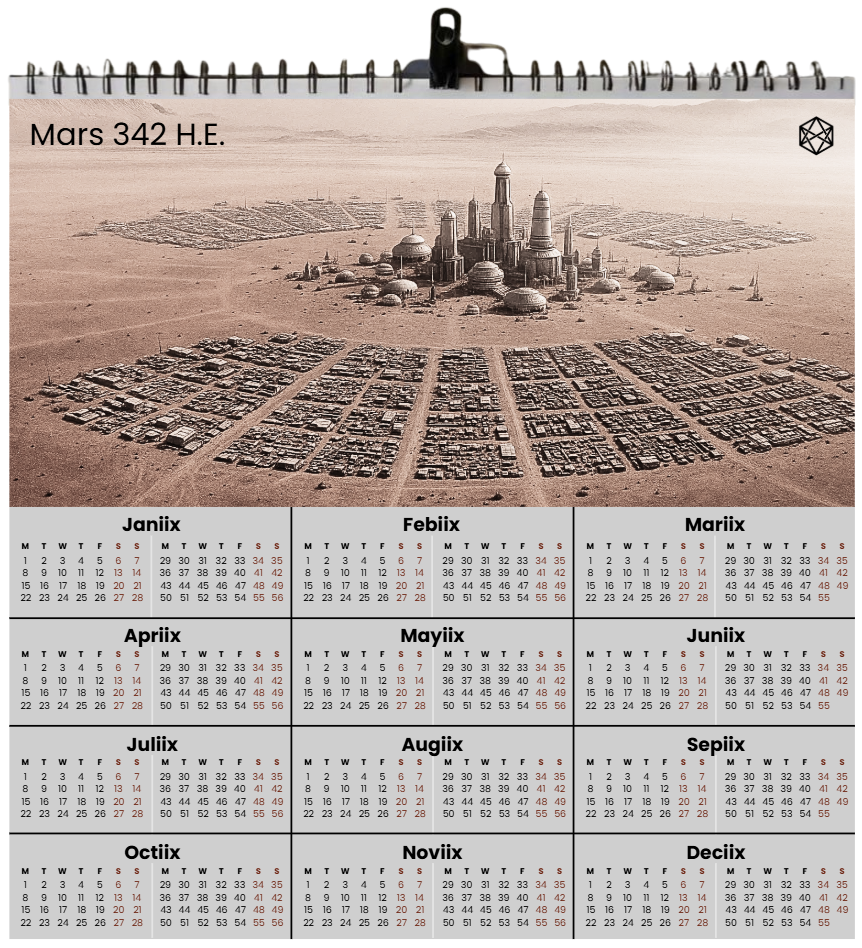
For more details see Mars Codex: Calendar & Cadence.