
Era 1. Facts – Encyclopedia Galactica
The Basebuilders | ~2044-2051 | 4-11 HE
TLDR: The Basebuilders era covers the transition from an overgrown expedition camp to a deliberate early outpost. Cargo mass per window rises into the low kilotonne range, and for the first time the hardware being landed is sized for a future town rather than a single crew. The key shift is conceptual: Port Harmonia begins to adopt a conscious spatial grammar—spine, ring, wedge, Green Zone—backed by Independence Levels and early layout scores. By the end of HE 11, the base is no longer just “whatever we bolted on last window”; it is a planned hub with a permanent Ring A segment, an engineered starport, and a layout designed to survive future shocks, not just the next dust storm.
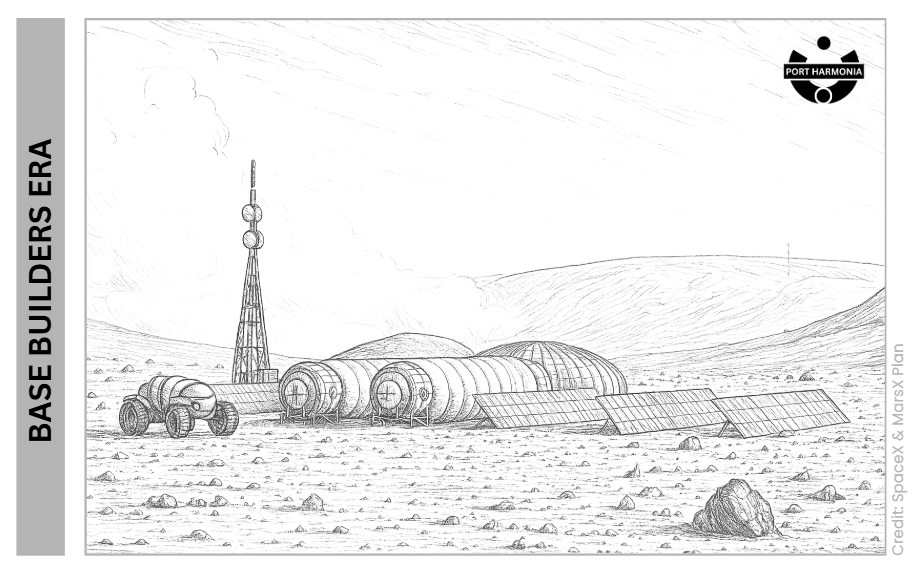
Main location: Port Harmonia, Arcadia Planitia
Stage (internal): From mid S1 “Base Camp Hub” → early S2 “Outpost Tribe Hub” (≈ IL-1 → IL-2)
Population: Peak ~80–100 at once. Total humans landed low hundreds; < 250 individuals
Era soundbite: Camping → base camp
Core question: Can we stop improvising and turn a safe camp into a base that strangers can inherit?
Core result: Camping becomes base camp. Months of continuous habitation with the basics actually used and the first repair loops closing the gap between “brought” and “made.”
Daily feel: Basics actually used; first repair loops close; hygiene moves from poster to practice.
Era Challenge: Stop living window-to-window on improvised layouts and crates from Earth; build the first deliberate backbone foundations — corridors, wedges, utilities, and cadence — that can one day carry thousands, even though you only have a few dozen and 95% of your mass still arrives in cargo holds. It’s where Mars stops being “camping with rockets” and starts pretending to be a city.
Era Accomplishments: Era 1 upgrades expeditionary ops to a lived-in base camp. Crews sustain continuous presence for months, run the environmental backbone without drama, and prove they can mend what breaks using local tools and prepositioned kits. Hygiene, incident command, and maintenance rhythms move from posters to practice. It’s still fragile, still supply-tethered, but the daily experience becomes routine: checklists are followed, spares are tracked, and the first “we fixed it here” stories start to stack up.
Survival Backbone Reliability: Environmental control and power run steadily through normal hiccups; boring handovers (solar → storage → genset or equivalent); small black-start steps rehearsed. Stable uptime charts; fewer nuisance alarms; preventative maintenance on schedule; root-cause notes tied to fixes.
Make–Mend–Multiply: (Local Production & Repair Depth): Working repair bench + light fabrication (seals, brackets, hoses, simple machined parts, printed adapters); calibration/QA documented. Shortening repair turnaround; in-house parts catalog with revision control; improving first-pass yield.
Food & Bioprocess Sufficiency: Flown rations primary; dependable water recycling; pilot ag/bioprocess modules produce meaningful supplements and practice sterile ops. Menu plans flex to pilot outputs; contamination monitoring with occasional drill recalls; basic reagent prep practiced.
Mobility, Storage & Logistics Resilience: EVA and rover ops support weekly tasks in marginal conditions; storages show clear days-of-cover; async comms + local timebase keep ops coherent during link drops. Labeled buffer dashboards; spare rover/suit check cycles; tested abort routes; cargo layouts minimizing single-point handling.
Economic Momentum & Trade Fit: Export = reliable data, tested procedures, validated small-scale ISRU/repair methods; partners commit to repeat campaigns that save money/time. External reuse of SOPs; follow-on contracts with specific deliverables; early service exchanges with other programs.
Gov. & Steward: Incident command is real; shifts, permits, escalation are followed; decisions/exceptions logged and reviewed. Clean handover notes; safety meetings that adjust SOPs; visible roles during drills; near-miss reporting without blame.
Health, Biosecurity & Care Culture: Routine health checks; quarantine windows around biotraffic; waste/water protocols enforced; wellness/sleep guarded as performance factors. Donning/doffing compliance; sentinel surface/air sampling; rest policies honored even under schedule pressure.
Talent, Training & Team: Cross-trained crew with ≥2 operators per critical task; drills/sims precede first-time ops; after-actions feed a live playbook. Skill matrices with coverage; mentorship pairings; night shift equals day shift; rotation schedules that actually recover people.
Identity, Story & Attraction: Grounded narrative: continuous ops for months; used these procedures; made/fixed these items—with receipts. Earned media from verifiable demos; consistent naming/signage; visitors/applicants citing published logs and guides.
Allies, Capital & Partnership Readiness: Small portfolio of aligned partners; diversified vendors for critical kits; MoUs sized to base-camp reality with clear interfaces and exit ramps. Terms avoiding exclusivity on essentials; sandboxed standards; graceful deferrals of misfit asks; staged funding tied to ops milestones
The Mars Grid System
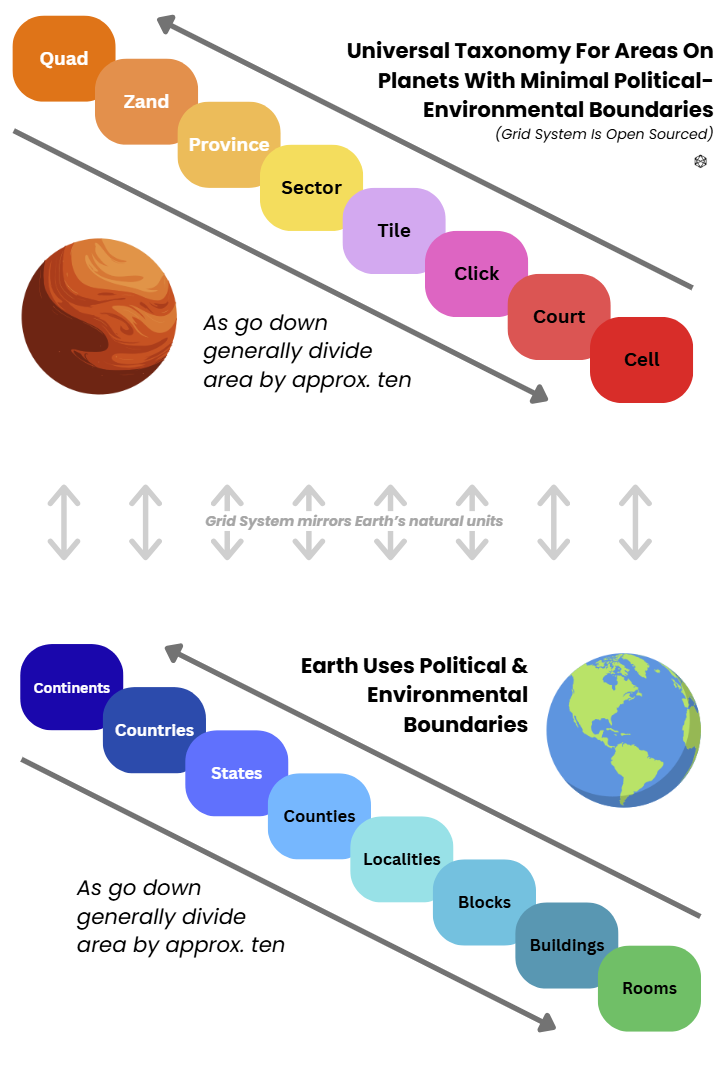
For more details see Mars Codex: Surface & Settlement