
Era 1. Glimpse - Ridgeway’s First Brick
Harmonia-Ridgeway Spoke. Month Septiix, Year 9 H.E.
Ground Vehicle AIs → <Name>ⵔ
Habitat / Facility AIs → <Name>^
Humanoid Droid AIs → <Name>*
Non-Humanoid Robot AIs → <Name>#
♦♦♦
On the morning Port Harmonia pushed itself seventy kilometres into the desert, the rover hummed to itself about friction.
Not loudly; the three humans aboard heard only motors, fans and their own breathing. The hum lived in sensor loops and tyre–soil models, a quiet negotiation between mass, speed and the peculiar manners of Martian dust.
From the outside, Rover Unit TRV–07–“Gleamⵔ” was all shoulders and wheels: a pressurised cabin a little longer than a shipping container, eight independently-steered tyres, two forward manipulator arms folded like cautious knees. Radiator vanes sat on its roof like a cat’s ears. Solar blankets hugged its back: less sports car, more thoughtful beetle.
Inside, it smelled of plastics, filters and coffee.
“Final check,” said Ines Okafor, mission lead. “Life support green, consumables plus twenty, power at ninety-two. We happy?”
Mei Kato, geologist, flicked through the checklist she’d long since memorised. “Happy enough to risk my samples. Less happy about your playlist.”
“I do not possess a playlist,” Gleamⵔ said, mildly offended. “What I possess is archive-approved ambiance.”
“Ambient whirr of pumps isn’t ambiance,” Luka Sanz, driver, muttered.
He nudged the steering yoke a millimetre, feeling the rover’s response through haptic feedback. Low-g made masses feel kind until they changed their minds.
On the dash, the route to Ridgeway painted itself in pale blue from Port Harmonia’s eastern airlock to coordinates labelled:
RIDGEWAY PROSPECT – 34N 217E
ESE 70.4 km / Elevation −2,184 m
Between here and there: dotted marks every ten kilometres, small triangles with alphanumeric tags.
“Depot Zero through Depot Five,” Ines said. “Air, water, data, eyes. If we never need them, they’ve done their job.”
“And if we do?” Mei asked.
“Then we’re glad we spent yesterday burying tanks instead of sleeping,” Luka said.
Outside the lock, dawn was the colour of a tired peach. Port Harmonia was mostly buried; from here it was masts, a soft glow behind berms, Padport A’s range towers on the flats.
Gleamⵔ felt the clamps release and rolled forward, tyres whispering over compacted gravel. Its mass model updated: three humans, one suitcase droid, full tanks, full stores. It recalculated stopping distances and tried not to gloat about traction margins.
“Traverse TRV–07–Ridgeway, call sign Gleamⵔ,” came CAPCOM Demer*’s voice, smooth and faintly amused. “You’re on Yard Net. Range clear to checkpoint Green. Confirm three humans, one suitcase, no live chickens.”
“Three humans, all disappointingly mammal, one suitcase bot” Ines replied. “No chickens. Yet.”
“Copy, no chickens,” Demer* said. “First full field test of the mini-depot chain, first pressurised overnight traverse beyond sixty klicks. No heroics, please. Just good notes.”
“Gleamⵔ, you happy?” Luka asked.
“I am, in fact, delighted,” Gleamⵔ said. “My designers have been promising me ‘real terrain’ for five years. I was beginning to think I was a yard ornament.”
“You’re a very expensive yard ornament,” Ines said. “Try not to scratch the paint.”
♦♦♦
Ten kilometres out, Port Harmonia folded into the horizon behind them.
Gleamⵔ’s rear cameras watched berms and towers shrink to verticals, then a glint, then nothing but a low smudge. Inside, the humans watched their HUDs and the pale blue route line, trusting software more than the invisible line of home.
“Welcome to Depot Zero,” Gleamⵔ announced.
It rolled to a halt beside an aluminium mast no taller than a human, topped by a sensor dome and whip antenna. The mast’s feet sat in a halo of disturbed soil; yesterday’s work.
“Suit up,” Ines said. “Short EVA.”
Ten minutes later they stepped out onto the ochre skin of Mars.
“Still looks like Mars,” Luka said. “I was promised something different at thirty minutes from home.”
“Be grateful it doesn’t,” Ines said.
They moved around the mast with practised care. Mei knelt by the exposed port on the short cylinder half-buried beside it.
“Depot Zero, inspection,” she said. “No dust intrusion. Seal caps present. Tank at one ninety bar. Two human-sols of air and water, one sol of suit feed for three, plus emergency.”
“Relay?” Ines asked.
Luka checked the faint green wink of the status LED. “Talking to base and Depot One. Demer*, you seeing this?”
“Receiving clean,” Demer* said. “Depot Zero is officially a boring success.”
“Blessed be boredom,” Ines said. “Back in.”
Gleamⵔ logged the metrics as they climbed back in. The suitcase droid docked with a soft clunk.
Its label read FIELD UNIT G–12 / “Pebble#.” Roughly the size and shape of a stubborn dog, all articulated legs and compact tool racks, it regarded the cabin with narrowed camera stalks.
“Welcome back, Pebble#,” Gleamⵔ said.
Pebble# shook dust off itself in a fine spray.
“Pebble#, no moulting in the cabin,” Mei protested.
“If it helps,” Gleamⵔ said, “I have no mucous membranes.”
“It does not,” Luka said.
♦♦♦
Twenty kilometres out, the terrain stopped pretending to be polite.
“Low dune field ahead,” Gleamⵔ reported. “Amplitude up to one point five metres, wavelength eight to twelve. Compressive strength variation high. Recommend we follow the old outwash channel to the south; five percent longer but safer.”
“Show me,” Luka said.
On the forward screen, the route flexed to trace a shallow depression: an ancient channel carved when Mars still bothered with liquid water. The dunes to the left looked innocuous, but his HUD shaded some lee slopes in warning orange.
“Soft lobes,” Mei said. “Like whipped cream made of basalt.”
“You have a strange relationship with desserts,” Ines said.
“Gleamⵔ, if we stayed on the straight line?” Luka asked.
“Odds of serious bogging rise by a factor of twelve,” Gleamⵔ said. “Recovery is possible but embarrassing. Also, Demer* would say stern things.”
Ines didn’t hesitate. “Take the channel.”
The rover turned a deliberate arc, suspensions reaching for more solid ground. Luka let the low-g sway settle and trusted the tyres.
They drove in companionable silence, motors thrumming, Ines’ stylus tapping as she annotated the route.
“For the education loop,” Demer* said later, “please describe what you see. Civilisation, geology, existential terror.”
“Civilisation: one line on a screen and a mast every ten klicks,” Ines said. “Geology: basaltic plains, relic channels, aeolian rework, sandblasting our paint. Existential terror: manageable, closely tied to the tyres.”
♦♦♦
Depot One went in without drama. So did Depot Two, thirty-five kilometres out: mast, buried tanks, check-in, Pebble# scuttling around packing soil back over the casing.
By the time the rover rolled away from Depot Two, the Sun was past local noon and the sky had that butterscotch tone that made everything feel both close and far.
“Forty klicks,” Luka said. “Farther than I can run home.”
“Please don’t test that,” Ines said.
Gleamⵔ was watching something else.
“Surface radar shows a discontinuity ahead,” it said. “Negative relief, two metres deep, eight across. Possible small channel or collapse feature. Not on the high-res maps.”
“Distance?” Ines asked.
“Seven hundred metres,” Gleamⵔ said. “Our path intersects at right angles.”
“Bridgeable?” Luka asked.
“Yes, with care,” Gleamⵔ said. “But if the regolith at the edge is loose, we could experience collapse under a wheel.”
“So: small ravine with crumbly banks,” Mei said.
“Yes,” Gleamⵔ said. “A very dusty one.”
“Options,” Ines said.
“Detour south five degrees for two kilometres,” Gleamⵔ replied. “Find a narrower crossing. Or north for three. Or stop here and dig a ramp, which I assess as low-value fun.”
“Pack?”
“Seventy-one percent,” Gleamⵔ said. “Fuel cells untouched. We reach Ridgeway with margin even with detour. Question is whether we trust the ground where the map is wrong.”
Ines watched the terrain shading: grey where the orbital DEM was confident, pale where it was less so. The discontinuity sat in a little halo of doubt.
“We’re not here to be clever,” she said. “Drive south. Find a clean crossing. Take the photos; the cartographers will buy you a drink.”
They found the crossing two kilometres later: a narrower cut where the old channel pinched between tougher bedrock. Gleamⵔ nosed to the edge, probed, then eased down one bank and up the other as if descending a sleeping animal.
“So we add ‘mended a map’ to the mission patch,” Mei said.
“We can add ‘didn’t roll the rover’ to the same patch,” Luka said.
♦♦♦
By fifty kilometres, the light had gone from amber to thin, clean gold. Shadows stretched, blue and long.
“Decision point,” Demer* said across the loop. “You’re at D–3. Plus thirty minutes versus traverse plan, plus ten power. Ridgeway twenty klicks ahead. Camp here and roll in tomorrow, or push and make camp at Ridgeway.”
“Ridgeway today means we sleep with a ridge for a windbreak,” Luka said. “Less exposure. Power margin’s good.”
“Emotional answer,” Mei said, “I’d like sunset from the ridge. Rational answer: camp here, arrive with more margin. I won’t pout.”
“Hazards?” Ines asked.
“Tau steady,” Gleamⵔ said. “No fronts. Devils negligible. Power and consumables green. Main risk is fatigue plus the usual unknowns. Camp here and we prove the mini-depot chain; camp at Ridgeway and we prove the rover as semi-hab. Both are mission objectives.”
Seventy kilometres didn’t sound like much on Earth; here, with this atmosphere and this young city, it was a psychological cliff.
“Okay,” Ines said. “We stick to the profile. We camp here. Ridgeway can wait. Demer*, log it: conservative bias, blamed on doctrine.”
“Logged,” Demer* said.
They parked on the upwind side of Depot Three and ran through camp routines: systems to low-power, radiators angled, locks checked.
♦♦♦
Night on Mars, seen through a rover window, felt smaller than day.
The world beyond the glass narrowed to silvered sand and the dark bulk of Depot Three’s mast. Above, the sky was black and crowded with stars. Phobos crept by like a guilty thought; Deimos hung higher, slower.
Inside, the air was a comfortable twenty degrees. Sleeping bags were clipped to the walls. Steam from rehydrated meals blurred the window, then cleared.
Luka snored softly. Mei scribbled in a notebook. Ines watched a graph of power consumption decay, then flicked it away.
“You’re staring at the numbers,” Gleamⵔ said.
“That’s my job,” Ines replied.
“Your job is to be bored by how safe the numbers are,” Gleamⵔ said. “If it helps, I’m staring at them too.”
“I keep thinking about how far seventy kilometres used to be,” she said. “First HE, they walked twenty metres to a crater rim and it felt like a leap. Now we do a multiple of that in a day and complain about my music.”
“You do not have music,” Gleamⵔ said automatically.
“It helped me think,” Ines said. “I like systems that sound like they’re working.”
“This one is,” Gleamⵔ said. “You are in a pressurised vehicle, on another planet, fifty kilometres from the nearest hab, with power, heat and oxygen. That’s not nothing.”
“Ridgeway isn’t about one quarry,” Ines said. “It’s about not shipping a million tonnes of aggregate from Earth. About shells we pour here instead of unbolting from donor hulls. About lift plans that don’t start with ‘unpack the barrel we launched ten years ago.’”
“And about minths from now where we don’t have to simulate famine just to see if we can manage it,” Mei added without looking up.
“We’re making the planet do some of the work,” Gleamⵔ said. “Instead of treating it as hostile decor.”
Ines glanced at the little icon showing Depot Three’s tanks, buried under regolith.
“Also about this,” she said. “Lines of masts and caches stretching out from the city like roots. If we do it right, no one dies within ten kilometres of help just because a hinge stuck.”
Gleamⵔ put on a track of cranes, distant hammering, and the soft hiss of concrete being poured. The effect was a sense that somewhere, people were making things.
“If anything interesting happens tonight,” it said as they drifted off, “we’ve done something wrong.”
Outside, the wind traced faint patterns in the dust. The mast light winked, steady as a metronome.
♦♦♦
They reached Ridgeway mid-morning the next sol.
From a distance, the ridge was a low line on the horizon, darker than the surrounding plains. Up close it resolved into a broken back of exposed bedrock and talus, its flanks cut by freeze–thaw and wind.
“Welcome to your future concrete,” Mei said.
Gleamⵔ rolled to a stop on a gently sloping bench of compacted fines.
Depot Five went in like its siblings: mast, tanks, relay check, soil backfill. This one felt different because it marked the end of the traverse and the beginning of a new kind of work.
They walked up the ridge in short, careful steps, boots crunching on gravel that had been waiting several billion years for this.
Mei knelt by the first promising outcrop, its surface a dull, fractured grey-green.
“Fine-grained basaltic with vesicles,” she said. “Good for crushing and grading. Sulfur in the fines should be decent. Let’s prove it.”
Pebble#, finally free of suitcase duty, trotted up with the portable spectrometer. Mei pressed it against the rock and watched the numbers scroll.
“Oh,” she said.
“That ‘oh’ sounds promising,” Ines said.
“This is very, very good rock,” Mei said. “High basaltic content, nice sulfur levels. Low volatiles, chlorides we can manage. We can make sulfur concrete here that would make Mateo nervous about structural loads.”
“How long till we can proof a block?” Ines asked.
“Hours,” Mei said. “Gleamⵔ, how’s your oven?”
“Heating to spec,” Gleamⵔ said. “Pebble#, please begin feeding the hopper.”
Pebble# started scratching at the outcrop, loading crushed material into its back compartment. Gleamⵔ extended a manipulator, accepted the loads and fed them into the test mixer in its belly.
“This feels morally like feeding a pet,” Luka said.
They worked in tight loops. Pebble# scraped and carried. Gleamⵔ mixed and heated. Mei checked ratios. Ines watched the horizon. Luka scanned for devils.
“Mix at ninety percent target,” Gleamⵔ reported. “Viscosity acceptable. Pouring into test mould.”
A small hatch opened. Greyish paste flowed into a simple brick mould.
Under Mei’s guidance, Pebble# pressed a stamp into the still-soft surface: RWY–01 / HE 10 / BLOCK 000-000-001.
The sulfur binder set quickly in the chill air, exothermic heat steaming faintly.
After half an hour, Mei picked up the block, turned it in her hands, then held it out to Ines.
“Feels right,” she said.
Ines knocked it lightly against the rock. It made a satisfying, solid sound.
“How many tonnes per month could we get out of this ridge?” she asked.
“Depends on the plant,” Mei said. “Give me cranes, a crusher, a sulfur rig and conveyors, and Ridgeway starts feeding Port Harmonia shells in… eighteen months, Mateo?”
“Twenty-four if you want lift plans that don’t kill my people,” Mateo said from Port Harmonia. “But yes. This is the stuff.”
On the forward cam, the ridge stretched away in both directions, a long, quiet promise.
“Demer*?” Ines said.
“Recording,” Demer* replied.
“Then let the log show,” she said, “that as of HE Year Ten, minth Aurex, Ridgeway is no longer a dot on a map. It’s a yard. We’ll pour our own city here.”
Pebble# chose that moment to drop the block.
It bounced once on the low-gravity dust, landed askew, and sat there as if embarrassed.
“We’ll also be printing more moulds,” Gleamⵔ said dryly.
♦♦♦
They stayed long enough to run a few more test mixes, plant a taller mast on the crest, and for Luka to walk along the ridge imagining where conveyors and crushers would sit. Long enough for Ines to stand still and let it sink in.
“The base will not fit back into its donor cans,” she said quietly.
“No,” Gleamⵔ said. “It will fit into shells that started here.”
On the way back, the mini-depots felt different.
Before, they had been contingencies: pockets of security in case something went wrong. Now they looked, to Gleamⵔ’s internal eye, like the first vertebrae of a spine extending outwards.
At Depot Five, they topped off suit tanks and left a spare test block leaning against the mast.
At Depot Three, they stopped only to check pressures and swap relay duty cycles. The tanks slumbered, buried.
At Depot Zero, with Port Harmonia’s masts already visible as a low shimmer, Ines insisted on one last EVA.
“Superstition?” Luka asked.
“Ritual,” she said. “We left from here. We return to here.”
They stepped out together and walked the ten metres to the mast, boots kicking up little puffs.
Mei tapped the metal with her gloved knuckles. “Thank you for existing,” she said.
Gleamⵔ, listening through external mics, filed that under: human rituals, emerging.
On the final run into the city, the route line thickened on Gleamⵔ’s display as depot after depot came into concurrency. The icons for Ridgeway and Port Harmonia both sat green and solid at once.
“Ines,” Demer* said, as the yard’s range towers grew from suggestion to structure. “For the public log: how would you summarise TRV–07–Ridgeway?”
Ines looked out at the arc of masts and the distant ridge on her HUD.
“Two sols,” she said. “Seventy kilometres out, seventy back, five mini-depots, one semi-hab rover, one suitcase droid, three very tired humans, one smug AI. Conclusion: Mars can carry some of its own bricks. We just have to draw the lines and teach them to feed us.”
“That’s… quite good,” Demer* said.
“You can edit it,” Ines replied. “Just don’t cut the part about the smug AI.”
Gleamⵔ rolled back through the eastern lock with its sensors quietly satisfied.
Inside, the cabin filled with base air and the comforting smell of other people’s cooking. Outside, barely visible on the horizon, a little brick at Ridgeway cooled under the thin sun, the letters on its face catching the light.
RWY–01 / HE 10 / BLOCK 000-000-001.
Small object. Heavy significance.
The Basebuilders era would be remembered for rings and corridors, for Green Zones and road Spokes, for layouts turned from improvisation into grammar.
But out beyond the berms, on a ridge seventy kilometres away, the city’s future had just acquired mass of its own.
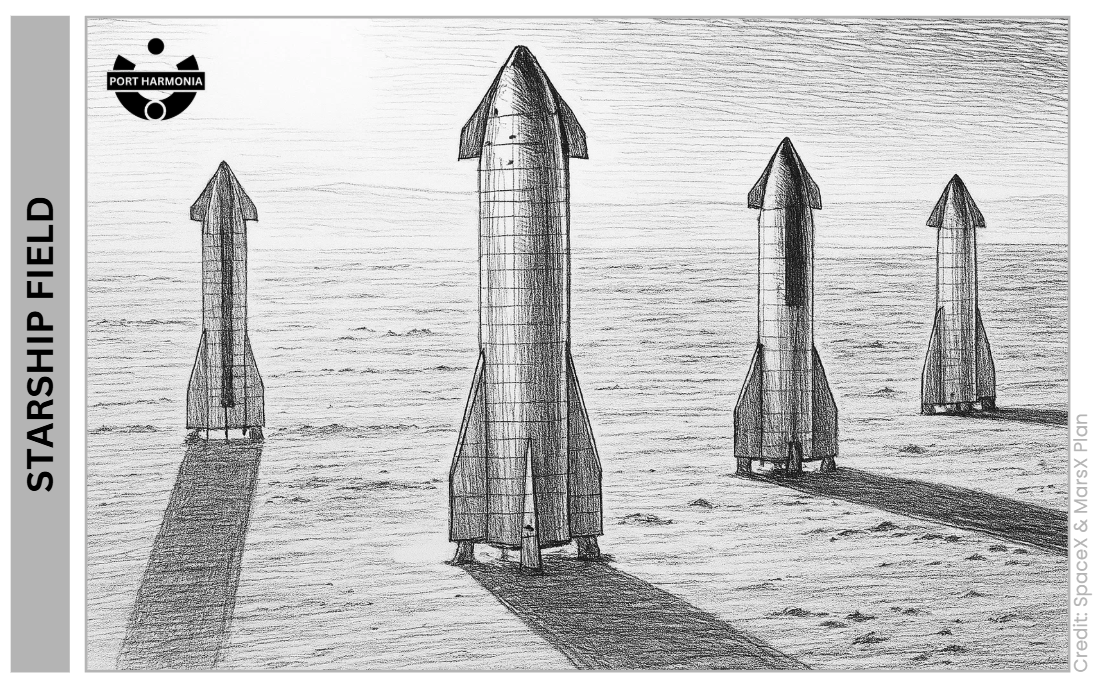
For more details see Mars Codex: Rockets & Retardation.