
Era 3. Facts – Encyclopedia Galactica
The Pioneers Era | 2060-2070 | 20-30 HE
TLDR: The Pioneers decade marks the shift from foothold to footprint. Port Harmonia ceases to be a “plant wrapped in bunks” and becomes a coherent small town under stone: Ring A is functionally complete, radials connect a strict Green Zone to industrial wedges, and spokes to Boreal, Solaron, Ridgeway and Acheron feel like truck routes, not expeditions. Food, water, power, ISRU fuel and basic manufacturing are no longer experiments but routines with KPIs and boredom. Earth begins to treat Mars as strategic infrastructure; Mars begins to treat itself as somewhere people live. On Earth, “Pioneer of Mars” becomes a meme and a status symbol; on Mars, the same people are just trying to keep hydroponic lines productive, pad ops predictable, and operating plans synchronised with drills.
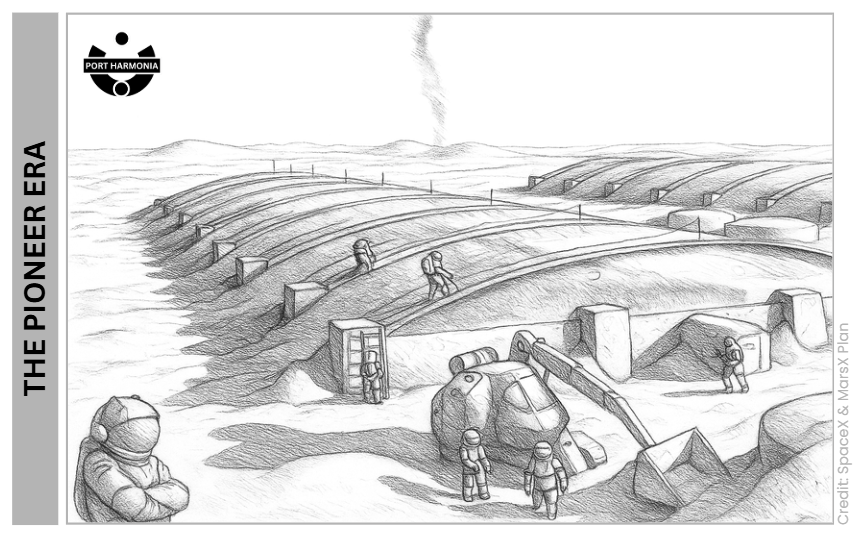
Main location: Port Harmonia and inner satellites (Boreal, Solaron, Ridgeway, Acheron), Arcadia Planitia; Yínghuo Gate (Utopia/Phlegra) appears as a second hub on the horizon
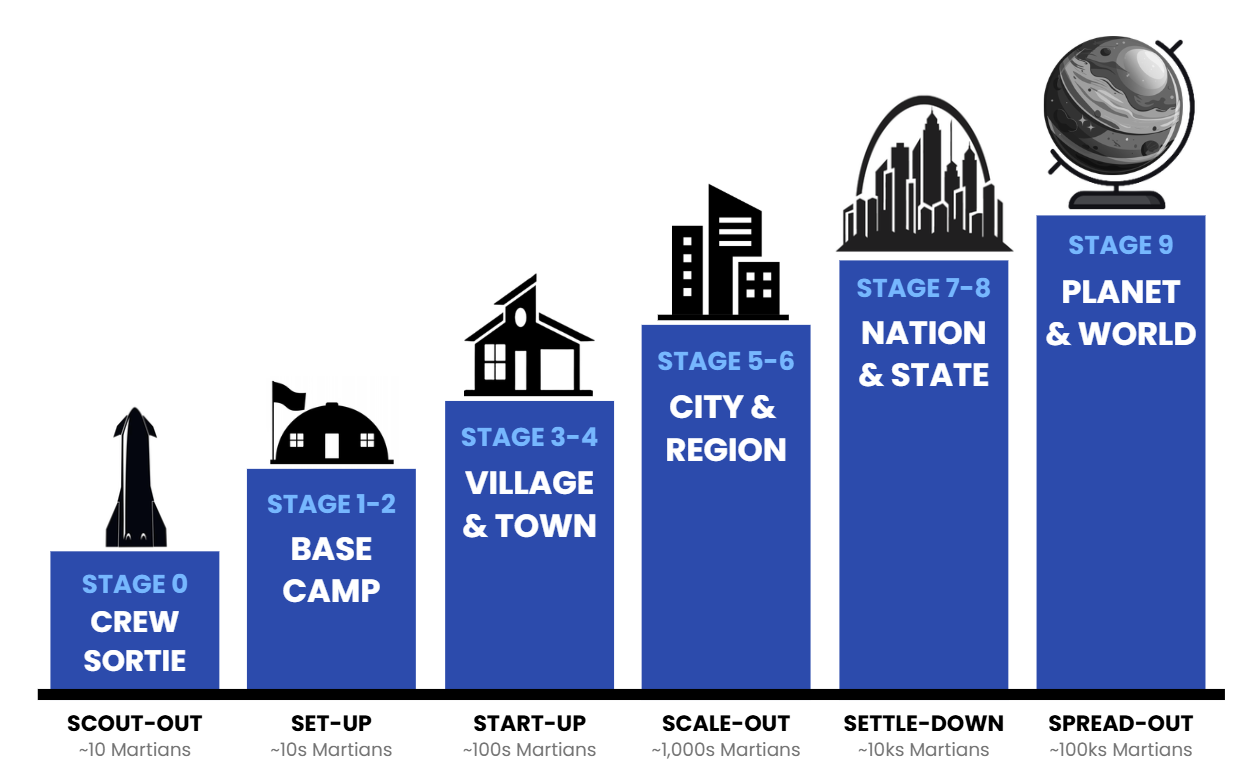
Stage (internal): From S3 “Start-Up / Village” → early S4 “Town Hub”
Population: Peak ~750–1,000 at once toward the end of the era. Total humans landed >1000s cumulatively
Era soundbite: A year on local utilities
Core question: Can we turn a survival-capable outpost into an organised, multi-node small town where people can realistically plan to live, work, and raise children?
Core result: A full year on local utilities. First black-start is on record; medicine moves from “we hope” to “we can”; the daily feel shifts from scramble to schedule.
Daily feel: Planned black-start on record; clinics say we can; schedule replaces scramble.
Era Challenge: Turn a hard-won, survival-capable outpost into an organised, growing settlement with its own recognisable “Martian operator” ethos – and do it just as Earth starts to believe the dream and demand a future that Mars is not quite ready to host. This is the tipping-point decade: the basic questions – can we live here at all, can ships come and go mostly on ISRU fuel, can we keep the lights on through bad years? – now have cautious “yes, if we’re not idiots” answers. The work shifts from “don’t die” to “build something worth living in and worth continuing.”
Era Accomplishments: Era 3 is the turn from expeditionary routine to lived reliability. The backbone runs for a year on local utilities without drama; a planned black-start has been executed and documented; clinical capability covers baseline surgery and urgent care with practiced protocols. Autarky deepens to “noticeable”—roughly a quarter of survival-critical needs are handled locally by habit, not heroics. Fragility stretches from hours to months: issues surface, are triaged, repaired, and folded back into procedure.
Survival Backbone Reliability: Year-scale stability on local utilities; planned black-start completed end-to-end with clean after-action; storm-season ops feel routine. Uptime charts flat and boring; shrinking maintenance backlog half-life; alarms consolidated and de-noised; ride-through targets met.
Make–Mend–Multiply: (Local Production & Repair Depth): Workshop beyond patches to repeatable part production with QA; jigs, fixtures, basic metrology; small batch runs are normal. Versioned in-house parts catalog; first-pass yield tracked and improving; repair turnaround in hours/days, not shipments.
Food & Bioprocess Sufficiency: Two dependable modalities contribute meaningful calories and micronutrients; sterile handling and recalls practiced and trusted. Menu planning resilient to module downtime; cold-chain audits pass; reagent/vaccine spin-up pathways rehearsed.
Mobility, Storage & Logistics Resilience: EVA/rovers support scheduled work across seasons; buffer dashboards cover months for essentials; async comms/timebase coherent through link outages. Storage trendlines stable or rising in stress periods; predictable spare vehicle/suit rotations; egress drills include civilians and techs.
Economic Momentum & Trade Fit: Repeatable services/outputs others plan around (procedures, manufactured spares, data products); early internal markets appear. Renewing contracts tied to SLAs; unit-level margin tracking; price signals guide workshop priorities.
Gov. & Steward: Decision-making and escalation work under pressure; audits/post-mortems change behavior; leadership rotates without process amnesia. Permits/lockouts enforced; visible exception logs; charter clauses invoked and sunset.
Health, Biosecurity & Care Culture: Baseline surgical/urgent-care on-hub; outbreak drills pass under load; quarantine windows culturally normal, not resented. Resident-readable sentinel dashboards; second-nature PPE/zone discipline; mental-health rota in ops planning.
Talent, Training & Team: Coverage for all critical roles with cross-training; apprenticeships produce new operators; night shift equals day shift. No red cells on skill matrices; sims precede first-time tasks; structured handovers; SOPs updated from learning.
Identity, Story & Attraction: Credible story: a year on local utilities, deliberate black-start, safe clinics—with logs to prove it. Earned media citing receipts; visitors observe drills; consistent naming, signage, and public dashboards.
Allies, Capital & Partnership Readiness: Partners align to cadence; diversified vendors for critical consumables; sandboxed interfaces and exit ramps in agreements. Milestone-based funding tied to operational proofs; joint drills with partners; refusal of exclusivity creating chokepoints
The Settlement Stages
For more details see Mars Codex: Surface & Settlement.