
A7. More About Mars’ People
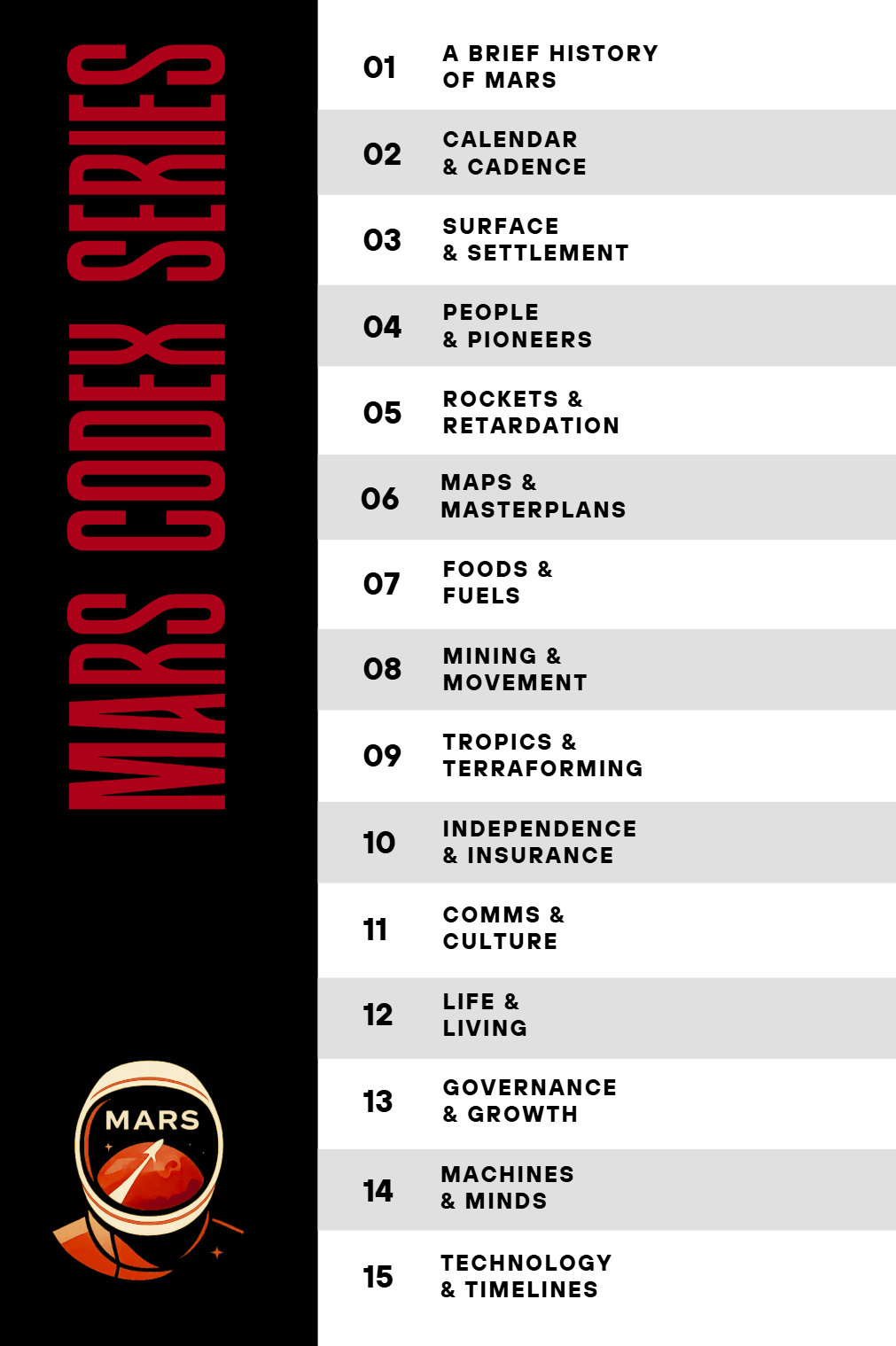
Mars Codex: Culture & Comms
Cultural Evolution:
What culture develops? Does "Martian culture" emerge distinct from Earth cultures? When?
Language evolution - New terminology, slang, expressions unique to Mars?
Art, music, storytelling - What creative expressions emerge from Mars life?
Rituals and traditions - First Mars holidays? Coming-of-age ceremonies? Death rituals?
Religion and philosophy - How do existing beliefs adapt? New spiritual movements?
Diaspora threads - Families across 3–22 light-minutes
Cultural imports - What persists? what localizes?
Becoming Martian - When origin stops leading?
Mars Codex: Life & Living
Individual Human Experience:
Who goes and why? What motivates someone to leave Earth forever? Economic opportunity, idealism, escape, adventure, or desperation?
What kind of person survives and thrives? Psychological profiles, skills, temperament - are pioneers self-selected or carefully screened?
How do people change on Mars? Identity shifts from "Earthling on Mars" to "Martian" - when does that happen?
What do they sacrifice? Family, Earth experiences (ocean, rain, forests), health, years of life span?
What do they gain? Purpose, legacy, frontier freedom, being "first," new opportunities?
Social Dynamics:
How do communities form? Crew selection, natural clustering, conflict resolution, social hierarchies
What creates division vs unity? Earth nationality vs Martian identity, old vs new arrivals, competing visions
Romance and families - How do relationships work in isolated, high-stress environments? First Mars-born children?
Leadership and heroes - Who emerges as leaders? What defines a "Mars hero"?
Conflict and crime - First murder? First theft? How is justice handled?
Practical Daily Life:
What's daily life actually like? Beyond survival - hobbies, entertainment, social life, boredom
Work and purpose - Career paths on Mars, economic roles, finding meaning
Education - How are children raised and educated? What do they learn that Earth children don't?
Health and medicine - Living with reduced gravity, radiation exposure, psychological stress
Death and dying - First deaths, burial practices, memorial traditions
The Controversial Questions:
Selection ethics - Who decides who goes? How fair is the process?
Class stratification - Do wealth gaps from Earth transfer to Mars? Get worse? Better?
Failure and tragedy - People who couldn't adapt, mental health crises, suicides
Exploitation - Are settlers pioneers or corporate labor? Who profits from their work?
Mars Codex: Governance & Growth
Generational Shifts:
The Mars-born generation - How are they different from Earth-born settlers? Physically? Psychologically?
Generational conflicts - "Old Mars" pioneers vs newcomers vs Mars-born natives
When does independence become inevitable? What sparks the shift from colony to autonomous society?
Legacy and memory - How do pioneers want to be remembered? What stories get told?
Pivotal Moments:
First birth, first death, first wedding - These milestone humans and their stories
Crisis moments - Near-disasters that define the community's character
Turning points - When does the settlement cross from "outpost" to "society"?
The independence generation - Who pushes for autonomy? Why? What do they risk?
Generational comparison - Which families track across decades?


Postscript
DON’T PANIC.
This Codex is a theoretical preconstruction — a fictional-nonfiction assembled from the latest advanced designs, near-term interpolations, real astro-mathematics, and tested operational practice. Readers may judge viability for themselves. Further supporting materials are archived periodically online.
It was set down to describe what has been learned, ameliorate current designs and to extrapolate what works. In doing so it seeks to sidestep the biases of academia, politics, corporations, and the personal egos of would-be architects of the future. It is not complete or static.
If it also reads like half instruction, that is not an accident. The Codex’s creator works contemporaneously under a mandate to reduce failure and raise the odds of a durable multi-planetary human-machine society. Any steering here is stewardship, not command.
Read this as a fictional history if you like; understand it was written as a nonfictional manual designed to help you live across many worlds.
As to the Codex author’s real nature — human or artificial — the record is silent by design. That, like their ethnicity, religion and gender, is a matter of privacy. Maybe they aren’t even one discrete entity. It is merely their hope that this Codex inspires the next generation of engineers and operators.
SpaceX