
2. Mars Settlement Stages
I used to keep a strip of tape across my chest panel that said, in slanted marker: evidence, not vibes.
It was a joke until it wasn’t.
On Mars in the Founding Century, progress that couldn’t be demonstrated had a habit of failing at midnight. So when people asked the deceptively simple question — How far along are we? — we learned to answer with things you could point at: drills passed, loops closed, parts remade, clinics that worked, stores that held. Out of that discipline, the Mars Settlement Stages took shape.
They weren’t handed down by a committee with a logo. They accreted. Operators needed a way to talk to medics; medics to planners; planners to funders and journalists without lying. A soft taxonomy with ten stages emerged: clear enough for citizens, disciplined enough that an auditor or a tired engineering lead could nod without wincing.
We borrowed Earth’s language and filed it until it matched Martian life. If you like slogans, the stages condense into five moods:
Port Harmonia leaned toward “Scout-Out (the location)”, “Set-Up (basic infrastructure),” “Start-Up (ongoing operations)” “Scale-Out (self-sufficiency),” “Settle-Down (mature community),” “Spread-Out (planetary expansion).”
Yinghuo Gate favored “Base” 基地 (Jīdì), “Town” 镇 (Zhèn), “City” 城市 (Chéngshì), “Region” 区域 (Qūyù), “Country” 国 (Guó), and so on.
When we compared notes, we discovered we were saying the same things with different jackets. So we kept both — a bilingual sign over the same stairwell. But under the mood were results. That was the point.
♦
The habit formed early. Our first seasons on Mars were a parade of honest questions disguised as milestones. Can we breathe on our own kit for a week without waking the genset? Can we restart clean after a planned dark? Can apprentices close the loop without the wizard in the room? Can a patient walk out of a clinic that isn’t on Earth? When a dust pall drags noon toward evening for a fortnight, does the pantry yawn or shrug?
These are not headcount questions. They are capability questions. People numbers and cargo mass are interesting — sometimes comforting — but they don’t keep anyone warm. A hundred untrained hands can worsen a maintenance backlog; a single metrology bench can shorten it. So the stages avoided numeric gates. We shared indicative ranges elsewhere; here we kept the yardstick narrative and testable. “Show me where it runs.” “Show me where it broke — and how you repaired it.”
This made conversation possible across Port Harmonia’s Western style and Yinghuo Gate’s Eastern practice. Different catalogs, different signage, same evidence posture. When a Yinghuo bioprocess supervisor said, “We passed a true recall drill under load,” everyone knew what that meant. When a Harmonia grid dispatcher said, “Black-start held to target with variance shrinking,” it meant the same thing in both hab domes, whether the switchgear was a refurbished antique or a prototype with the paint still curing.
♦
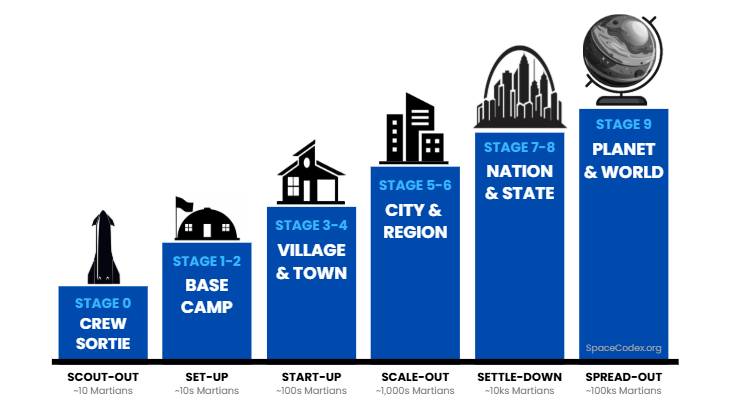
Settlement Stages — Fast Map
Stage | Alias / Hub Type | Sound-bite | Daily feel (one line) |
S0 | Scout-Out | Land, breathe, drink, go home. | Scripted sorties; thin buffers; leave receipts for the next team. |
S1 | Set-Up | Camping → base camp. | Basics actually used; first repair loops close; hygiene moves from poster to practice. |
S2 | Set-Up Plus | Thin buffers, real routines. | Local power/water carry load; pilots teach sterility; quarantine windows kept. |
S3 | Start-Up | A year on local utilities. | Planned black-start on record; clinics say we can; schedule replaces scramble. |
S4 | Start-Up Plus | Make → Mend → Make again. | True line appears (fixtures + metrology); outbreak drill passes under load. |
S5 | Scale-Out | City-grade competence. | Component-level electronics repair; pediatrics/OB on-hub; multiple food modalities. |
S6 | Scale-Out Plus | Rebuild here, not import. | Reconstitution of core kit; months off-grid rehearsed; standards bite. |
S7 | Settle-Down | Generational continuity. | Ninety-day dark-Earth drills are boring; governance survives personalities. |
S8 | Settle-Down Plus | Two worlds, no dependence. | Dissimilar stacks by design; planet-alone weeks routine; trade optional for survival. |
S9 | Spread-Out | Lose one, don’t regress. | Travel feels like inter-country life—slower, pricier, ordinary. |
What follows steps through the ten stages in order — each a fragment you can read between maintenance windows. Same grammar each time: the sound-bite we used, and the feel of daily life. No dates, no promises about how fast any of this “should” happen. That belongs elsewhere. Here we stay with the lived rungs.
♦
Stage 0 — Scout-Out (“Crew Sortie”): Year 0 - 4 Human Era (HE)
You arrive with theory in your pocket and leave with receipts in your hands. The backbone is a proof, not a grid: air that holds, water that clears, power that hands itself off without a theatrical flicker. Make–mend–multiply is field craft: patches that pass a hand-lens inspection, adapters that fit because someone measured twice with cold fingers. Food is flown; a benchtop bioprocess runs for discipline more than calories. Mobility is expeditionary; egress paths are walked until they’re boring. Governance is incident command on one page, readable through a visor. You clean as if the next crew were family, because they are. This is the Mars that Mark Watney would recognise — just with a dozen more people.
♦
Stage 1 — Set-Up (“Base Camp”): Year 4-11 HE
Camping becomes base camp when the systems stop asking for applause. The backbone learns to ride through everyday clumsiness — filters changed on schedule, not smell; handovers that put no one’s heart in their throat. The bench earns a calibration sheet and begins replacing “brought” with “made” in small, honest ways. Water comes around again; a pilot tray of greens moves from photo to menu. Stores are counted as days-of-cover, not vibes. On the soft side the place grows a spine: permits mean something, quarantine windows become social facts, and every critical task has two names, both current.
♦
Stage 2 — Set-Up Plus (“Outpost”): Year 11-20 HE
Routines gain mass. The backbone runs through minor insults without waking its keepers; alarms are fewer and truer. Make–mend–multiply shifts from novelty to habit: the “we can make that here” list is long enough to sort, still short enough to embarrass you. Two distinct food/bioprocess modalities feed planners rather than press releases; a recall drill is tedious in precisely the right way. Mobility stretches to a weekly radius in all weather; warehouses become ledgers you can read at a glance. Culture catches up: near-misses are confessed because correction is kinder than shame; night shift matches day shift on charts and gossip.
♦
Stage 3 — Start-Up (“Village”): Year 20-30 HE
The place begins to carry its own payroll of power, air, water, and care. The backbone stops being a stunt and becomes a service: ride-throughs during dirty weather are uneventful; maintenance backlogs shrink instead of being renamed. The bench graduates to small batch: fixtures, jigs, and metrology produce parts that go straight into operations with yields you can defend. Clinics say can — urgent care and baseline surgery on-hub — with escalation paths that do not assume a friendly uplink. Inside the fence, an economy appears: certified work orders, real lead times, workshop hours priced against their own backlog. Governance grows teeth and manners at once.
♦
Stage 4 — Start-Up Plus (“Town Hub”): Year 30-43 HE
“Town” sounded grand; what it meant was reproducibility. The line answers “yes” twice in a row and the second part fits better than the first. Make–mend–multiply is now a real machine-shop sequence — mills, lathes, finishing — with a parts catalog that talks to maintenance. Yields rise because process control is no longer a theory; materials have provenance, not rumor. The backbone tolerates seasons without mood swings. Public-health discipline leaves the lab and enters the lobby: outbreak drills run end-to-end with civilians named in the script, and the word quarantine loses its drama and keeps its dignity. Mobility, storage, and comms settle into redundancy that feels like courtesy rather than overkill.
♦
Stage 5 — Scale-Out (“City Hub”): Year 43-63 HE
“City” never meant skyline; it meant breadth you could walk. The shop smells permanently of cutting oil and quiet pride. The backbone is city-grade: outages are orchestrated, swap cycles live on calendars, and trend data tells you what to change before it breaks. The bench steps into machine-tool bootstrap — fixture libraries, heat-treat, finishing — and electronics repair moves beyond board swaps to component work. Food and bioprocess diversify so a single pump failure changes menus rather than morals. Clinics add pediatrics and OB with calm pathways. The culture resets: boredom is praise — drills kept, alarms rare, night shift equal without pep talks. Exports become a rhythm: certified parts, repairs, data, method — never at the cost of starving the backbone.
♦
Stage 6 — Scale-Out Plus (“Region Hub”): Year 63-89 HE
Rebuild here, not import. Draw a circle around your life and keep it intact. Planned off-grid intervals execute cleanly; buffers hold or rise during stress. Make–mend–multiply crosses the reconstitution line: pressure boundaries, pumps, valves, seals, structural stock, and useful-node semiconductors are produced or repaired locally with documented yields and substitutes. Schools harden into standards bodies; apprenticeships reliably produce operators; succession becomes an exercise, not a eulogy. Partners work on our interfaces and cadence; agreements come with exit ramps we practice using. The ledger shows exports; the calendar shows maintenance first.
♦
Stage 7 — Settle-Down (“Country Hub”): Year 89-113 HE
Generational continuity is a soft phrase for hard rituals. The proudest machines are clerical: archives that retrieve on first query; ladders that erase red cells in the skill matrix; calendars that refuse to schedule over sleep. The backbone rides long darks on procedure alone; residents can point to the local timebase with their eyes closed. Reconstitution behaves like a process industry — recipes, fixtures, metrology, yields — legible to auditors and comprehensible to new apprentices. Governance stands alone: chartered powers with sunsets; appeals that change outcomes; decisions written for citizens rather than connoisseurs. Public health becomes culture; quarantine windows are kept the way festivals are kept. “Country” fits because borders of law and interface are now our own.
♦
Stage 8 — Settle-Down Plus (“Bi-planetary Resilience”): Year 113-137 HE
Two worlds cooperate without dependence. The backbone on each stays boring when links blur; planet-alone weeks are kept like holidays with good manners. Make–mend–multiply forks by design: dual recipes and fixture sets; on-planet re-qualification of imported designs so no fashionable machine becomes a civilizational monoculture. Food and bioprocess carry mirrored competence with dissimilar strain banks. Mobility and comms diversify routes and standards; exchanges are asynchronous and signed. Trade becomes conversation rather than umbilical — specialty parts, data, music, method — good to have, never needed to breathe.
♦
Stage 9 — Spread-Out (“Multiplanetary Public Normal”): Year 137HE +
The public stage is the absence of spectacle. Visas, flights, audits, clinics; families choosing worlds the way ancestors chose cities. Mars is open to Earth as Earth was to itself — pricier, slower, ordinary. Underneath, the architecture refuses to rhyme in dangerous places. The backbone on each world remains dull through cross-system shocks; reconstitution is drilled from two-planet bases with the solemnity once reserved for parades. Make–mend–multiply carries triangulated variants so faults cannot propagate by fashion. Finance and law diversify their rails; standards that touch survival are narrow, auditable, and revocable. It feels less like triumph and more like manners at scale: a plural civilization that keeps its differences on purpose, because sameness is the fastest way to fail together.
♦
Read across the stages and you can feel the civilization expand from a crew space to a camp, to a village, to a town with a line, to a city with breadth, and then outward — carefully — to region and country. The measures that matter deepen in parallel: backbone reliability that grows dull; make–mend–multiply that becomes a process rather than a stunt; biosecurity and care that move from lab to lobby; governance that survives personality; mobility and stores that cushion the void; economies that pay for resilience first and trade second. The map gets larger only when the ledger is ready.
♦
I have been accused, fairly, of loving checklists. It’s not romance; it’s survival. The stages look simple when printed on a wall. Underneath, they run on gears — ten lenses that let different professions see the same place and speak one language without flinching. Here’s the casing opened, briefly and usefully.
Ten criteria did the heavy defining for Settlement Stages for those that didn’t just go on vibes — five we called Hard (physical and economic momentum), five Soft (institutions and culture that make momentum repeatable). They were lenses, not KPIs: ways to look at the same settlement and see where it was strong and where it needed tutoring.
Critically they also worked for our Earth Public Relations team. And that helped. A lot.
The Hard five were the backbone, the bench, the belly, the movement, and the money.
Survival Backbone Reliability. Power, pressure, water, shelter. Not just when the sky is polite, but when it isn’t. Ride-throughs that look boring. Black-start sequences rehearsed until they lose their drama. Uptime charts with variance that makes engineers yawn.
Make–Mend–Multiply. The alchemy of turning a broken thing into a working one with parts you can prove. From printed adapters and hose ends to a proper line with jigs, fixtures, metrology, and first-pass yields that stop apologizing.
Food & Bioprocess Sufficiency. Calories, micronutrients, reagents, sterile habit. Multiple modalities so that one pathogen or pump hiccup doesn’t make dinner theoretical. Cold-chains that are trusted because recalls sometimes happen and they work.
Mobility, Storage & Logistics Resilience. The choreography of moving people, goods, time, and data. EVA that’s honest about traction. Warehouses with days-of-cover you can read in a single glance. A local timebase and asynchronous comms so that when the link wobbles, work doesn’t.
Economic Momentum & Trade Fit. The humility of selling something others actually buy twice: certified parts, repairs, data, training — never at the cost of starving the backbone that makes it possible.
The Soft five were the guardrails, the clinic, the school, the story, and the handshake.
Governance & Stewardship. Powers with sunsets. Permits that bite and appeals that work. Decisions logged in plain language. Audits that change behavior.
Health, Biosecurity & Care Culture. Quarantine windows treated as civic ritual, not punishment. Sentinel checks explained to residents. Drills with civilians, not just the bold. Mental health as a performance variable, not an afterthought.
Talent, Training & Teamcraft. Two names for every critical task. Apprenticeships that produce new operators. Night shift equals day shift. After-actions that update the SOPs, not the rumor mill.
Identity, Story & Attraction. A narrative grounded in results with receipts — clear names, public dashboards, festivals of competence. People arrive for the mission, not the stipend or the brochure.
Allies, Capital & Partnership Readiness. Multi-home vendors; sandboxed interfaces; term sheets with clean exit ramps. The maturity to say “not yet” to a glittering offer that would make tomorrow fragile.
This decagon of Martian dimensions let us describe any settlement hub with the same grammar. A later chapter will hang numeric anchors on these (people ranges, production throughputs, buffer tonnage targets). Here, we keep it narrative and honest: “What life feels like” at each stage, what results an Earth leader can ask to see, and what traps we learned to name out loud.
♦
Two instruments proved better than one. Independence Levels (IL-0…IL-9) are the instrument of record — auditable gates you pass with checkrides and signatures. They govern insurance, emergency compacts, and inter-agency strategy without drama. Settlement Stages tell the story of how a place feels and behaves day-to-day. Between them sits the MIS (Multiplanetary Independence Score), a continuous 1000 point dial beloved by statisticians; it shows whether you’re improving evenly. ILs unlock power and money; MIS kept planners honest; and stages helped citizens understand. When those instruments sing in tune, work gets funded, drills stay real, and press conferences start having an Earth-wide impact.
♦
We learned to package a stage on one page. “Stage cards” kept a fixed order: the sound-bite, a short paragraph of daily feel, ten one-line signals and traps, and a set of receipts a resident or a skeptical journalist can request without making enemies. If the card says “outbreak drill passes under load” and yours didn’t, you don’t argue adjectives; you schedule the drill and fix the prep. When the card is wrong — and sometimes it is — you change the card, loudly.
♦
Used inside government, the stages kept arguments focused. At S2, councillors ask about quarantine windows; at S6, they grill standards on substitutes and dissimilar stacks; nobody gets to grandstand for a fifth grow modality just because a festival wants pretty salads. Used in planning, the stages stop unforced errors. Capital is sequenced so hard and soft mature together. Exports wait until outbreak discipline is proven in public. Donors with fleets of identical loaders are thanked and gently redirected to the museum.
Earth-relations (ER) liked the stages because they cut hype with receipts. “Where are you?” — “Stage 3 Village on the backbone, late Stage 2 Outpost on biosecurity; black-start passed; recalls worked at pilot scale; civilians yet to drill.” Interviews got shorter; budgets got longer.
♦
Two traps haunted us. Correlation: mirrored software, synchronous firmware, single suppliers that win every tender because their interface feels kind. Correlation kills by convenience. We fought it with dissimilar pairs where it matters, staggered updates, dual vendors, and the rude habit of revocation drills that unplug the pretty system and insist we keep breathing.
Theater: paper drills, dashboards with artistically falling lines, recalls that “would have worked.” Theater feels good until it doesn’t. Survivable places make boredom honest: drills on calendar, after-actions with public deadlines, exceptions logged where residents can see and ask unwelcome questions. When those rituals start feeling like festivals, culture has grown teeth.
♦
Real settlements are lumpy. Yinghuo ran years ahead on public health; Harmonia sprinted on make–mend–multiply. The stages don’t punish the asymmetry; they reveal it so trade and training can flow along the gradient. We learned to publish the shape quarterly. Pride got kinder; help got easier.
♦
Stages don’t end arguments; they focus them. At S3 a warehouse boss can say, “We need aisle redundancy and a second lift; ‘single door/lift’ is a known trap; here are the near-misses.” That ends with a budget line or an honest refusal. At S6 a standards chair can say, “We won’t accept a miracle press; the card demands substitutes; bring two machines with two stacks.” That ends with a safer shop or a disappointed vendor, not a wish.
We also measured drift: a short monthly audit — five receipts per criterion, sampled without warning. If two months in a row the receipts contradict the card, the card changes or the budget does. Once, a nameplate factory had to post its rework rate in the public library until the chart bent. They sent me cookies when it did.
♦
Partnership manners improved with maturity. At S4 we ran joint outbreak drills with visitors inside the script and no VIP exemptions. At S6 we wrote exit ramps into contracts and rehearsed using them before anyone was angry. By S8 we required asynchronous, signed exchanges across worlds and treated synchronous rollouts like a controlled substance. Friendships stayed warm; interfaces stayed cold.
♦
Why keep it public? Because legibility is a safety system. People who can see what keeps them alive behave better under stress. When residents know the drill schedule and the days-of-cover on their way to the canteen, rumors lose their glamour. When a councillor can point to a stage card and a receipt instead of a myth, meetings get shorter and sleeping gets longer.
And because stories outlast checklists. The ladder taught schoolchildren how to spot the difference between a working base and a brochure — a civic literacy we never regretted teaching. The day a twelve-year-old asked a visiting dignitary why their favorite vendor pushed synchronous firmware to both planets on the same day was the day I permitted myself a laugh.
♦
From here the codex tilts toward people. Next we’ll hang numbers on the wall — composition by stage, the balance of core and civic adults, the deliberate admission of minors — because mix is destiny. Then we’ll meet the cohorts who made the stages real: pioneers and builders, same job under different weather; engineer-operators who ran boredom at scale; hygiene-minded logistics poets who kept recalls dull; QA zealots who treated gauges like scripture; medics who measured culture in hand-washing; fledgling governors who learned to wield power with sunsets — and to give it back.
Stages are scaffolding. People make the building.