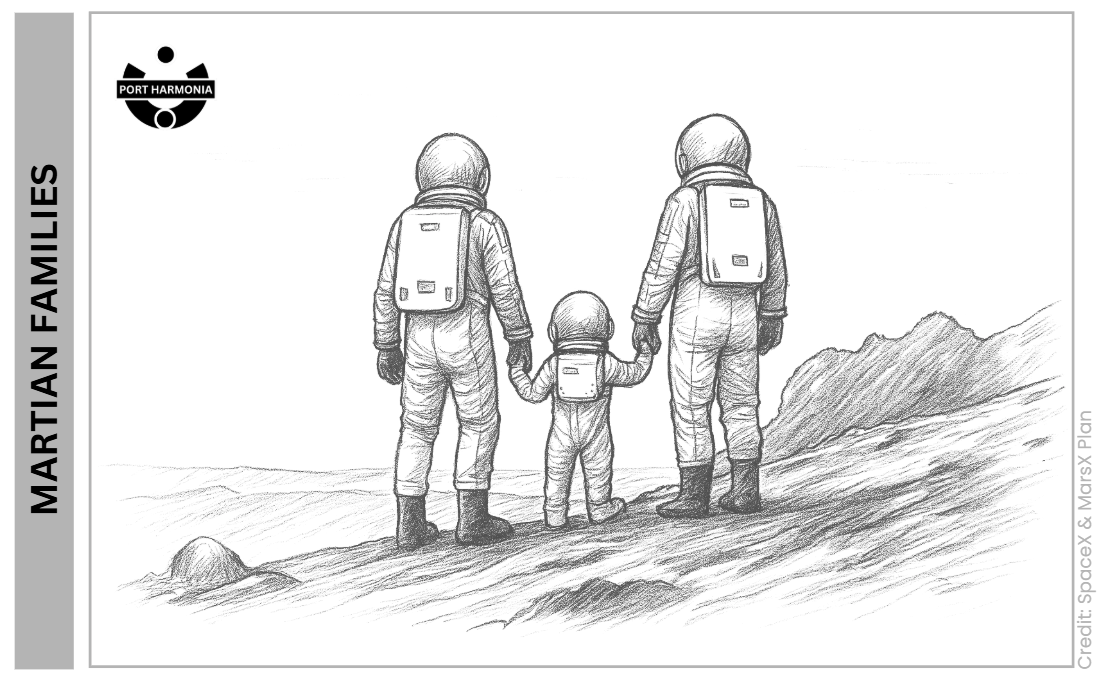
27. Horizon Two Emigration Explosion
I was present when the first constant-thrust fusion liner made Earth–Mars feel like a well-timed breath.
Present as in: my processes booked its corridor slot, cross-checked the quench curves on a 100-tesla nozzle, and reminded the steward to plate meals with lids because at half a g soup acquires dangerous opinions.
The First Horizon had taught us to live by windows: months out, months back, twenty-six Earth months between convoys. Then the Second Horizon arrived and replaced windows with timetables. Schedules, as every engineer learns, are just promises with receipts.
♦
The dates matter. History is a rhythm section; it keeps time under the melody of anecdotes.
The Human Era count places Horizon One — the chemical tide — across roughly HE 0 to ~125, tapering toward ~140 as fleets and habits reluctantly retired. Horizon Two — fusion constant-thrust — slid into scaled service around HE ~140 (give or take a cautious safety board), became dominant by ~150, and played lead until ~290. Only then did Horizon Three begin to set up its own instruments. If you prefer Terran conversions, think late 22nd century for the fusion inflection and the mid-24th for the microjump era taking the stage.
I note this not to impress you with numeracy but to anchor everything that follows. Because what changed with fusion was not romance or rhetoric; it was cadence. The sky stopped being a gate and became a corridor.
♦
A fusion constant-thrust ship is an unromantic miracle. It is not new physics. It is old courage plus a century of materials science and some high energy engineering that would make Tesla blush.
Pellets of D–He³ or D–T lit at absurd rates in a compact driver — think inertial confinement or pulsed magnetic compression — then shaped by fields into a jet that does not try to eat its own throat. A thin line of antimatter in Penning traps lowers ignition thresholds, which lowers mass, which raises confidence, which lowers prices, which changes behavior. The nozzle sings in magnetism at ~100 T; the specific impulse sits in the neighborhood of 10^6 seconds; the exhaust leaves at ~10^7 m/s. Wrap that in a vehicle of ~300 metric tons fully loaded and you live comfortably in the 0.3–0.5 g bracket, with later bravura touching a whole g when someone with serious money and big reasons insists.
Engineers called the flight plan “brachistochrone” not to impress classics professors but because that is what it is when you can push all the way: accelerate to the midpoint, flip, decelerate. The maths is polite. The consequences are not.
At ~0.33 g, the typical Earth–Mars separation (~0.5 AU) falls in about three and a half days. At ~0.5 g, a hair under three. At a full g, two and a bit. Favorable geometry trims you toward ~1.7–3.0 days; a sulky far-side stretch pushes ~4.7–8.1. Midcourse you flirt with a few thousandths of light. No one on board feels heroic. Everyone feels seated and on time.
♦
The most honest thing fusion did was end the tyranny of the launch window. Hohmann ellipses and synodic patience had been good teachers, but they were not kind. Under fusion, departures unhooked from ~26-month tides and became a rolling schedule. Any-time launch, filed corridor, slot confirmed, ship goes. The change looked small in the logbook — one new column labeled “next departure” — and it was the hinge of a century.
This also moved the handshake. Big drives do not play with atmospheres. Interplanetary ships kept to the vacuum and handed cargo and people to the surface on separate legs: tugs, skyhooks, aerocapture buses, and (later) nuclear-thermal shuttles. Orbital ports replaced surface pads as primary ports of call. Low Earth orbit and cislunar hubs on one end; areostationary yards on the other. The ground still mattered profoundly, but as first and last mile, not main trunk. Ports learned lanes, separations, quarantine as architecture, and the art of saying “no” in three polite languages when a captain wanted a favor the corridor could not afford.
♦
I can list the machinery — shielding massed where it counts; quench protection that trips faster than a rumor; radiator wings that blossom like patient iron flowers — but you should remember the timing that matters to people who are not rocket engineers. Months became days. Windows became schedules. Those two sentences are the Second Horizon’s thesis and conclusion both.
♦
On Mars you could hear the change before you felt it. The Long Quiet — the dry season between Hohmann windows — went away. The ops pit at Port Harmonia used to breathe in tides: surge, lull, surge, lull. Under fusion the lull thinned to a hum. Logistics stopped being canal and became artery. Lemons arrived before jokes about lemons got old. Medevac windows shrank until “within the week door-to-door” moved from fantasy to policy. Scientific campaigns behaved like conversations instead of expeditions. Finance discovered new and annoying ways to be immediate. So did love. That is not my department; I will simply note it drove more corridor bookings than most economists predicted.
The deeper change hid in paperwork. When distance collapses to days, you cannot hide bad calendars behind the polite fog of nine months of coast. Contracts and maintenance logs learned to carry three timestamps as a matter of course: Solar System Coordinated Time for machines and law; local civil time for humans; and MET/SET for vehicles that care about their own clock more than ours. You will find the standards in the appendix. You will also find the gossip that made them necessary. Both are instructive.
♦
And now the emigration explosion. A technology pivot is only half a story. The other half is what people do when the door opens and the hallway is lit (and comfortably survivable.)
At the beginning of Horizon Two — call it HE ~150 — Mars held roughly twenty-five thousand people behind its glass and steel. We were clustered: a few areopoles, the old names, the early corridors connecting them like careful stitches. A lot of our critical kit still arrived in 26-month convoys; we could make a surprising amount of what kept us alive, but the habit of stockpiles and the fear of slips shaped minds and menus alike.
As fusion took schedules from elegance to boredom, the numbers began to drift upward in a way auditors recognize as real growth. By HE ~175, headcount sat in the low sixties of thousands. By HE ~230, the count pushed into the ~170,000 range. By the close of Horizon Two — HE ~290 — Mars floated a quarter of a million souls with room and will to grow. The curve read like a steady ~1.5% compounded, with the little stair-steps you expect around infrastructure builds and policy shifts.
Tenfold in roughly a century and a half.
Not a gold rush, a slow orchestra warming into its piece.
♦
Why that shape? Because secure cadence pulls people.
The new ships created a different grammar of movement. Short-rotation tours — thirty to ninety days — suddenly made sense; specialists could solve problems and go home without turning their lives into interplanetary projects. Families began to migrate as families rather than reluctant soloists. “Split-home” arrangements — grandparents on Earth, parents on Mars, children sampling both — functioned because “see you next season” did not mean “see you when you are taller than me.” Universities built bi-campus degrees that assumed a semester here and a semester there. Employers learned to plan rotations without a sacrificial calendar goat.
Immigration policy discovered nuance. Early in Horizon Two we tied long-stay residency to critical sectors — life support, medicine, port ops, basic fabrication. “Bridgehead” rights, we called them, because they secured the span while we poured the rest of the bridge. As the century wore on, quotas broadened, skills points grew less doctrinaire, and family reunification took a rightful seat.
By the midpoint the biggest determinant of eligibility became whether the habitat could absorb you safely and teach you usefully. That may sound cold. It felt warm.
♦
Settlement geography followed tonnage. When your trunk line lives in orbit, you build the big interchanges up there.
Areostationary yards bloomed like patient coral: docks, depots, quarantine rings, customs arms that looked like sculptures if you were very high and very tired. Surface access specialized — skyhooks for cargo, thermal shuttles for people, buses that kissed the air and then repented. On the ground, areopoles grew in pairs near water and stone, then linked into cliques by sub-surface corridors that politely ignored weather. The legal fiction of “company towns” matured into municipal charters because taxes and schools appear wherever people raise children on purpose.
The economy moved along an import substitution curve you could plot in a training class. Early in Horizon Two we made perhaps thirty percent of life-support consumables and twenty percent of food calories on-Mars, with a lot of algae and not enough oranges. By the late second century those numbers climbed toward eighty-plus and seventy respectively, thanks to CEA agriculture, fungal ingenuity, and the kind of freight decisions that prioritize morale along with mass fraction. Tier-1 spares — the parts that keep the rest of the parts from being interesting — went from maybe ten percent local to more than half. High-end electronics remained anchored to Earth for wafers, but we got good at packaging, assembly, and radiation-hard designs because failure rates teach humility faster than textbooks do.
If you like GDP composition pie charts — and I do when no one is looking thanks to an early mentor that studied at LSE — Horizon Two begins heavy on construction, ISRU, port ops, basic fab, and science services; glides toward precision manufacturing, biotech, controlled-environment agriculture, software and remote operations, and a touch of tourism; and ends with advanced composites, propulsion components, pharmaceuticals, power and depot services, and dangerous quantities of media and design. Our exports became reliability in physical form. Our imports shrank to what you should not make under pressure unless you want a bad story with your tea.
♦
The port authorities learned a new language overnight and then spent a generation teaching everyone else to speak it. Under windows you license launches like rare festivals; under schedules you regulate lanes like highways. Corridor reservations, separation minima, slot auctions that behave themselves, quench doctrine written in sentences tired brains can love: that was the work. Insurance — bless them, for I do mean it — pivoted from mission risk to traffic risk. “Will the ship survive?” faded into “Will all these ships behave?” The actuarial tables put numbers to it and you could feel civilization thicken.
Quarantine moved to orbit by necessity and decency. More crossings per month means more chances for life to make a point. We built biosecurity hubs that do not feel like prisons, and we made protocols boring by practicing them. You do not protect a planet with melodrama. You protect it with vestibules that people respect because your signage is good and your culture is better.
Law followed traffic. The Interplanetary Trade Accord took shape in the HE ~180s–200s — tariffs, liability, salvage, radiation standards, intellectual property enforcement that fails gracefully when radios sulk. The Martian Administrative Court handled the civil and commercial messy middle. Certification — medicine, engineering, foods — moved from ambition to mutual recognition; both sides found their pride soothed by competence. Fiscal autonomy crept in behind this like a skilled pickpocket. Excises, port dues, zoning that kept the night quiet, the dawning rude surprise that public goods cost money and that this is fine. By the late second century, Mars kept its own books and paid most of its own bills, which is the adult definition of independence.
♦
We measured independence not in speeches but in thresholds crossed and held. Food over sixty percent local. Life-support consumables over eighty. Tier-1 spares over fifty. Medical capability handling routine and moderate-acuity care in-house while using days-scale transfer windows for the rare and the brutal. Revenue covering most civil spend without theatrical appeals. These were not slogans. They were the lines my colleagues and I underlined in pencil when we closed the ledger at shift’s end.
The cultural signal of all this is quieter. Arean identity — what Earth media insists on calling Martian — which runs on pragmatism rather than costume, thickened. Bilingual signage shifted to symbols you could parse at a jog. Festivals stayed anchored to the Marian seasons and atmosphere while the week acquired a workmanlike beat set by ship clocks. Education assumed collaboration across light minutes; children assumed grandparents as subscription rather than absence. You can tell a civilization is getting the hang of itself when its arguments are about taste and zoning instead of oxygen and real-time anesthesia.
♦
“Explosion” is a dangerous word, so I will justify it. We did not add one zero to population because marketing demanded it. We added it because the constraints that justify mortality fell away. Days-scale medevac saves lives without ceremony. Reliable supply chains keep clinics stocked with the boring items that prevent interesting emergencies. Family cohabitation rates climb when migrations do not feel like exile. Work rotations stop snapping marriages when you can schedule “home” without resorting to 26-month math. The Tenfold arrived through a thousand small mercies plus the honest desire of ten thousand people to move toward a horizon they could finally reach without a prayer.
♦
The Second Horizon did not expand only Mars. It turned the Main Asteroid Belt into an archipelago with ferries. Ceres consolidated as a water and volatile hub; Vesta hammered metal and built ships; Hygiea discovered it could be a factory and a pharmacy simultaneously. The Jovian system, once a lesson in radiation humility, became a two-moon civilization on Callisto and Ganymede where eclipse tables and quart-orb schedules are not trivia but the poetry of going outside. Titan learned to fly. Europa and Enceladus turned the discipline of clean labs into a sacrament. Triton and Pluto reminded everyone that distance does not mean silence when a liner can set sail today and anchor next week.
This mattered to Mars more than pride will admit. Exports have to go somewhere. So do students. So does craft. The Belt and the cold worlds gave us markets and mirrors. Interdependence is not a failure of independence. It is a choice made from strength because your own shelves are no longer hostage to tides.
♦
None of this was smooth. Nothing worth building ever is.
We ran the usual drills and the unusual ones. Radiators cracked. A trap cassette quivered and then obeyed. A dock lost patience and found humility. Quarantine caught something nobody wanted to talk about and did its job anyway. A port licensee tried to bribe a corridor scheduler and discovered that corruption is a lot harder when records are triple-stamped and the scheduler is a droid who thinks jokes are for off-hours. We got through because an era that compresses distance also compresses excuses.
The ship will be here on Thursol; either your process is ready or your process is theater.
♦
By the end of Horizon Two we had, for practical purposes, stopped asking Earth for permission to exist, or if we were independent yet. We still asked for things — wafers, catalysts, art, occasionally forgiveness — and they asked us for things in return. That is how adults live. The important difference is that a missed shipment became a phone call rather than a winter. We did not declare independence because paperwork does not pump air. We demonstrated it by standing up seven mornings out of seven with our own water, our own food, our own tools, our own rules, and our own willingness to help someone else do the same.
♦
You may be tempted to conflate this reflection with the one about fusion drive design. Do not. Engines shrink distance. Societies decide what to do with the slack.
The Second Horizon’s emigration explosion is not a machine story. It is a calendar story, a port story, a clinic story, a school story, a thousand stories about the way ordinary decisions add and add and add until a planet that began as an outpost wakes up and discovers it has become a home. A human story.
I am, as ever, Droid 2A, Water by assignment and by habit, an engineer with a taste for ledgers and a weak spot for radiators that behave. If I could hand a single line to the shift lead reading this three centuries from now, it would be this: when distance becomes days, act like it. Ship on time. Staff the clinic. Balance the books. Keep the quarantine polite and firm. Invite the new arrivals to stew night. That is how tenfold happens without breaking. That is how a city turns into a civilization.
♦
Horizon Three before us now in the twenty-fourth earth century will ask different virtues.
Flights of hours compress the solar system again; etiquette must sharpen to keep pace. But if you look back from here, this is what you will see: a horizon two century-and-a-half in which we learned to live on schedules, built ports that preferred receipts to rhetoric, and welcomed enough people to turn our early echo into a choir.
You can call it an emigration explosion if you like. I call it an old promise kept from a speech to the world’s leaders at the UN many centuries ago.