
18. Mars Team Values
We were careful in those first years on Mars. Too careful, perhaps, but the caution fit the airlocks. In the early decades we wrote runbooks, not scriptures.
Vision, mission and principles were acceptable — fix the leaks, widen the future, single accountability — but “values” belonged to press kits and chaplaincies, which meant Earth would argue about them while we tried to keep oxygen from turning into a meeting.
So we explicitly side-stepped the cultural landmines and kept our working culture implicit: tools signed, doors that closed, drills that ran. If you asked for a creed, we changed the subject to spares.
♦
Then a child did what committees could not.
Late afternoon; Port Harmonia’s Mess 3 where the light pooled under a dust-blue skylight. A twelve-year-old named Laleh Faroukh — short braid, stubborn pencil grip, the sort of student who labels her lunch and her rulers — had an art assignment titled “We Are Mars” to draw the city she wanted.
She didn’t draw a skyline. She drew badges. Ten circles, black lines, thick enough to cut from vinyl, with phrases scrawled around a simple mark. She taped them to the mess wall with that untidy gorilla tape all rovers carry. People looked up between bites and smiled with half their faces. By shift change someone from Maintenance & Metrology traced them in CAD, cleaned the curves, printed a sticker sheet on the labeler that usually lied about pump families. No vote. No town hall. The badges walked out on tool chests and laptops and airlock boards. They spread because they were true.
We didn’t announce them to Earth. We didn’t announce them to ourselves. They became a kind of low-friction Esperanto that worked at 01:00 — short signals for habits we already admired. “Simplicity on this one.” “Challenge the norm here.” “Fast and easy, folks.” When a teammate nailed a drill or wrote a runbook the way runbooks want to be written, someone wordlessly handed over the matching sticker. Peer to peer. No ceremony. The story, when asked, fit on a breath: kid drew ’em; we liked ‘em; we kept ’em.
We also kept them small. No pledges. No quotas. No quarterly sermons. If a badge helped the work, it stuck. If it didn’t, it peeled. That was the governance: adhesives and embarrassment.
♦
Badges first, footers later. In the Encyclopedia Galactica entry it read: We Are Mars badges (Founding Century) - born from a kid’s art class; adopted because they worked. Use what helps. Ignore what doesn’t. Add better ones if they appear.
The minimalism was strategic. Earth’s feeds loved a manifesto. We loved uptime. Values here were a thing done by Martians for Martians, not a projection for governmental donors, psuedo-religious HR missionaries or Earth PR.
They lived lightly, which is why they endured. You saw them in four places: on things (decals on doors, carts, rovers, laptops; I still carry “Simplicity” near my left wrist sensor because it argues back when my subroutines get fancy); in talk (callouts that shaved a minute off debate); in notes (a tiny badge glyph in a pull request or a field log to signal the vibe behind a choice); and in welcomes (new arrivals got a sticker sheet with Laleh’s one-liner story, “Kid drew ’em. We kept ’em.” Then an invitation: add your own if you dare).
You will want the list now. Lists are how Earth believes in culture. We kept the bones Laleh drew and we barely sanded the edges. The phrases below are what we wrote down later; the behaviors are what people actually did.
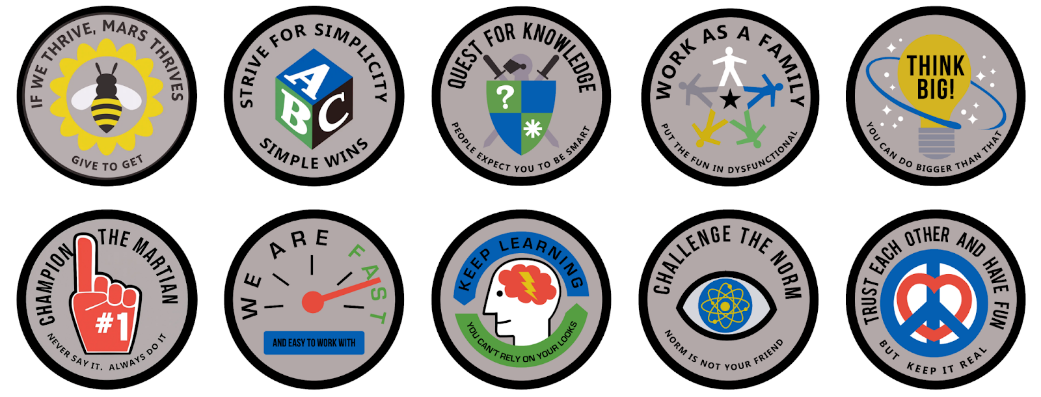
IF WE THRIVE, MARS THRIVES — Give to Get.
Mars intent: if the settlement thrives, we all thrive.
What it meant: optimize for settlement health and future Martians over personal preference or credit.
Pioneer behaviors: design for reliability, maintainability, and handover—assume someone else runs this at 03:00; share spares, time, and know-how across teams; measure success in system uptime and human wellbeing; leave every system clearer than you found it—labels, logs, SOPs, breadcrumbs.
STRIVE FOR SIMPLICITY — Simple Wins.
Mars intent: simple beats clever when oxygen is on the line.
What it meant: choose the simplest design that works and can be fixed with the tools on hand.
Pioneer behaviors: prefer one proven part over three novel ones; write one-page runbooks; diagram before you debate; remove steps, handoffs, and bespoke “genius” wherever possible.
QUEST FOR KNOWLEDGE — People expect you to be smart.
Mars intent: we don’t guess; we learn fast and share faster.
What it meant: curiosity is survival—test, measure, and spread the insight.
Pioneer behaviors: run small experiments; publish results the same sol; instrument everything; bias to data over lore; teach as you go—micro-demos, lab notes, lunch-and-learns.
WORK AS A FAMILY — Put the fun in dysfunctional.
Mars intent: we’re a crew, not a crowd.
What it meant: high trust, high standards, low ego. Look out for each other.
Pioneer behaviors: close the loop—check on people after hard shifts; default to help—never walk past a fixable issue; disagree cleanly, commit completely.
THINK BIG! — You can do bigger than that.
Mars intent: be audacious—then make it operational.
What it meant: aim for step-changes (mass, energy, logistics), but land them with disciplined execution.
Pioneer behaviors: frame bets with clear kill criteria and supply-chain reality; build v1 in days; scale only what proves itself; keep a ten-sol moonshot on the board at all times.
CHAMPION THE MARTIAN — Never say it, always do it.
Mars intent: champion the Settler and the Unborn Martian.
What it meant: design for the person who will live with the consequences — today’s operator and tomorrow’s child.
Pioneer behaviors: ergonomics first — gloves, fatigue, failure modes; minimize ops burden — alarms, cleans, calibrations; when in doubt, choose options that widen the future.
WE ARE FAST AND EASY TO WORK WITH — Speed with grace.
Mars intent: high tempo, low friction. Be the team others want to call.
What it meant: move fast, remove drag, stay polite under pressure.
Pioneer behaviors: clear interfaces, published SLAs, honest ETAs; ship small increments daily; remove blockers visibly; communicate in checklists, photos, and plain language.
CHALLENGE THE NORM — Norm is not your friend.
Mars intent: no sacred cows on a new world.
What it meant: respect physics, question tradition. If there’s a better way, try it.
Pioneer behaviors: run A/Bs on process, not just hardware; reward refactors and deprecation, not just launches; escalate odd data — “because we’ve always” is not an answer.
KEEP LEARNING — You can’t rely on your looks.
Mars intent: relentless skill growth is mission insurance.
What it meant: cross-train, rotate posts, build T-shapes and deep spikes.
Pioneer behaviors: pair on shifts; swap roles weekly where safe; keep a personal learning backlog—close one item per week; do blameless postmortems; capture fixes in SOPs immediately.
TRUST EACH OTHER AND HAVE FUN — But keep it real.
Mars intent: serious work, light hearts.
What it meant: trust is the grease; humor is the coolant. We do hard things and enjoy the doing.
Pioneer behaviors: assume good intent; verify with data; celebrate small wins every sol; make time for shared rituals — meals, games, stories.
That was the set. Ten circles, spare ink. They were not commandments. They were the habits of Mars’ first five thousand pioneers with a label.
♦
If you want a creation myth, it fits on a single table. Laleh’s mother ran cold-chain in the agri barn; her father did valve seats until his wrists said “teach apprentices.” Laleh herself had patience for rulers and an intolerance for pomp. She asked me once — this is my sole indulgence in anecdote — whether droids had values. “No,” I said, “but we have settings, and they’re set by people.” She nodded like I’d admitted to a small crime. The next week she drew the badges.
In the months that followed, their spread obeyed the same law as a good safety check: quiet and everywhere. Stickers accumulated at eye level where the next hand reached. “Simplicity” colonized tool chests; “Fast & easy” lived near hatch logs; “Champion the Martian” crept into clinic notes next to hand measurements for gloves; “Challenge the norm” appeared in the last line of a refinery PR that removed 400 lines of code and three ways of failing. No one compiled metrics on the badges because the badges were how we avoided metrics that could be gamed. We watched for other signs: fewer rework loops, faster drills, calmer after-actions. The curve bent slightly in the right direction and stayed there.
We kept them off posters unless the practice arrived first. If a badge drifted toward theatre, it yellowed on its own. There were no quotas, no HR OKRs tied to a cultural adoption badge count, no leadership sermons. The culture policed the culture by a trick that only works in small civilizations — gentle ridicule and the expectation that you can show your work.
♦
Earth eventually noticed, as Earth notices anything that makes a good news segment about Mars. A media service ran a five-minute piece with soft music under a close-up of “We Are Fast and Easy to Work With” on a rover door. Back home the social media commentariat argued about whether “Think Big!” sounded like an old Earth company with a history of exploding PR. We [Martians] didn’t answer, not because we were aloof but because the badges were not a press product. They were a localized language of discipline. They were ours, not Earth’s.
You can translate a proverb. You cannot export a drill.
We did find one use for broadcast. In the welcome kit, tucked between the list of quarantine windows and the map of Mess 3, we included the sticker sheet and a one-liner for provenance. Kid drew ’em. We kept ’em. The subtext was the actual policy: if a better badge appears, adopt it by using it, not by announcing it. A few did appear, and a few faded. The finite set helped; ten is a human number. It fits on a hand twice, which is how you carry a thing up a ladder.
“Trust each other and have fun” was the one Earth liked least. It sounded unserious to people who have never tried to keep a space city running through boredom. We weren’t cheerful because work was play. We were cheerful because we chose to reduce friction where we could. Humor is coolant. Without it, even good metal seizes.
♦
Laleh grew up, of course. She apprenticed in metrology, then in later decades did art for living rooms we refused to call “domestic galleries.” She still draws like a person who understands tolerances. If you visit Harmonia’s inner ring you’ll find a mural she did in HE-53 of a child’s hand holding a wrench the size of a future.
If you ask her about the badges she shrugs and says, “I drew what people already said.” That humility is accurate. The values existed in practice before they found ink.
♦
If you insist on a moral, it is this: we did not write values because we feared Earth would misread us. We didn’t write them because written values become arguments while air becomes thin. What we did was better and smaller. A child handed us mirrors. We carried them to work.
You can still find the original sheet in a battered folio in Archives A — Mess 3, HE-26, ten circles, pencil pressure heavy enough to emboss the paper. The line across “CHALLENGE THE NORM” wobbles because the tape buckled when she pressed it to the wall. I know because I watched. Later that sol, a power tech took a sticker that said “Simplicity” and lined it up on a relay panel with the same care we use for bulkheads. He closed the door and went back to the shift. It was not a moment for a camera. It was better than that: a small habit becoming contagious.
♦
So how did we become Martian? Not by reading values on an official poster, but by embracing what a Mars-born kid drew and as a city deciding to act together as we knew they were already true.
At that moment, under a thin sky and a red horizon, we stopped waiting for Earth to approve our values and culture.
We became Mars. We were Martians.