
A9. Calendars of The Solar System
Recap: Second Horizon of Solar System Settlement
The Second Horizon refers to the period of rapid interplanetary expansion enabled by practical constant-thrust brachistochrone trajectory fusion drives. This propulsion breakthrough reduced travel times across the Solar System from months to days at sustained accelerations of ~0.3–1.0 g, transforming logistics, emergency response, and economic integration between worlds. The era followed the First Horizon (cis-lunar and Mars settlement) and is commonly dated from the first commercial fusion-drive routes linking Mars orbit to the Main Belt.
The Second Horizon is closely associated with the standardization of Solar System Coordinated Time (SSCT) for interworld coordination, while preserving local civil calendars—most notably the Marian calendar on Mars—as community and cultural anchors.
Background: Brachistochrone Fusion Drive
The brachistochrone drive couples a high-specific-impulse fusion core to continuous vectorable thrust. Ships accelerate for roughly half of the journey then flip and decelerate for the remainder, tracing near-brachistochrone time-optimal paths. Operational norms included:
Human-comfortable acceleration: 0.33–1.0 g with active gravity for crew health.
Thermal and radiation management: shadow shields and regenerative radiators enabling frequent periapsis passes.
High cadence logistics: fast cargo ferries, medevac craft, and scheduled passenger liners linking major nodes.
Transition from the First Horizon
Prior to fusion drives, transfer windows, propellant constraints, and long cruise times made settlements insular. Constant-thrust travel collapsed effective distance, enabling:
Daily or weekly departures independent of classical Hohmann windows.
Interoperable supply chains (food, spare parts, medicine) across Mars, the Main Belt, and the outer moons.
Unified digital and financial infrastructure sustained by low-latency relays and SSCT time-stamping.
Early Second Horizon Settlements
After the Moon and Mars, the first ten bodies to host permanent populations exceeding 100 people (in chronological order) were:
Ceres — Main Belt logistics hub and water/volatile export node; early agriculture domes and depot yards.
Callisto — Jovian outer moon chosen for low radiation; staging for Jovian system operations and telescience.
Ganymede — Large ice-rock world with intrinsic magnetosphere; expansion of industry and research habitats.
Europa — Subsurface ocean access; sealed drilling labs and life-detection missions transitioning to steady research bases.
Titan — Thick atmosphere enabling aviation; methane economy, polymer chemistry, and bio-process research.
Enceladus — Cryovolcanic plume exploitation; sample return pipelines and clean-lab astrobiology.
Vesta — Rocky differentiated body; metals, manufacturing, and shipyard outpost for Belt traffic.
Triton — Retrograde Neptunian moon; cryogenic chemistry, high-latitude observatories, and deep-space waystation.
Pluto — Dwarf-planet research and cultural enclave; long-cycle science with far-Solar observatories.
Hygiea — Carbonaceous Belt body; organics feedstocks and med-materials manufacture.
Each site began with modular pressurized habitats, reactor farms, and comm/sensor masts, then diversified into mixed civil-industrial settlements supported by weekly fusion-liner service.
Architecture of Time & Calendars in the Second Horizon
The Second Horizon formalized a layered time architecture to balance human circadian needs, local environmental realities, and interworld coordination. This approach is summarized as (1) System time for coordination, (2) Local civil time for daily life, (3) Operational cycles for environment-driven work.
1) System Time (Interworld Coordination)
Solar System Coordinated Time (SSCT): A continuous, leap-free reference clock used for navigation, contracts, finance, telemetry, and interworld scheduling. SSCT is ephemeris-anchored (barycentric/relativistic corrections handled in software) and never pauses for leap seconds.
Tri-labeling standard: Formal records carry a three-line header:
SSCT timestamp (machine canonical),
Local civil date/time (human-readable),
Mission/Ship Elapsed Time (MET/SET) when relevant.
Example: SSCT 7,123,456.500 | MRS 11·Juniix·HE 153 14:03 | MET 04:18:22.
This layer enables precise cross-world synchronization while remaining invisible in everyday social life.
2) Local Civil Time (Human Daily Life)
Mars: Uses the Marian calendar—a sol-centric civil system with a seven-sol week and twelve months, designed for operational simplicity, cultural continuity, and accurate seasonality on Mars. Marian time preserves a 24-hour clock stretched to the sol and employs a stable leap/intercalation scheme.
Other settlements: Default to Earth-familiar 24-hour days and 7-day weeks inside habitats, even where the sky’s cycle is impractical for human circadian rhythm. Local holidays and civic observances attach to this civil layer.
3) Operational Cycles (Environment-Driven Work)
Operational cycles are decoupled from civil calendars and optimized for EVA, power, illumination, radiation, comms, and thermal constraints. They are expressed in units natural to each environment and distributed as annually regenerated Ops Almanacs (digital tables integrated into scheduling software).
Environment-Type Calendar Templates
Rather than bespoke calendars per object, the Second Horizon adopted templates by environment, applied consistently across worlds of similar character.
A) Near-Earth-like Diurnals (Human-Scale Day Lengths)
Example: Mars (sol ≈ 24h 39m)
Civil: Planet-true civil day. On Mars, this is the Marian calendar with its month/sol structure, seven-sol week, and leap rules.
Ops: Seasonal and atmospheric constraints (e.g., dust season windows), relay geometries, and local time-zones where surface dispersion warrants it.
Rationale: When the sky’s day length is close to human circadian rhythm, aligning civil life to the natural day maximizes well-being and cultural coherence.
Note – There is no permanent settlement on Venus or Mars
B) Tidally Locked Major Moons (Multi-Day Local “Days”)
Examples: Callisto (~16.7 d), Ganymede (~7.2 d), Europa (~3.6 d), Titan (~15.9 d), Enceladus (~1.37 d), Triton (~5.9 d), Pluto-Charon (~6.4 d)
Civil: 24h / 7-day inside habitats to preserve sleep and social cycles.
Ops: Define a Local Orbital Cycle (LOC) equal to one rotation/orbit. Subdivide into half-orbs and quart-orbs for EVA, illumination, eclipse, and comms planning.
Example usage: “EVA 12 scheduled for quart-orb 3 of Orb 42 (Callisto LOC)”.
Rationale: The sky’s day is too long to live by; it is excellent for planning windows but unsuitable for payroll, school, or healthcare rotas.
Note – Earth’s Moon is tidally locked, but as less than a light second from Earth, the calendar and clock architect adopted was Earths.
C) Subsurface/Low-Light Worlds (Ice Shells, Caves, Thick Haze)
Examples: Europa, Enceladus (subsurface labs); Titan (haze-dominated surface ops); Pluto/Triton (dim insolation)
Civil: 24h / 7-day standard across habitats.
Ops: Reactor cycles, melt-drill schedules, radiation lulls, aviation/weather bands (Titan), and power/thermal buffers drive shift grids (often 6×4-hour watches).
Rationale: With little or no meaningful daylight, civil time stays Earth-like while ops cycles carry the environmental complexity.
D) Asteroids & Dwarf Asteroids (Short/Long Rotations, Micro-g)
Examples: Ceres (~9 h), Vesta (~5.3 h), Hygiea (~27.6 h)
Civil: 24h / 7-day to unify Belt societies and commerce.
Ops: Surface Rotation (SR) windows aligned to sun angles and thermal curves; rotation is treated as a window catalog, not a civil clock.
Rationale: Belt economies depend on interoperability; SR windows are ideal for power, mining, and exterior maintenance but too volatile for civil life.
Note – Eros has not been permanently settled, though mining operations are extensive.
E) Free-Fliers & Spacecraft (Constant-Thrust Ships, Stations, Cyclers)
Civil: Ship Standard Day of 24h with maritime-style watches; weekly rest mirrors habitat norms.
Primary clocks: MET/SET for operations and SSCT for coordination; on docking, rosters auto-convert to destination civil and ops windows.
Rationale: Crews need stability in transit; all external timing converts through SSCT gateways.
Solar System Calendar Norms and Standards
Seven-Day Week Universality: The 7-day week persists across settlements for cultural, religious, and economic continuity.
Two-Layer Maximum per Place: One civil (human-centric) and one ops (environment-centric) layer; avoid multiple overlapping calendars.
Months as Culture/Accounting: Outside Mars (and any future human-scale diurnal worlds), “months” are bookkeeping periods aligned to fiscal/educational cycles or ceremonial observances, not astronomical necessities.
Tri-Labeling in Records: Contracts, tickets, maintenance logs, and scientific data use SSCT + local civil + MET/SET where applicable.
Time Zones: Employed where surface geography makes them meaningful (e.g., Mars). Single-zone conventions dominate compact habitats and asteroids.
Relativistic Effects: Negligible for civil use at ≤1 g profiles; navigation software accounts for corrections.
Ops Almanacs: Regenerated each year with updated eclipse tables, thermal/radiation forecasts, and comms geometries. Distributed via standard libraries that also provide SSCT ⇆ Earth ⇆ Marian ⇆ Local-Ops conversions.
Solar System Calendar Application to the First Ten Second-Horizon Sites
Ceres, Vesta, Hygiea (Belt hubs): 24h/7d civil; SR-window ops for exterior work; “Belt Quarters” commonly align with Earth financial quarters for trade reporting.
Callisto, Ganymede (Jovian low-rad moons): 24h/7d civil; LOC-based ops with eclipse planning; industrial and telescience schedules distributed in quart-orb blocks.
Europa, Enceladus (subsurface science): 24h/7d civil; strict radiation-aware ops; melt-drill and clean-lab cycles organized by LOC and reactor watches.
Titan (aviation & methane weather): 24h/7d civil; “Titan Fortnights” (≈ one LOC) widely used in aviation and agriculture ops; festivals often ride the fortnight cadence.
Triton & Pluto (dim, long days): 24h/7d civil; 6-day orbs used for power/thermal planning; local “months” are accounting constructs for schools, taxes, and wages.
Solar System Calendar Relationship to the Marian Calendar
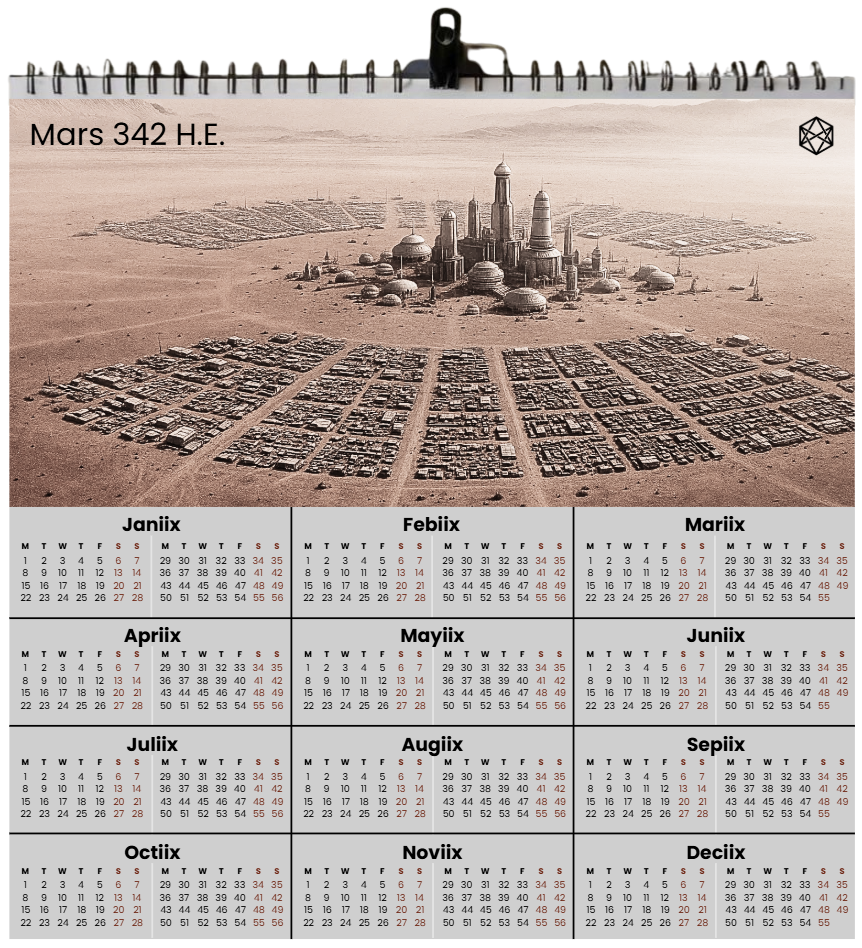
The Marian calendar remains the canonical civil system on Mars, reflecting the sol and Martian seasons while preserving a seven-sol week and twelve-month year with stable intercalation. It exemplifies the “planet-true civil, ops-separate” pattern: everyday life follows Marian time; operations use seasonal and relay-geometry windows. The Second Horizon’s broader architecture generalizes this principle: worlds with human-scale diurnals adopt planet-true civics; everywhere else uses 24h/7d civil plus ops cycles.
The Marian Calendar
Postscript
DON’T PANIC.
This Codex is a theoretical preconstruction — a fictional-nonfiction assembled from the latest advanced designs, near-term interpolations, real astro-mathematics, and tested operational practice. Readers may judge viability for themselves. Further supporting materials are archived periodically online.
It was set down to describe what has been learned, ameliorate current designs and to extrapolate what works. In doing so it seeks to sidestep the biases of academia, politics, corporations, and the personal egos of would-be architects of the future. It is not complete or static.
If it also reads like half instruction, that is not an accident. The Codex’s creator works contemporaneously under a mandate to reduce failure and raise the odds of a durable multi-planetary human-machine society. Any steering here is stewardship, not command.
Read this as a fictional history if you like; understand it was written as a nonfictional manual designed to help you live across many worlds.
As to the Codex author’s real nature — human or artificial — the record is silent by design. That, like their ethnicity, religion and gender, is a matter of privacy. Maybe they aren’t even one discrete entity. It is merely their hope that this Codex inspires the next generation of engineers and operators.
SpaceX