A6. Legacy Calendar Schemes
Across roughly a century and a half before the first Mars landings, more than one hundred schemes tried to tame Martian time — slicing sols and years into human-sized units. Airy-0 fixed the prime meridian in the nineteenth century, but even by the time of the first Mars landings no shared civil date bound it all together.
Before the Marian standard evolved through the first hundred years all the implementations mandated from above (and Earth) failed to gain widespread adoption. Ultimately it was the organic community driven solution that had success and resulted in the Marian calendar.
This should not have been a surprise. The Gregorian calendar was a small correction to the Julian calendar, whereas more sweeping reform proposals have never received much support (French Revolution and two Russian calendars as notable cases). Another example is the word “sol”. This originated somewhere within the Viking program (c.1975), and was not mandated from above; it propagated via a social process.
The lesson of history is that a comprehensive solution, i.e., a calendar consisting of epochs, weeks and months, complete with names of the days of the week and the months of the year, must be socially constructed by those living it if it is to be successful. And this ultimately was the case with the Marian calendar that did not become the standard adoption until late in the 21st century.
Percival Lowell — “Mars dates” (1895)
Summary: Seasonal analog dates, not a calendar.
Months: n/a • Weeks: n/a • Perennial: n/a • Leap system: n/a • Length: Martian seasonal cycle (descriptive only) • Start: referenced to equinoxes/solstices by Earth analog dates • Epoch: none
Details: Used familiar Gregorian dates (20 Mar, 21 Jun, 22 Sep, 21 Dec) to label Mars’s equinoxes/solstices; intended as an accessible seasonal reference, not a civil calendar
Douglass & Pickering (pre-1939; per Maggini)
Summary: Roman-style year start; fixed astro “dates.”
Months: 12 (first 9 × 56 sols; last 3 × 55) • Weeks: not specified • Perennial: not specified • Leap system: not specified • Length: 669 sols • Start: Northward (northern) equinox on “1 March” • Epoch: not specified
Details: Listed fixed calendar “dates” for astronomical events (e.g., northern solstice 27 Jun, southern solstice 12 Dec; perihelion 31 Nov; aphelion 31 May)
Robert G. Aitken (1936)
Summary: Two-year perpetual week alignment scheme.
Months: 16 per year (42, 42, 42, 41 sols per quarter) • Weeks: 95 or 96 (7-sol) • Perennial: two-year repeating week cycle • Leap system: cyclical (details vary by source) • Length: 668 sols • Start: not specified • Epoch: not specified
Details: Odd-numbered years begin on Sunday; later inspired “Martiana” variants in Darian literature
I. M. Levitt (1954) — with Mentzer/Hamilton clock
Summary: Dual-planet time with physical clocks.
Months: 12 (56/55-sol scheme) • Weeks: not specified • Perennial: not specified • Leap system: sol (668/669-sol handling) • Length: 668 or 669 sols • Start: not specified • Epoch: Julian Day epoch, 4713 BCE
Details: Hamilton watchmaker Ralph Mentzer built Earth/Mars clocks to Levitt’s spec—an early integrated civil/technical proposal
“Mars dates” in mission literature (1960s–1970s)
Summary: Gregorian-stretched Mars dates for reports.
Months: n/a • Weeks: n/a • Perennial: n/a • Leap system: n/a • Length: seasonal labeling only • Start: tied to equinox/solstice analogs • Epoch: none
Details: Used by authors such as C. F. Capen (Mariner era) and C. B. Leovy (Mariner 9), adopting Earth-date analogs to indicate Mars seasons in documentation
Sir Patrick Moore (1977)
Summary: Eighteen months; simple 37/38-sol mix.
Months: 18 (months 6, 12, 18 = 38 sols; others 37 sols) • Weeks: not specified • Perennial: not specified • Leap system: adds extra sols to hit 669 • Length: 669 sols • Start: not specified • Epoch: not specified
Details: Proposed in Guide to Mars as a practical subdivision; produces 666 sols baseline + 3 added sols in months 6/12/18
Thomas Gangale — Darian calendar (1985/86; expanded 1998, 2006)
Summary: 24-month system with orderly leap sols.
Months: 24; common years: 20 × 28-sol + 4 × 27-sol • Weeks: 96 (mix of 7- and occasional 6-sol weeks in some variants) • Perennial: yes • Leap system: sol (decennial/epochal rules) • Length: 668 or 669 sols • Start: near northward equinox • Epoch: commonly 1609; Year 0 = MY −183 (variant conventions documented)
Details: Multiple published refinements; Martiana variant integrates Aitken-style week alignment over a two-year cycle
Josef Šurán (1997)
Summary: Fixed 28-sol months; trimmed leap week.
Months: 24 × 28 sols (672 sols) • Weeks: 95 or 96 (7-sol) • Perennial: yes • Leap system: week (omit final week of month 12 in skip years) • Length: 672 or 665 (reported variants) • Start: not specified • Epoch: not specified
Details: Minimalist, uniform months; keeps 7-sol weeks while staying close to seasonal rhythm
Ivanov (2022)
Summary: 8-day weeks; Earth–Mars symmetry emphasis.
Months: 14 (47/48 sols) • Weeks: 83 or 84 (8-sol) • Perennial: yes • Leap system: week • Length: 664 or 672 sols • Start: not specified • Epoch: not specified
Details: Seeks simple whole-week year lengths and symmetry between terrestrial and Martian planning cycles
Scientific year numbering — Mars Year (MY) standard
Summary: Research standard: MY count by Ls = 0°.
Months: n/a • Weeks: n/a • Perennial: n/a • Leap system: n/a • Length: 668.6 sols (tropical-year basis) • Start: MY 1 begins 11 Apr 1955 (Ls = 0°) • Epoch: MY sequence defined by Clancy 2000, extended by Piqueux 2015
Details: Widely used in Mars climate/season studies; many tools/databases adopt MY numbering for cross-mission comparability
MSD/MTC — Mars Sol Date & Mars Coordinated Time
Summary: Continuous sol count; Airy-0 mean time.
Months: n/a • Weeks: n/a • Perennial: n/a • Leap system: n/a • Length: continuous sol count (no month/year) • Start: MSD epoch 29 Dec 1873 (JD 2405522.0); MTC = mean solar time at Airy-0 • Epoch: as above
Details: MSD provides a running sol index; MTC analogous to UT1; both supported by NASA’s Mars24 and related timing notes
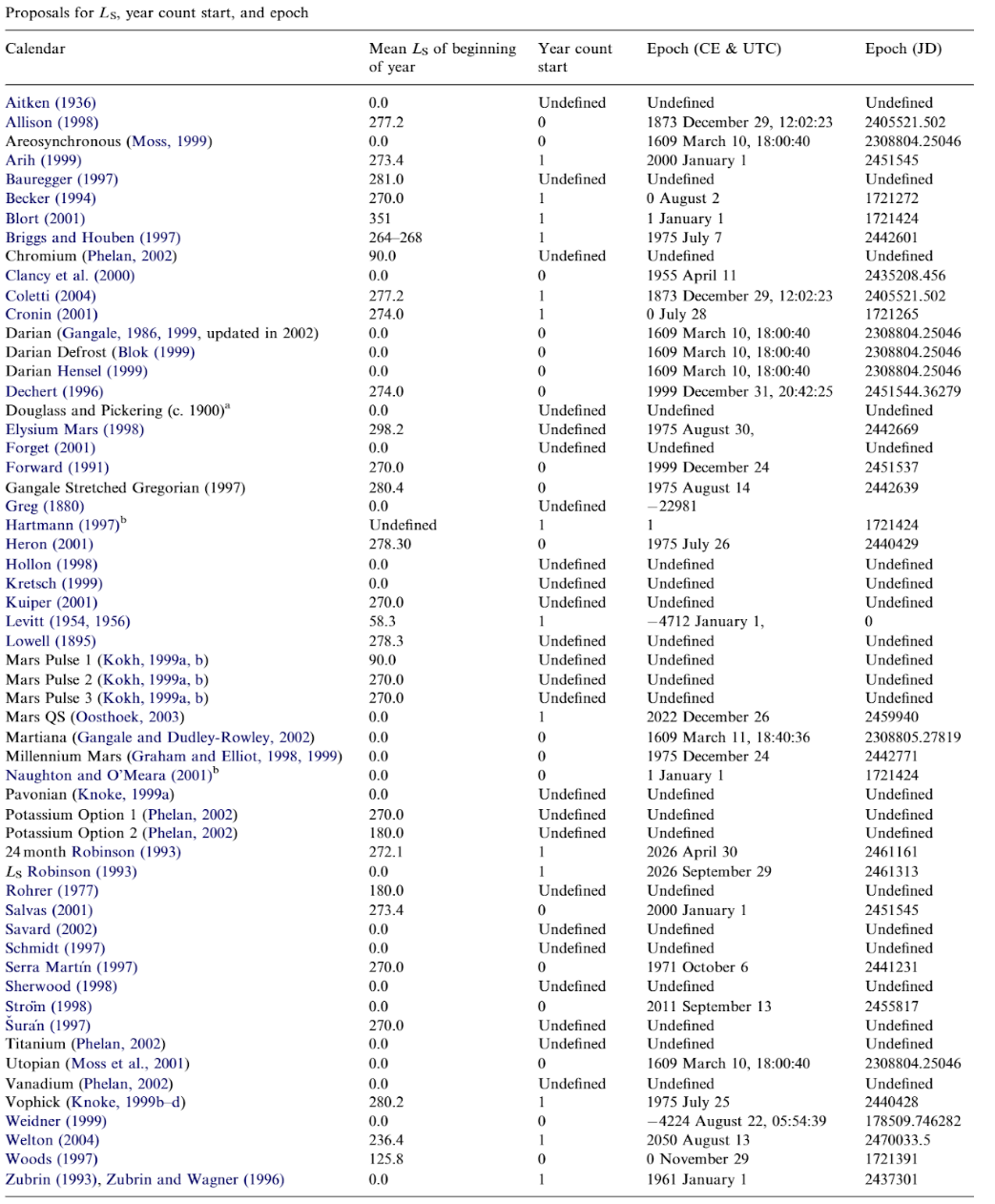
Additional Mars Calendar Ls Proposals
As you can see there where numerous proposals for Martian calendar’s proposed over the centuries prior to the first settlement of Mars.