
A1. Marian Calendar
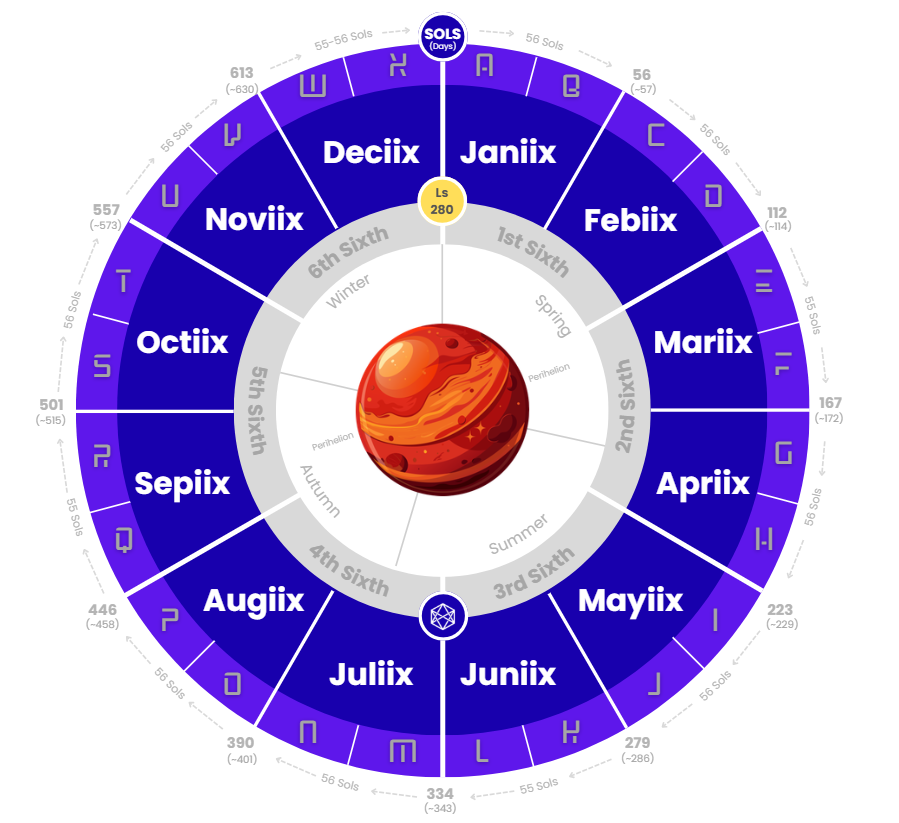
The Marian calendar is the civil timekeeping system that was adopted for long-term human settlement on Mars during the first one hundred years of settlement. It preserves familiar Earth conventions (a seven-day week and a 12-month year) while aligning to Martian astronomy: the solar day (sol) and the vernal-equinox (tropical) year. The design emphasizes operational simplicity, cultural continuity, and seasonality that matches conditions on Mars.
◊
Design principles
Sol-centric: The sol is the fundamental unit. One sol equals 24 h 39 m 35.244 s of Earth time (≈ 88,775.244 s). For civil use the sol is divided into 24 hours × 60 minutes × 60 seconds; each Marian second is 1.02749125 Earth seconds, preserving the familiar 24-hour clock while matching the Martian day length.
Astronomically anchored: Years begin at Ls 280° (relative to northern vernal equinox) and track Mars’s asymmetric seasons.
Human-practical: Months and weeks are regular enough for planning, with stable holidays and minimal rule exceptions.
Epochal: Year numbering uses the Human Era (HE), with Year 0 HE defined as the year of first human landing on Mars; earlier dates are Before Human Era (BHE).
◊
Units, reference meridian, and time zones
Prime meridian: All civil time is referenced to Airy-0 (Mars’s prime meridian).
Standard time: A Mars-wide reference to ATC (analogous to UTC) is maintained at Airy-0; with settlements adopting local zones in ~15° longitude increments (≈ 1 Marian hour), with practical adjustments for operations.
Earth–Mars latency (≈ 4–22 minutes one-way) is not part of civil timekeeping.
◊
Year length and seasonality
Tropical year: ≈ 668.5907 sols (≈ 686.9711 Earth days).
Season lengths (northern hemisphere, rounded): Spring 193 sols; Summer 179 sols; Autumn 143 sols; Winter 154 sols. The asymmetry reflects Mars’s orbital eccentricity (southern summers are shorter and warmer; northern summers longer and cooler).
◊
Calendar structure
Months: 12 months per year, grouped into four quarters of three months each, and six sixths of two months each.
Length pattern: Most months are 56 sols. Months 3, 6, and 9 are 55 sols. Month 12 has 55 sols in common years and 56 sols in leap years.
This gives 668 sols in common years and 669 sols in leap years.
Weeks: A seven-sol week with weekday names Monsol, Tuesol, Wedsol, Thursol, Frisol, Satsol, Sunsol.
◊
Week alignment rule
To ensure that every month begins on Monsol, the calendar employs a controlled weekday omission:
In months 3, 6, and 9, and additionally in month 12 of common years, Sunsol (the 7th weekday) is omitted once at month-end.
The omission is a civil adjustment (“outside the weekly count”) that keeps month-starts aligned without changing the total number of dated sols in the month.
This preserves an intuitive monthly rhythm (each month opens on Monsol) while keeping the seven-day work/rest cadence intact across the year.
◊
Intercalation (leap-year) system
Base rule (decadal): In each 10-year cycle, six years are leap years of 669 sols and four are common years of 668 sols.
A convenient expression is: any odd-numbered year, or any year divisible by 10, is a leap year (→ 6 leap years per decade).
Placement of the extra sol: always added to month 12, keeping all prior month/day patterns stable.
Average year length: 668.6 sols, close to the tropical value (668.5907 sols).
Long-cycle stability (drift control): To bound long-term seasonal drift, the system allows epochal corrections without affecting monthly structure:
Century correction: In centuries designated by civil statute (e.g., every 100th year), omit one leap within the century so that each 100-year block has 59 leap years (mean ≈ 668.59 sols).
Great-cycle correction: Add a single compensating extra leap roughly every 1 400 years (policy-defined) to keep cumulative drift within a sub-sol per multi-millennium tolerance.
These corrections are silent to everyday users and keep the year’s start near Ls 0° across eras.◊
◊
Epoch and compatibility with scientific dating
Human Era (HE): Year 0 HE = first human landing on Mars. Positive integers count forward; negative years (BHE) count backward.
Mars Year (MY) mapping: For scientific compatibility, MY numbering (e.g., MY 1 ≈ 11 April 1955 Earth date) is retained for almanacs; deterministic HE↔MY conversion tables are part of the standard.
◊
Naming conventions
Months: A practical, Earth-familiar set adapted for Mars, e.g., Janiix, Febiix, Mariix, Apriix, Mayiix, Juniix, Juliix, Augiix, Sepiix, Octiix, Noviix, Deciix. The “-iix” suffix cues the 8-week internal structure of a 56-sol month.
Weekdays: As listed above, “-sol” replaces “-day” to reflect the Martian solar cycle.
Names are conventional rather than prescriptive; some communities adopt variants while retaining the same month lengths, week structure, and intercalation.
◊
Zodiac and orbital reference
A Martian zodiac is optionally defined by the constellation at northern vernal equinox (planet-centric view) and proceeds in 30° segments of true anomaly across the year. Almanacs also mark perihelion, aphelion, equinoxes, solstices, and other orbital points relevant to season, navigation, and cultural observances.
◊
Stability and drift tolerance
The combination of 6 leaps/decade, century tuning (59 leaps/century), and rare great-cycle corrections keeps the calendar within a tight seasonal envelope while avoiding complex recurring rules in everyday life. The policy goal is sub-sol drift across many millennia without disrupting civil usage.
◊
Proleptic and postleptic use
Proleptic: Applicable to pre-settlement history, simulation, and mission planning.
Postleptic: Intended for civil governance, operations, festivals, education, and inter-settlement coordination.
◊
Digital and civil implementation
Public time systems: Colony clocks, work shifts, and civil records use Marian dates/times.
Interoperability: Software libraries provide Earth↔Mars conversions (e.g., via Julian-Date-based offsets, Mars Sol Date, and MY/HE bridges).
Almanacs: Standard tables include Phobos/Deimos events, seasonal markers, and leap-year listings.
Localization: Settlements may add local observances while sharing the same global backbone (months, weeks, leap pattern, epoch).
◊
Example year (common vs. leap)
Common year (668 sols)
Month lengths: 56, 56, 55, 56, 56, 55, 56, 56, 55, 56, 56, 55
Weekday omission (Sunsol) at end of months 3, 6, 9, 12 to start each subsequent month on Monsol.
Leap year (669 sols)
Month lengths: 56, 56, 55, 56, 56, 55, 56, 56, 55, 56, 56, 56
Weekday omission at end of months 3, 6, 9 (month 12 adds leap sol).
◊
Minths (half-months)
Definition. A minth is a half-month subdivision of the Marian calendar used for planning, record-keeping, and cultural observances. There are 24 minths per Marian year, each tied to a fixed position within a civil month. Minths make week-to-week work cadence legible at a finer grain without abandoning the 12-month frame.
Lengths.
In a 56-sol month: two minths of 28 sols each.
In a 55-sol month: by convention the first minth has 28 sols and the second 27 sols (to preserve stable month starts and reporting cycles).
◊
Minths catalogue and mapping to sixths
A sixth is a two-month operational block; each sixth contains 4 minths. This yields 6 sixths × 4 minths = 24 minths.
Here’s the Minths (A–X) standard catalogue, with each entry showing: Quarter • Sixth • Month (half) • Length • Ls midpoint • Mandarin alias (gloss). Ls midpoints are approximate; Mars’s orbital eccentricity means equal-Ls spans cover unequal numbers of sols.
Primus • Sixth I
A — Aurex — Janex (H1) • 28 sols • Ls ≈ 280° • Aihan
B — Borox — Janox (H2) • 28 sols • Ls ≈ 305° • Bahan
C — Cerex — Febex (H1) • 28 sols • Ls ≈ 310° • Chunli
D — Dorox — Febox (H2) • 28 sols • Ls ≈ 325° • Dushui
Secondus • Sixth II
E — Epex — Marex (H1) • 28 sols • Ls ≈ 340° • Ezhe
F — Furax — Marax (H2) • 27 sols • Ls ≈ 355° • Fenhua
G — Garex — Aprex (H1) • 28 sols • Ls ≈ 10° • Guanming
H — Herox — Aprox (H2) • 28 sols • Ls ≈ 25° • Huyu
Tertus • Sixth III
I — Itrex — Mayex (H1) • 28 sols • Ls ≈ 40° • Ignixia
J — Jorox — Mayox (H2) • 28 sols • Ls ≈ 55° • Jiman
K — Korex — Junex (H1) • 28 sols • Ls ≈ 70° • Kangzhong
L — Larax — Junax (H2) • 27 sols • Ls ≈ 85° • Luxia
Quartus • Sixth IV
M — Marex — Julex (H1) • 28 sols • Ls ≈ 100° • Mushu
N — Norox — Julox (H2) • 28 sols • Ls ≈ 115° • Nushu
O — Orex — Augex (H1) • 28 sols • Ls ≈ 130° • Oqiu
P — Parox — Augox (H2) • 28 sols • Ls ≈ 145° • Pushu
Quintus • Sixth V
Q — Qorex — Sepex (H1) • 28 sols • Ls ≈ 160° • Qilou
R — Rilax — Sepax (H2) • 27 sols • Ls ≈ 175° • Runfen
S — Sarex — Octex (H1) • 28 sols • Ls ≈ 190° • Silu
T — Torox — Octox (H2) • 28 sols • Ls ≈ 205° • Tongjiang
Sextus • Sixth VI
U — Urex — Novex (H1) • 28 sols • Ls ≈ 220° • Undong
V — Varox — Novox (H2) • 28 sols • Ls ≈ 235° • Vaxue
W — Warex — Decex (H1) • 28 sols • Ls ≈ 250° • Wanxue
X — Xenax — Decax (H2) • 27 sols (common) / 28 sols (leap) • Ls ≈ 265° • Xianzhi
◊
Mandarin Minths (jiéqì-aligned aliases)
To support a cross-cultural seasonal intuition, each minth also carries a Mandarin alias aligned to the spirit and order of the 24 jiéqì (solar terms). The aliases follow the traditional sequence (planet-centric, by solar longitude Ls), while retaining the A–X index for interoperability. This layer is descriptive (for almanacs, education, and ritual) and does not alter civil month boundaries.
Key: A–X index → Standard pinyin (English gloss) — typical Ls window on Mars, by analogy
(On Mars, Ls advances unevenly in sols; aliases reference the nearest Ls midpoint, not exact sol counts.)
Quarter groupings. The 24 minths are grouped into four seasonal quarters reflecting lived rhythms:
Primiv (A–F): emergence
Secondiv (G–L): activity
Tertiv (M–R): transition
Quartiv (S–X): restoration
◊
New Pinyin | Original Jiéqì | Root Echo | Construction Notes | |
A | Aihan | 小寒 (Xiǎohán) – Minor Cold | 寒 = cold | A (initial) + hán = evokes "early cold" (fitting start of year) |
B | Bahan | 大寒 (Dàhán) – Major Cold | 寒 = cold | B + hán = bloom amid harsh cold, poetic tension |
C | Chunli | 立春 (Lìchūn) – Spring Begins | 春 = spring, 立 = begin | Inverted order to sound elegant; still clearly linked to "spring beginning" |
D | Dushui | 雨水 (Yǔshuǐ) – Rain Water | 水 = water | Du = dew + shuǐ = gentle moisture, soft rain |
E | Ezhe | 惊蛰 (Jīngzhé) – Awakening of Insects | 蛰 = hibernating insect | E merges with zhé = evoke emergence, stirrings of life |
F | Fenhua | 春分 (Chūnfēn) – Spring Equinox | 分 = divide, balance | Fen = balance, hua = blossom; harmony in growth |
G | Guanming | 清明 (Qīngmíng) – Clear and Bright | 明 = brightness | Guan = viewing/light, ming = clarity; vision, enlightenment |
H | Huyu | 谷雨 (Gǔyǔ) – Grain Rain | 雨 = rain | Hu = humidity, yǔ = rain; steamy fertile rainfall |
I | Ignixia | 立夏 (Lìxià) – Summer Begins | 夏 = summer | Igni = ignite + xia = summer; start of heat and energy |
J | Jiman | 小满 (Xiǎomǎn) – Grain Full | 满 = full | Ji (like jet) + mǎn = bursting with growth |
K | Kangzhong | 芒种 (Mángzhòng) – Grain in Ear | 种 = to sow | Kang = kindle or spark, zhong = planting; sowing heat |
L | Luxia | 夏至 (Xiàzhì) – Summer Solstice | 夏 = summer | Lu = light/lux, xia = summer; radiant high point |
M | Mushu | 小暑 (Xiǎoshǔ) – Minor Heat | 暑 = heat | Mu = magnitude, shu = heat; rise in temperature |
N | Nushu | 大暑 (Dàshǔ) – Major Heat | 暑 = heat | Nu = nudge/turning point, shu = heat; peak tipping point |
O | Oqiu | 立秋 (Lìqiū) – Autumn Begins | 秋 = autumn | O = opulence + qiu = autumn; ripe abundance |
P | Pushu | 处暑 (Chǔshǔ) – Limit of Heat | 暑 = heat | Pu = pause, shu = heat; calming of intensity |
Q | Qilou | 白露 (Báilù) – White Dew | 露 = dew | Qi = quest, lou/lù = dew; searching stillness |
R | Runfen | 秋分 (Qiūfēn) – Autumn Equinox | 分 = divide | Run = reflect, fen = balance; inward contemplation |
S | Silu | 寒露 (Hánlù) – Cold Dew | 露 = dew | Si = still/shelter, lu = dew; serene shelter |
T | Tongjiang | 霜降 (Shuāngjiàng) – Frost Descent | 霜 = frost | Tong = threnody, jiang = descent; poetic fall into frost |
U | Undong | 立冬 (Lìdōng) – Winter Begins | 冬 = winter | Un = umbra, dong = winter; shadow-turn of season |
V | Vaxue | 小雪 (Xiǎoxuě) – Minor Snow | 雪 = snow | Va = Velcro metaphor, xue = snow; adherence, seal |
W | Wanxue | 大雪 (Dàxuě) – Major Snow | 雪 = snow | Wan = waning/winter, xue = snow; snow at fullness |
X | Xianzhi | 冬至 (Dōngzhì) – Winter Solstice | 至 = arrival | Xian = strange/alien, zhi = arrival/utmost; renewal via cosmic stillness |
Usage. Almanacs and school charts often show both layers side-by-side: the civil A–X minth (e.g., C · [Aurex-series name]) and its Mandarin alias (e.g., Jīngzhé), plus the containing sixth (e.g., Sixth I). This tri-labeling helps settlers coordinate operations while building shared seasonal literacy on Mars.