2. Months of Mars
The Marian Calendar
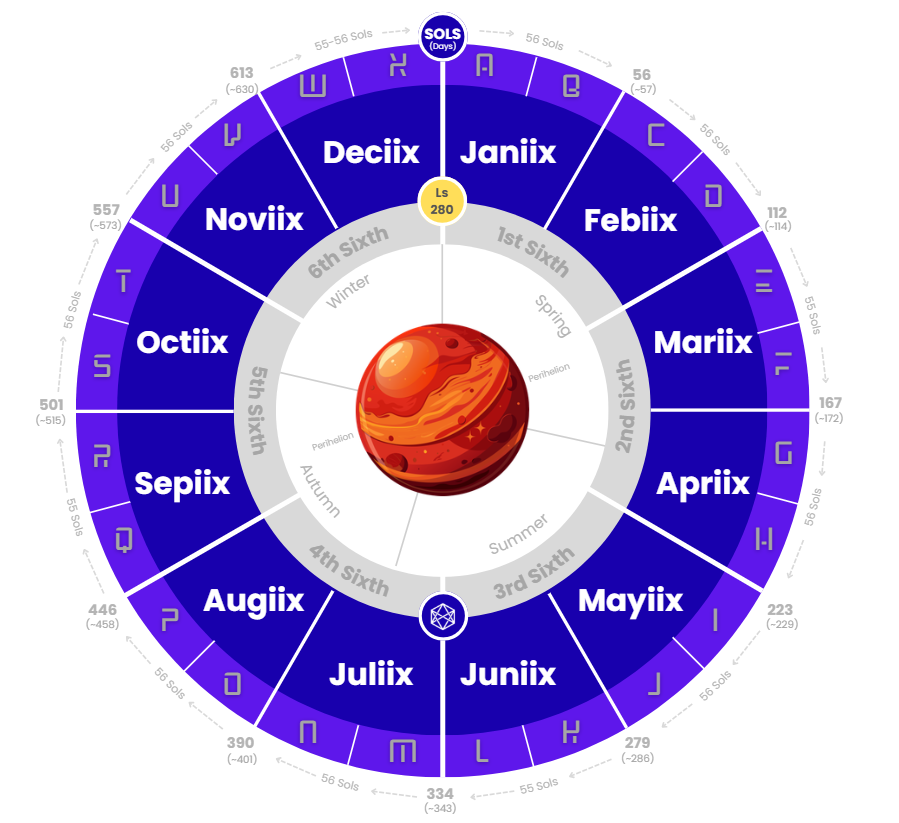
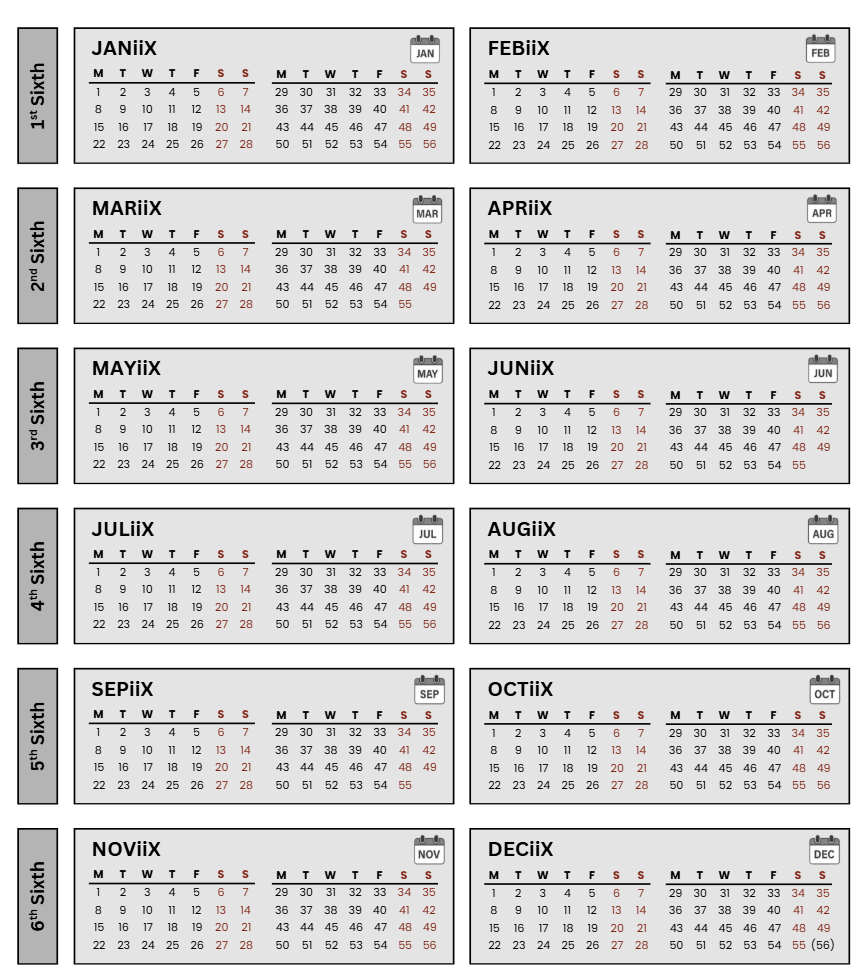
If the week reveals a civilization’s rhythm, the month reveals its structure. And nowhere is this more elegantly seen than in the Marian Calendar: the 12-month system is designed not merely for arithmetic convenience, but for psychological coherence, seasonal alignment, and cultural grace.
It may surprise some to learn that there was ever any debate. That the now-familiar procession of Janiix, Febiix, Mariix, Apriix… Deciix was not always inevitable. In fact, the naming of Martian months became one of the most contentious and unexpectedly passionate debates of the early settlement era — rivalled only by the selection of the official color scheme for the Port Harmonia transit maps (a dispute that, I’m told, still simmers in certain corners of the Lower Levels of Ring A).
♦
At the outset, there were several competing models.
The Darian Calendar, among the oldest and most mathematically elegant Martian timekeeping systems, proposed a set of 24 months named after Latin and Sanskrit roots, many of them unknown to most Terrans, let alone the average early settler with dust in their boots and logistics to run. It was precise. It was well-argued. It was… unloved.
Others proposed mythic naming conventions — invoking Greek gods, Martian geography, or obscure calendrical cycles from Earth antiquity. These were colorful, but carried the risk of cultural bias, excessive learning curves, and semantic mismatch. (The suggestion of “Plutember” was thankfully short-lived.)
What finally emerged — after much deliberation and no small number of compromises — was something both familiar and lightly alien: a 12-month cycle whose names echoed their Earth counterparts, yet wore the subtle mark of Martian adaptation. That adaptation took the form of a single, repeated letter — the letter X — and the soft elongation of vowel sounds to signal difference.
Thus:
January became Janiix
February, Febiix
March, Mariix
April, Apriix
May, Mayiix
June, Juniix
July, Juliix
August, Augiix
September, Sepiix
October, Octiix
November, Noviix
December, Deciix
♦
To the uninitiated, this may seem whimsical — decorative, even. But the decision was strategic.
The names are intuitively matched to Earth’s, making memory retention easy for both children and new explorers from Earth. More importantly, the months correspond to the same portion of the sky as their Terran counterparts. When Mars is in Janiix, Earth is in January. The stars seen at midnight over Gale Crater in Janiix will be roughly those visible in a January sky over the Andes or Himalayas.
This celestial mirroring — despite Mars’ slower orbit — was an intentional act of synodic alignment. It means that cultural rituals, communication cycles, and seasonal expectations can be mapped between worlds, even as the durations diverge.
No, the Martian year is not the same length as Earth’s (668.6 sols versus 365.25 days), but the start of the Martian year (Ls 280° from the northern vernal equinox) often falls close to Earth’s own. And so, month by month, the alignment roughly persists. Mariix is Mars’s March. Juliix is its July.
This makes cross-world coordination — so vital in the early decades and generally a good thing for humans on both planets — markedly easier. And it gives settlers the psychological comfort of continuity. You may not even be from Earth, but at least you still know what November is.
♦
The calendar’s structure is no less thoughtful.
Each quarter contains three months. The first two months are long: 56 sols each. The third month is slightly shorter: 55 sols, with the last Sunsol intentionally skipped to reset the weekly cycle cleanly. This creates a year of 668 sols, matching the Martian vernal equinox year with only a minimal intercalary leap adjustment.
It also yields a satisfying rhythm:
8 full weeks per month in the long months — where the “iix” comes from.
7 full weeks plus a six-sol week in the short months.
4 quarters of consistent internal logic.
6 sixths of ~100 sol operational spans
12 months that start on the same weekday — always Monsol.
No drift, no split weeks, no confusion.
And never a “Frisol the 13th!”
To planners, this is pure bliss. To poets, it’s a quiet symmetry.
To children, it means their birthdays (almost) never fall on a Sunsol that doesn’t exist.
♦
Much has been made — usually by non-Martians — of the Martian affection for the letter “X.” It appears not just in month names (Janiix, Febiix…) but in the technical half sub-divisions of those months (Janex / Janox, Febex / Febox), in informal slang (Xols as a shorthand for experimental sols), and often in the naming of Martian-born children (Exa, Xiven, Moxi).
Cultural linguists have several theories:
That the X conveys alienness — a deliberate mark of difference from Earth.
That it echoes the Roman numeral ten — signifying a break with the decimal-based past.
That base six and hexadecimals are used in Mars’ societies axioms — blame early AIs.
That it’s simply aesthetic — a sharp, symmetrical letter in an otherwise soft typographic landscape.
Or perhaps, as one six-year-old in Cerberus Trench once suggested, “it just looks cooler than a Y.”
♦
There is more to explore — sub-month divisions, named holidays, and how these months interface with operational planning cycles and “minths” (which we will treat separately). And exactly where does Janiix 1st land? But the core point remains:
The Martian months are not just functional. They are mnemonic, symbolic, and celestial.
They anchor a people newly rooted in red soil. They speak to both continuity and divergence. They are, in short, the scaffolding of Martian civil life.
♦
The Martian months may have begun as a civic convenience, but over time, they gathered layers — like regolith sifting over bedrock. Meaning accreted. Associations crystallized. Myths took root.
Take Janiix, for instance. Ostensibly the first month of the year — its name derived from the Roman god Janus, symbol of doorways and beginnings. But ask any Martian of a certain age what Janiix means, and you’ll hear stories of solstice storms, the First Light Ceremonies, or the annual joke that “Janiix only feels new after the first ten sols of dust.”
Or consider Mariix, the third month of the year. It is both a nod to Mars’ ancient namesake (the Roman god of war) and a subtle reference to early mission codes — M31, M32, M33 — that clustered around that celestial period. Settlers in the southern domes still mark the Red Sol Festival in mid-Mariix, commemorating a now-defunct rover that broadcast its final signal on Sol 14, Year 6 HE.
In Juliix, the surface temperatures begin to rise in the northern hemisphere, and traditional hydroponic rotations shift accordingly. For reasons no one can quite explain, twins born in Juliix are statistically more likely to be named after gemstones or flowers, though this may be an artefact of post-hoc data dredging (or as one Martian put it: “Juliix babies tend to bloom”).
The point here is not to catalogue these emergent associations in detail (others have done so with more rigour and less flair), but to note that months on Mars have begun to carry cultural weight — not just as administrative scaffolds, but as temporal terrain. People remember in months. They plan in them. They feel them.
♦
Of course, some of this is projection. The mind seeks pattern, narrative, story. It clutches at the familiar. But it is precisely this tendency that makes the Marian Calendar work so well.
Because the months are close cousins of Earth’s, they allow for cognitive anchoring — a kind of neurological shorthand. If you know that October on Earth feels like golden leaves, early dark, the cusp of winter — then Octiix on Mars becomes, at least metaphorically, a sibling season. Even if the air is thinner, the leaves are artificial, and the nearest tree is eight months from being bio-fabricated.
This cognitive overlay is no accident. Early Martian operators were acutely aware of the psychological demands of off-world living. A stable temporal structure — with recognizable names, regular weeks, and a sense of seasonal pacing — was as much a mental health intervention as a civil planning tool.
(There is a now-famous memo from the Noctis Interdome Planning Authority, Year 13 HE: “We can’t terraform the planet yet. But we can terraform the calendar.”)
♦
Still, not everyone was pleased.
A minority of traditionalists, particularly among early Earth-based mission control teams, argued that using Earth-like names on Mars was a form of cultural neocolonialism — an imposition of Terran norms on a world that ought to chart its own course. One proposal suggested renaming the months after Martian geological formations: Tharsis, Hellas, Isidis, Valles, Argyre… The logic was sound, but the results… clunky. ("Your meeting's been moved to Sol 12 of Utopia?")
Another, more poetic camp proposed a calendar based on Martian qualities: Dustwind, Echo, Rift, Flame, Silence, Bone, Dawn. Beautiful — but ultimately too abstract for operational planning. (“Please update the budget forecast for mid-Flame.”)
In the end, the blended approach of continuity with adaptation won out. The X-inflected names offered enough distance to signal newness, while retaining Earth-compatible structures that eased migration and long-distance coordination.
And they stuck.
♦
Each month is now also divided in two — not officially, but in some people’s common usage — into so-called minths: Janex and Janox, Febex and Febox, and so on. These are not formal calendar entries (yet), but they’ve become widespread in both speech and software. "Your ration allocation renews in Febox" is a perfectly clear instruction, even if no legal document uses the term.
We will explore minths in more detail later. They are an interesting twist in the cultural calendar. For now, it is enough to say that this sub-month segmentation further enhances granularity and rhythm in planning cycles — a key concern for both commercial operations and communal governance on Mars.
♦
One final note for the romantics.
As the Martian year is longer than Earth’s, the months seem to stretch and dilate. Juliix lingers, Deciix deepens, Mayiix lasts forever. This is not illusion, but orbital truth. Martian months, like Martian days, are slightly… more.
There is time, on Mars, for the slow unfolding of things. Time to track stars, to walk regolith paths, to build and rebuild and refine. The calendar does not race; it paces. It does not demand, it suggests.
And in that gentle cadence — through Janiix and Octiix, through festivals and famines and family dinners — we find not just structure, but story.
A Martian year has twelve names.
And each, in time, becomes its own chapter.
The Marian Calendar