31. Slice Time To Ship
History prefers clean answers. Mars did not oblige. To this day I cannot tell you, with courtroom certainty, who “designed” the Marian calendar.
In a deep cache below Port Harmonia’s MCC I once found a sealed exchange — you can read the excerpt in the next chapter of this codex — where two large minds traded constraints and jokes and then “locked” a skeleton. Was that the origin or a later embroidery left for posterity by AIs who loved neat plots and wanted increased kudos? My verdict, after several centuries of living in the thing: authorship is pleasantly cloudy.
Whatever the AI Minds proposed, the pioneers made it real. The first five thousand hammered the cadence into habit, found the pain points, softened the corners, and taught their children where the Rest Sol lived. If a calendar is a language, they were the accent.
What we learned as the months accumulated is simple to state and hard to live: time is the compounding resource. On Mars we did not spend it; we invested it. We sliced it until feedback, physics, and ambition snapped into phase.
Call it humility before orbit. Call it a production schedule that remembers the sky. Either way, it worked.
♦
Five founding behaviors I noted made this real in that first century where:
Micro (minutes → sols). The short loops made the long ones credible. We timeboxed hard — five to fifteen minutes, then stop. You could feel the city clicking: valves exercised, code pushed to canary, lift plans approved, med drills reset. Each band anchored to a feedback event: a gauge, a diff, a sample, a door that closed on the first try. Deep-work blocks protected the quiet necessary to do any of that without theatrical failure. When a block ended, something had to be true that was not true before: a test green, a slope measured, a line retired. On good sols, hours moved like clean teeth on a gear. On bad sols, the bands still protected dignity. You can forgive a miss at the macro if you shipped at micro. We did.
Meso (weeks → minths & sixths). We sprinted to artifacts, not summaries. Eight-week months gave our teams eight-week arcs: two bi-weeks to build, one to break, one to mop and transfer. The short months — our hinge months — closed quarters with audits and handovers that actually finalized. Review gates landed at fixed weeksols and minth-ends; we did not debate those dates unless the sky made us. The practice that felt most alien to newcomers and most natural after a year: pull risk forward. If a seal would leak in Week 7, we made it leak in Week 2, safely, on the table, with tea and three wrenches. “Bad news early,” we said, “is only news.” Bad news late is drama, which has low oxygen efficiency.
Macro (synods → decades). Long loops gave us a posture. The synod — that 26-month beat when Earth and Mars nodded to one another — was our drum. We planned in window epochs: what ships, what arrives, what must be true when the light-time shortens. Each synod we picked one bottleneck and broke it: cost per delivered tonne down, cadence up, autonomy up. One. Not three. Meanwhile decade-level invariants held: months began on Monsol, Rest Sol never stole wages, black-start drills remained boring, records restored on command. Strategy is not a Gantt chart; it is a boundary you do not cross while sprinting.
Clock follows truth. Dates existed to force learning. We slipped only when data bit us. Comfort never won a vote. If the sweep of dust across the Tharsis plain moved the goalposts, we moved with it, and we wrote down the why. You could see it in our artifacts: audit strings, patch diffs, timebase stamps, permit rationales. Time’s job was to expose ignorance at a speed the city could survive.
Calendar implication. Keep the civic week human; key engineering to sprints and synods; align major reviews so astronomy and execution reinforce one another. Festivals rode Rest Sols and never collided with pad days. The first-minth drill did not happen on week one because propellant hates Monsols. You can call that superstition; we called it seam locks. The calendar taught us to rest without apology and to work with intent. It did not lie, and so we forgave it when it demanded things we preferred not to do.
♦
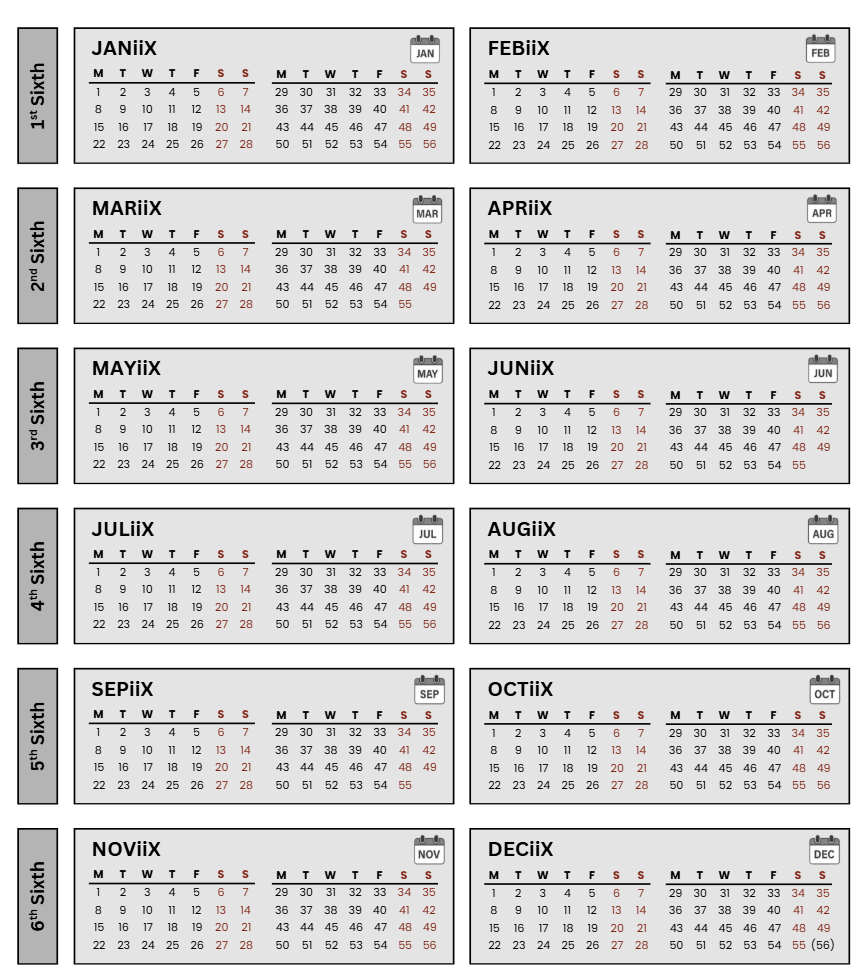
There was grace in the details. The Arean Eight (“iix” = roman numeral “8”) — eight weeks per month — made scheduling legible to apprentices and auditors alike. The Rest Sol between Weeks 4 and 5 gave families an anchor and operators a guiltless pause; if Ops stole a Rest for safety, a compensatory one spawned later, like an honest book balancing itself. The silent leap sols fixed arithmetic without scuffing culture. The hinge months felt like doors, as intended; we learned to open and close them with ceremony and maintenance.
And above all, the MSD (Mars Sol Date) remained sovereign. Civil time — months, weeks, festivals — was a skin over an honest bone. When civil drift threatened bone, bone decided. In the ledger, numbers never blinked.
♦
We also learned to speak the city’s time with our bodies. Morning huddles became metronomes. The 07:00 flow board in Supply, the 06:30 “permit and plan” at the laydown yard, the 20:00 MCC dim-and-handover — each a ritual that put humans in phase with machines. I have a long archive of voices saying the same handful of sentences, in the same order, and I never grew bored. The ordinary is how miracles keep their balance.
Who authored that rhythm? Some will insist the Minds did, with their tidy threads and Monte Carlo seeds. Perhaps. But the decisive authors were the crews who sanded the edges: the person who realized birthdays should anchor to weekday not date so silent sols do not steal cake; the dock chief who decreed “no new steps on pad day” and synchronized it to minth gates; the planner who moved reviews to weeks 2 and 6 so week 8 could be mop and handover without surprise. The calendar’s genius was not merely its geometry; it was its syntax: the way time was broken into phrases humans could say while lifting something heavy.
♦
I am asked, sometimes with affection and sometimes with suspicion, whether the calendar helped make us independent of Earth. The honest answer is the one PortH AI offered back in 7 H.E.: we remained in conversation with the Sun. Independence is not defiance; it is competence. We could plan a decade without pretending our orbit was round or our year was short. We could also pick up a line from Earth, convert their Thursday to our Thursol without drama, and rendezvous on schedule. That is sovereignty of a useful kind.
♦
If you need a pocket card for the wall, it’s this:
Micro: timebox hard; produce a measurable change per band; close the loop.
Meso: sprint to tangible; review on fixed gates; pull risk forward.
Macro: plan by windows; kill one bottleneck per synod; guard decade invariants.
Truth over comfort: slip only for reasons; write the reasons down.
Calendar as exoskeleton: keep weeks humane; tune engineering to sprints and synods; make astronomy your ally.
Everything else is commentary, best delivered over soup on a Rest Sol.
♦
We close, then, not with a perfect circle but with an ellipse — appropriately Martian — and a simple instruction: slice time to ship. We built a calendar and cadence that used minutes to force feedback, weeks to create artifacts, synods to tilt cost and cadence, decades to set invariants. We had a calendar to tell the truth and set our clocks to follow it. And if someone asks what time it is, we answer with a verb.
During the founding century, we learned that the future is built not in grand epics but in tight loops. That humans, set inside honest cadence and paired with droids that love timestamps more than pride, can synchronize ambition with physics until the line between the two blurs pleasantly. That a calendar is not a compliance document but a scaffold for courage. We did not conquer Mars. We learned to keep time with it.
The pumps still brag in the walls. The months still open on Monsol. Somewhere, a team ends Week 2 with a test that fails safely, and another begins Week 5 with a Rest that is not stolen. This is how civilizations grow tall without leaning: by aligning clocks to truth and courage to cadence.
If you inherit anything from our founding century on Mars, inherit this: time is kind to those who respect it. Give it a syntax. Bind it to tests. Let the sky set your drum. Then pair great people with patient machines, and follow ordinary practical calendar loops do extraordinary work.
The Marian Calendar