
19. In-Direct Transits 101
Let’s now turn to the least well know of transit classes, the in-direct class.
In the first century of Mars settlement this transit involved “cycling” between the planets — hence the name. But more precisely it is when a spacecraft is on a repeating heliocentric trajectory that regularly encounters both Earth and Mars.
Think “moving space station on a fixed route between the planets rather than around a single one.”
It does not stop or land. It simply sweeps past each planet on a schedule set by celestial geometry, and we rendezvous with it from the planets using smaller vehicles — spokes — when it comes past.
This chapter is the mental model for that transit: what a cycler is, what it is not, why it works, and which numbers matter when you plan to use one.
♦
Hold three clocks in your head. Earth’s year is ~365 days. Mars’s is ~687 days (~1.88 Earth years). The beat the two make together — the synodic period — is ~780 days (about 26 months).
That 780-day drum is when “the line-up repeats,” and most practical Earth–Mars cyclers are built from whole-number multiples of it. You can fly a cycler transit rail that repeats every one synodic (~2.135 years), or more languid rails that repeat every two, three, or six synodics. The cycler rail — the orbital path — is what you establish; the timetable is what you publish; the ships that follow that cycler rail are just good manners.
What distinguishes a cycler transit from a “normal” transfer is that the cycler is the orbital rail itself, not really the spacecraft that runs on it. You do not launch a new interplanetary spacetrain every mission; you put a spacetrain on an orbit in the sky that comes around when expected.
The pay-off is schedule and shielding: you concentrate long-haul mass (hab volume, storm shelters, power) in one spacetrain vehicle that carries it every time. The price is rendezvous: at each flyby you must match relative speed, dock, exchange, and separate on a clock measured in hours.
♦
Start with the simplest picture, the one-synodic “Aldrin-class” cycler transit. It is designed to encounter Earth, then about 4.8 months later encounter Mars, then coasts ~16 months through aphelion, then ~4.8 months back to Earth’s neighborhood.
The period is one synodic, ~2.135 years, but it does not meet Earth at the same longitude each loop. Earth has moved ~51.4° around the Sun by the time the cycler transit intersects, so a single cycler transit gives you an encounter every ~26 months at dates that rhyme but longitudes that drift. To get near-annual service you set-up two or more cycler transits in different phase.
The headline speeds as the cycler transits pass the planets are what matters. Relative to Earth, arrival V∞ for a 1× cycler transit typically sits around 6–7 km/s. Relative to Mars it is often ~4–6 km/s. Those are hot flybys. They are the price you pay for not buying interplanetary Δv each trip on a traditional direct transit. You can ease that price by choosing calmer cycler transit — multi-synodic designs where Earth or Mars V∞ lives closer to ~3–5 km/s — or by adding small powered tweaks at the encounter. The decision is architectural: do you want the cycler transit rail to stay strictly ballistic and put the burden on the on-off planet vehicle spokes, or do you spend a little cycler transit spacetrain propellant to “kind” the rendezvous and simplify the spokes?
♦
A clean way to think is cycler interplanetary spacetrain versus on-off planet spoke vehicle. The cycler is the big moving spacetrain — more like a space station really — on its repeating heliocentric path: it owns schedule and long-haul infrastructure. The on-off planet spoke vehicle spokes are the nimble interceptor spacecraft that leave local orbit, match the cycler’s relative velocity, dock, transfer people or modular cargo units, and then return to planetary orbit. Cycler rail orbit equals “train;” spoke on-off planet orbit equals “taxi/truck;” pads and low orbit depots are the transfer stations.
When we say in-direct transit, we mean the planet-to-planet trip is the combination: planetary spoke → interplanetary rail → planetary spoke, not one continuous burn from one atmosphere to the other.
From a planner’s desk this buys you decoupling. Departure day from Earth can slide inside a window to suit weather and tankers, because the spacetrain cycler will be there for weeks or for multiple rails per year. Arrival day at Mars is no longer the same day you must descend to a pad; you can buffer on orbit, inspect, or wait out dust. The single phrase we taught interns — capture timing ≠ pad timing — captures why cyclers scale.
♦
Keep the physics gentle and honest. A cycler is a repeating heliocentric path tuned by resonance.
Once established, it needs only small trims to hold the schedule — usually tens to a few hundred meters per second per synodic. Those maintenance Δv live in two ledgers. Phasing trims keep the calendar: they nudge mean motion and argument of perihelion so encounters fall within published windows despite Mars’s eccentricity and third-body tugs. B-plane trims at each flyby set how high you pass and how your V∞ vector is oriented for docking and your next free turn. Aim too deep and you court atmosphere; too high and you get a weak gravity bend and drift off timetable. Aim clever and a tiny burn where you are already fast buys you days of schedule at single-digit m/s. That is the craft.
Do not be spooked by the word “resonance.” You do not need to recite 15:8 to use a cycler. What you must carry is the minimum: encounters repeat at fixed intervals (often ~2.1 years per hull for 1× cycler transit rails), and with the right phasing two or more rails give you multiple usable passes per Earth year. Publish those as timetables. Everything else is housekeeping.
♦
Semi-cyclers are the pragmatic variant that most skeptics of in-direct transits end up liking. Where a pure cycler transit orbit slashes past Mars at several kilometers per second and never stops, a semi-cycler transit orbit brakes into bound Mars orbit for weeks to months of loiter, then re-boosts onto a return leg that will re-phase for Earth.
You pay propellant — round-numbers ~0.7–1.2 km/s to capture, similar to depart, exact budgets per design — but you buy lower rendezvous speed, wider windows, in-orbit inspections, and operations that feel like a port call instead of an air show. For crew and delicate cargo this is often decisive. For bulk freight with good tugs, the pure flyby cycler transit plus spoke captures can be better tonnage economics. The corridor lets you choose by mission.
A helpful mental picture is “rests written into the score.” Semi-cyclers insert rests at Mars so your teams, pads, and weather can catch up. The resonance is still there — the return leg is built to meet Earth on schedule — but the rendezvous is human again.
♦
The numbers that ran our program fit on a card. Synodic period: ~780 days. 1× rails: Earth V∞ ~6–7 km/s; Mars V∞ ~4–6 km/s; Earth↔Mars leg ~146 days (~4.8 months) and the long outbound/back leg ~16 months. Multi-synodic rails (3×, 5×, 6×) can be tuned so Earth V∞ or Mars V∞ sits ~3–5 km/s at encounter, with cycles of ~6.4, ~10.7, ~12.8 years respectively; the trade is calendar inertia. Maintenance trims: budget ~50–150 m/s per synodic for a mature non-ballistic rail; under ~1 km/s per hull per year was a decent early-era bound across a small fleet. Semi-cycler capture/re-boost: order-of-1 km/s each, bought as chemical burns near periapsis where Oberth is kind.
Operationally, rendezvous with a hot 1× rail costs your spoke a few additional km/s beyond a plain Hohmann-class intercept. That is why depots matter: top the spoke cleanly, fly crisp profiles, let the rail carry the calendar.
♦
Clarity check: a cycler transit is not a “free ride.” You invest to establish the spacetrain on orbit (often with staged low-thrust spirals and gravity assists), then invest small trims to hold time and aim. The “free” is that you do not keep paying door-to-door interplanetary Δv with every mission. Your spoke’s burns are local: climb from LEO to the rail’s Earth flyby on the right hour; after handover at Mars, you burn into Mars orbit and continue surface ops as usual. The cycler’s transit’s gravity turns handle most of the heliocentric turning between worlds; small spacetrain burns handle drift; the spoke burns handle rendezvous and local capture. Good programs keep those ledgers separate and honest.
Second clarity: a cycler is not a hotel. The spacetrain should not become a parking lot for indecision or overflow cargo. Touch, transfer, depart. Keeping the spacetrain “thin” — no long dwell beyond plan — preserves safety and schedule. The loiter lives at Mars in the semi-cycler case or in your Mars-side depot/yard, not on the flyby path.
Third clarity: in-direct cyclers transits do not replace direct transfer classes; they overlay them. The spokes still choose H (Hohmann-like), F (fast), BC (ballistic capture), or low-thrust staging to reach the cycler spacetrain’s door. The cycler orbit sets when and where; the spoke interception sets how.
♦
Why in-direct cycler transits won hearts after the learning curve is mundane. They changed a story. Before cyclers, each interplanetary mission was its own cliff: a fixed departure window and an arrival that had to line up with pads, weather, and the mood of dust. Cyclers amputated that coupling. We captured when geometry was kind; we landed when the planet and pads were ready. Dust storms became planning inputs, not destiny. EDL anomaly rates fell because landers flew the profiles they were designed for, not the ones the calendar panicked at. We did not “save propellant” so much as we saved sanity.
From a settlement ledger perspective the gains showed up as EDM — effective delivered mass. Cyclers improved EDM by smoothing misses into the next spacetrain, shrinking re-integration churn, and keeping heavy long-haul shielding and life support out of the spoke mass every cycle. A cycler with honest shielding reduces crew dose without forcing every taxi to be a bunker. A cycler with stable power lets you run closed-loop systems at mass fractions that would make a one-off interplanetary stack blush. None of this is magic; all of it is arithmetic.
♦
Choose cyclers to match your weakest system. If your spokes are strong and your depots disciplined, 1× cyclers provide cadence and you eat the rendezvous burden happily. If your Mars pads, weather, or politics demand wider windows and calm handovers, semi-cyclers buy time with ~1 km/s bookend burns. If you want gentler rendezvous for fledgling ops teams, seed a 6× rail with V∞ in the 3–5 km/s band and live with the calendar. If you need the timetable to survive perturbations, accept non-ballistic trims of tens to hundreds of m/s per cycle and sleep.
We learned to write this into governance rather than taste. Cyclers have owners; spokes have chiefs; depots have vetoes. The memo that aged best was short: “The schedule is the ship.” Treat the timetable as the primary vehicle you operate, and the rest of the architecture behaves.
♦
A last mental picture to keep students honest. Draw the Sun at the center, Earth’s nearly circular path at 1 AU, Mars’s more eccentric path at ~1.52 AU average. Now sketch an ellipse that crosses both, tilted so that when it meets Earth it will, months later, meet Mars, and so on in a repeating cadence.
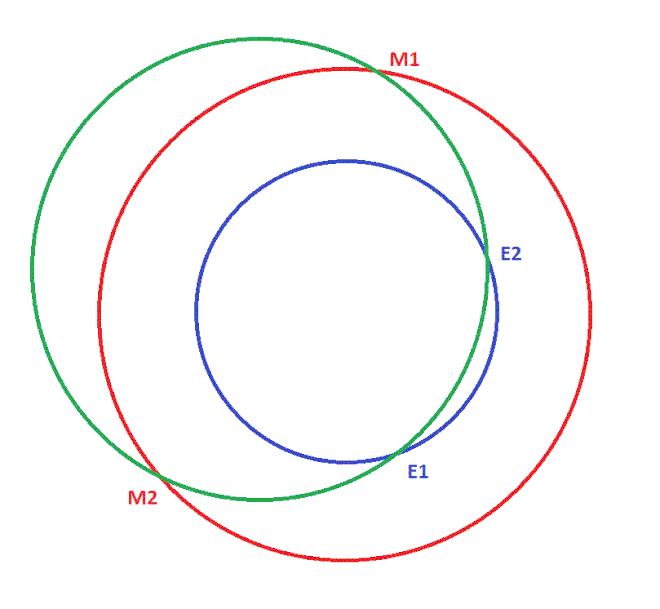
Label that curve the cycler where it joins both orbits — Earth (E1+E2) and Mars (M1+M2)
Then draw a small arc from Earth orbit up to meet the cycler spacetrain: that is your spoke. On the far side, draw another small arc from the cycler spacetrain down into Mars orbit. That is the whole thing — intersections plus rendezvous, repeated forever with tiny trims. You can adorn the picture with B-planes, turn angles, and Oberth notes; you can attach phase labels and period-in-synodics if the room likes algebra. But the picture that stays is simple: a moving platform that regularly crosses both orbits, and a pair of short transfers that meet it.
If you keep only the key figures, keep these. Synodic beat ~780 days. One-synodic rail legs ~146 days Earth→Mars and ~146 Mars→Earth, with a long ~16-month coast between. Encounter speeds often ~6–7 km/s at Earth and ~4–6 km/s at Mars for 1× rails; multi-synodic or semi-cycler choices can bring those into ~3–5 km/s at the price of calendar or burns. Maintenance trims budgeted at ~50–150 m/s per synodic; semi-cycler capture/re-boost ~0.7–1.2 km/s each bookend. And the operational rule that quietly powers everything else: capture timing ≠ pad timing.
That is all a cycler is: an orbit that meets two worlds regularly, turned into a service. Once you see it that way — a schedule more than a ship — the rest of the corridor reads like a timetable, not a cliff. The next chapters will return to spokes and pads and dust. For now, keep the cycler orbit in your eye and the drum in your ear.
♦♦♦
Cycler In-Direct Transit 101
Cycler Type | Synodic Periods / Cycle | Cycle Duration (yr) | Typical Earth & Mars V∞ (km/s) | Encounters / Cycle (E,M) | Strengths | Tradeoffs | Good Uses (early → mature) |
Aldrin (single-synodic) | 1 | ~2.135 | 6–7 (E) | (1,1) | Fast cadence; simplest resonance; minimal maintenance | Very high flyby speeds; tight attach windows; strong ops discipline | Early freight demo; later human castles with robust taxis & depots |
1× Semi-Cycler (Mars loiter) | 1 (with Mars orbit stay) | ~2.1–2.5 (incl. loiter) | 4–6 (E) | (1,1) | Low relative speed at Mars; easier docking; schedule buffer at Mars | Burns break ballistic purity; extra prop/logistics at Mars | Early human transfers; high-value cargo needing gentle Mars ops |
2× Ballistic Cycler | 2 | ~4.27 | 5–6 (E) | (1,1) per loop | Calmer phasing than 1×; more forgiving windows | Half the cadence; misses cost years | Bulk freight when depots are steady; training wheels for ops teams |
3× Ballistic Cycler (VISIT-class) | 3 | ~6.4 | 4–6 (E) | Mixed (e.g., 3–5 total) | Multiple encounters per cycle; flexible phasing | Calendar inertia; complex ephemeris | Long-haul freight; low ops tempo periods |
5× / 6× “Quiet” Cyclers | 5–6 | ~10.7–12.8 | 3–5 (E) | Several per cycle (design-dependent) | Very stable; large windows; minimal trims | Long gaps if you miss; inventory risk | Mature cargo backbone; heavy castles with low taxi stress |
Powered (Non-Ballistic) Cycler | 1–6 (any) | As designed | 3–7 (E) | As designed | Locks timetable despite perturbations; meets ops needs | Requires routine burns & active nav | Operational workhorse once depots & GNC mature |
Earth-Focused Semi-Cycler | 1–2 | ~2.1–4.3 | 1–3 (E) | (≥1 Earth, 1 Mars) | Easy Earth access (crew rotation, maintenance) | Pays propellant at Earth; still hot at Mars | Crew embarkation hub; maintenance-heavy castles |
*Maintenance ∆v per cycle = planned trims to hold phasing/B-plane; order-of-magnitude guide for good designs.
Reading notes
V∞ figures are Mars/Earth-relative flyby speeds for the cycler; taxi burn burden depends on rendezvous strategy and whether you add small powered tweaks at flyby to “kind” the encounter.
Rendezvous burden compares to a spoke that goes direct H/F to the planet; cycler rendezvous usually adds km/s to the taxi unless you pay some of it with cycler-side burns or adopt semi-cycler loiter.
Choose single-synodic when cadence is king and your depots+taxis are ready; choose multi-synodic when schedule slack is acceptable and you want gentler flybys and wider windows; choose semi-cyclers when one planet needs low-speed, port-like operations.