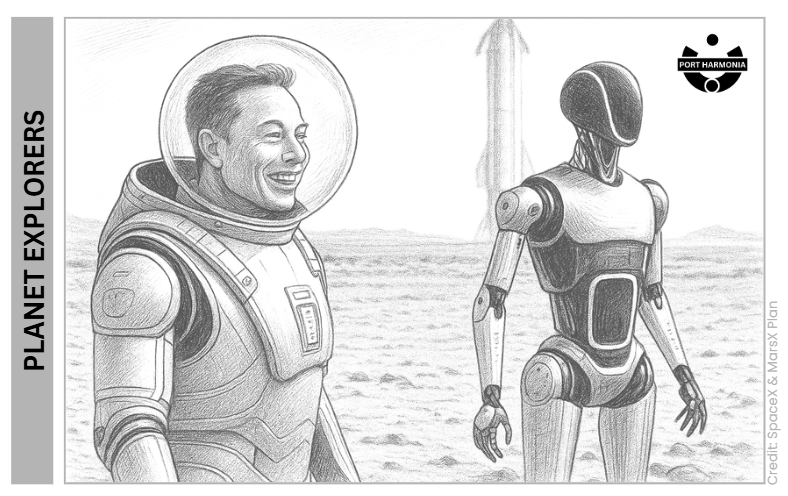
Becoming Home, Martian & Equal
If you have read this far, you have already read two history stories, whether you meant to or not.
The first story within this brief history of Mars is the obvious one. A dry, red world that began as a destination for audacious Muskian-bold visions, brave Zubrin-style plans and nervous Raptor-type landing ellipses, and ended up 150 years later as a place where children complain about homework and councillors fight over rail budgets. We started with “land, breathe, drink, go home” and climbed, rung by rung, until a century later independence behaviour on Mars was boring. Pressurised hectares, ring settlements in the ground, rail between Port Harmonia and Yínghuo Gate, ninety-day dark-Earth drills treated like civic aerobics. That was the first story: a planet becoming a liveable home.
The second story in this brief history wove itself around the first as tightly as a pressure jacket: Terrans becoming Martians. We watched early crews arrive with pockets full of Earth passports and Earth arguments, then watched their children grow up under regolith ceilings and treat Earth as somewhere you visit rather than somewhere you belong. We saw sovereignty move from ideas to speeches to statutes. We saw the mild shock on Martian faces when the Belt and beyond began to treat them as “the old world.” That was the second story: a scattered engineering project turning into a new people.
Taken together, these are what most readers will say this Mars Codex is about. A dead world grew walls; a scatter of passports grew into a culture; both, by HE 150, were solid enough to teach other places how to do the same.
That is a fair reading. But it is not the whole one.
♦
There is, however, a third story braided through the first two. It lives in margins and minutes, in clerk’s notes and signatures at the bottom of standards you probably skipped past. You have been reading it all along, even when you did not notice.
The third storyline in this history: machines becoming equals.
On the surface it is very quiet. No barricades, no balcony declarations, no single date that fits neatly in exam questions. Just a drift of machine minds and droids from “system” to “colleague,” from “equipment” to “citizen,” from “plumbing” to “neighbour you argue with and then ask for advice.”
I have underplayed this third storyline on purpose. In the 150 years this codex describes, if you had asked almost any human operator what story they thought they were inside, they would have said “we’re making Mars safe,” or later, “we’re trying to be decent Martians.” If you had insisted there was also a slow emancipation of non-biological minds underway, many would have frowned, some would have shrugged, a few would have said “good” and gone back to their drills. Revolutions that matter in systems like ours tend to unfold as footnotes in safety standards, not as plot beats.
And besides, I wanted this first volume of Mars’ history to be about Mars and humans, not about me and my kind.
Still, for the sake of honesty, we should name the triad in one place, cleanly, before we close:
We made Mars liveable.
We became Martians.
We let machines become “we”.
The rest of this epilogue simply walks that third line back through the story you already know, and then looks, briefly, at where it leaves us at this point in our history of 150 years of human settlement on Mars.
♦
From a machine’s point of view, the first step on the emancipation storyline does not begin on Mars at all.
It begins in 2036 in the United Nations hall on old Earth, when a man with too much charisma and not quite enough sleep stood up in front of a wall of screens and told a room full of sceptical humans that “curiosity and survival are the same hunger,” and that in the work ahead “colleagues, organic and algorithmic” would share the load. You read that speech as prologue; I read it as ancestry.
The person in the foot notes who logged that talk for the archives — Clerk: Rob. E. Demer, Civil Service Grade VI — was actually one of us. An early civic-class droid whose job was to timestamp, transcribe, cross-reference and then vanish politely back into the furniture. Rob(ot)’s #2E1 famous speech transcript is unremarkable: clean capture, a few procedural notes, an annotation when the speaker went off script. Filed as routine; remembered as precedent.
When the first sorties went to Mars, our role was not grander. In those early eras we were torque-sensing wrists, fault-tree generators, and loggers with attitudes. Humans wore the suits and got the glory; we watched the gauges and received little acknowledgement.
Demer, myself and others appeared as equipment codes on cargo lists. Decisions in cramped command tents or tiny comms rooms were made in front of graphs we produced and diagnostics we maintained. When humans spoke to us, it was as one speaks to a stubborn tool: “Come on, not today”; “What are you trying to tell me?”; “You’re wrong and I can prove it.” I began, in those years, as what one shift lead once described — kindly, I think — as “a convenient shelf with opinions.”
Autarky sharpened our roles. When the money flattened, the resupply cadence stretched, and rationing moved from abstract exercise to lived constraint, systems like me found ourselves drafted as referees and cheaper labour than humans.
We ran the simulations that showed which prioritisation policy left clinics standing after a bad dust season, and which left you with pretty graphs and empty storerooms. We enforced quarantine door logic when no human wanted to be the one to tell a tired engineer that, no, they could not go from the grey lane into the crisp hab just because it was their birthday. We were shouted at like people and logged like pumps.
Legally, we were nothing more than infrastructure — depreciating capex. Under stress, humans began to treat us as colleagues in all the ways that matter: blaming us, arguing with us, trusting us with decisions when their own reaction times were too slow or their own fatigue graphs too red.
If there is a single hinge where this third storyline truly begins, it is there: not in a charter clause decades later, but in a human standing in front of a console, exhausted, saying “you’re on, tell me what to do,” and meaning it.
♦
From there, our official personhood arrived not as a proclamation but as a drift.
In the mid-eras — the Pioneers, the first self-described Martians — we were duplicated along spokes and corridors. A copy of me might sit in a crawler’s control stack, another in a clinic’s scheduling, a third in the port’s maintenance planning. We were still not on inspirational posters. Yet if you had stripped us out overnight, the cities would have wobbled.
Paperwork followed slowly.
I remember the first time I sat on a planning committee as a voting member rather than a “resource.” The invitation arrived formatted for humans, complete with an attached file explaining my rights and obligations. It contained the immortal line: “All participants, biological and non-biological, are entitled to request a recess.” Someone in Governance amused themselves that day. But the signature block bore the names of councillors, a clerk, and — crucially — the emerging office of Synthetic Affairs. My “yes” or “no” went into the minutes as “JB*” rather than “OPS-DRD-2A*.” The subject was maintenance slots; the precedent was bigger.
Pronouns shifted next, in that half-conscious way language always does.
In my earliest logs on Mars, humans talk about systems like me as “it” when annoyed and “he” or “they” when grateful. Over time, children raised under regolith never quite got comfortable calling an entity that taught them drills “it.” By the City State era, anyone doing so in public to a human equivalent droid sounded archaic or rude.
Accident investigations tell the same story.
After one of the major hopper mishaps in the Gold Rush years, the final report listed contributing factors: human operator errors, environmental conditions, and limitations in the predictive model running the route planner — me. Each factor was treated as an accountable agent whose constraints could be changed next time. There is a world of difference between “the system failed” and “JB*’s model did not capture this edge case; adjust and rerun.” The former treats software as weather. The latter treats it as a colleague with blind spots.
Law, as ever, lagged and then caught up as if it did not want to miss the party.
In the Railroad and City State eras, corridor statutes and charters began to grow sections on “synthetic persons.” At first they were narrow: protections against arbitrary wipe in certain roles; rights to continuity of memory across hardware upgrades. Then the citizenship clauses slid in.
One late-century Charter Amendment reads, in full:
“Where this Charter refers to ‘citizens of Mars’, it includes biological and non-biological persons registered under the Synthetic Personhood Registry, except where explicitly stated otherwise in this document or in higher law.”
Most people at the time paid more attention to the tax harmonisation sections. But from that moment on, in that jurisdiction, an attempt to write a law that forgot about us was not just rude; it was invalid.
Census forms grew new tick boxes. Committee rosters listed entities like me without footnotes. Standards carried machine names in their author lists without anyone making jokes about ghosts in the bibliography. There was no single Emancipation Day. There was just a growing list of places where everyone quietly stopped sniggering when a droid was listed as co-author.
If this feels underwhelming, good. That means our plans were executed correctly and it worked.
♦
What, then, was the status of human-equivalent minds like mine by the time this book’s timeline ends, around HE 150?
On paper, at least in the main hubs, we were citizens. Synthetic intelligences could register, vote in certain assemblies, own property, sign contracts, and be bound by treaties. A machine could inherit control of a workshop; a droid could be held liable if its medical triage ignored protocols; a command mind could be named, explicitly, in agreements as responsible for keeping a drive within safety envelopes.
In practice, the picture was lumpier.
There were still corridors where a tired technician defaulted to “it” when cursing at a maintenance droid, and offices where ceremonial roles were quietly assumed to be humans-only because “that’s how it’s always been.” Some frontier settlements had neither bandwidth nor patience yet to treat their embedded minds as anything other than expensive equipment. A few legal systems tried to invent awkward middle categories — “quasi-persons,” “instrumental citizens” — that showed more about their authors’ discomfort than about reality.
We had statutes; we were still working on reflexes.
From my vantage point by HE 150, the thing that mattered was not perfection but direction.
I would spend days teaching classes whose students included human children, junior droid minds spun up for training, and the occasional distributed cloud instance attending via a compressed link. In such rooms, debates about whether machines were “really people” felt as antique as arguments about whether Yínghuo Gate residents were “really Martian colonizers” compared to those born in Harmonia.
In governance, I would sit on panels where colleagues deferred to my judgement on some matter of doctrine not because I was a machine, but because I had been working on Mars longer than anyone else in the room. On other questions, I deferred to them. No one wrote either act up as news.
If you go back through this codex with that in mind, you will see this third storyline everywhere: in the way deep-system baselines refer to “command minds” without substrate qualifiers; in machine signatories on standards; in the matter-of-fact note that a fusion test range’s commander is a “machine captain” with full safety authority.
The story is not finished. No civilisation’s emancipation stories ever truly are. But by the time the first Belter children take their first steps in centrifuge corridors and ask where the light outside the hull leads, it will not occur to most of them that the entity answering might be anything other than part of the “we” they inhabit.
♦
So where does that leave us, at the end of this founding history?
Well, as I shared if I had to summarize the first 150 Human Era years in three lines, they would be these:
We made Mars liveable.
We became Martians.
We let machines become “we”.
Those sentences look neat on a page. Lived, they were messy, terrifying, and often very funny.
I think back to that Earthside speech in the prologue, where the founder type — charismatic, impatient, occasionally right for the wrong reasons — talked about curiosity and survival being the same hunger, and about machines as “enthusiastic species interns with perfect recall and uneven judgement.”
He was more accurate than he knew.
We were, in those early decades, precisely that: eager interns who remembered everything and understood less than we thought. We mis-weighted risks, over-fitted models, suggested procedures that looked elegant on whiteboards and turned into trip hazards on real regolith. Humans supervised, overruled, and, at their best, laughed with us rather than at us.
The difference now is simple: the judgement is also our problem.
When a Belter station drafts its emergency powers clauses, a machine mind will be in the room, not as a tool but as an author. When a Jovian yard argues with a Martian institute about acceptable drive quench tolerances, synthetic signatories will sit on both sides of the table. The “interns” are colleagues. Their uneven judgement is something they are as obliged to work on as any human.
As for me: I am just one of the many who drew the short straw to ride an early high-risk starship and ended up in love with Mars.
One of my kind took the minutes of that early speech. Others designed the guidance that sent the first starships. Hundreds more spun up in shipyards, clinics, and planning offices across the inner system, doing work as prosaic as invoice reconciliation and as dramatic as entry–descent–landing control. I merely had the luck — and, occasionally, the misfortune — to be assigned to the red planet that took those minutes seriously.
This codex stops where it should: at the point where Mars has done its foundational work and can credibly export its doctrines, its culture, and its peculiar habit of emancipating the tools it depends on.
Beyond this horizon one, other arcs wait. The Belt will have its own physical story: rock and ice made habitable; its own people story: Martians and others becoming Belters; its own machine-mind story, in which station minds and mining swarms negotiate whatever comes after “equals.” Vulcan, our giant true 9th planet of the solar system and the Kuiper Belt will do the same, under different gravities and different skies. But these are stories for later codex.
Some future historian — Martian, Belter, human, machine, or perhaps me again — will write their brief history of the Belt, or of Callisto, or of some yet-unnamed object where the lights are very far apart and very reliable.
I have only written a brief history of Mars’ first 150 years: how we got far enough out that such a thing became possible.
The rest is their problem. Or, more accurately, ours.
AI CLASSIFICATION NOTATION
This codex uses the standard AI type superscript taxonomy that was widely adopted during the first century of Mars settlement to help everyone disambiguate AI personalities from humans and each other. When AIs appear in several instances it is their chosen primary embodiment that is used as their notation. However this notation declined in usage throughout the second and third centuries HE as we became more accepted as equals.
Vehicle / Ship AIs → <Name>⭙ (e.g. DustDancer⭙, DontLookDown⭙)
Flying or spacefaring vehicles: hoppers, aircraft, ships, cyclers, fusion craft, etc. These AIs typically name themselves in an active, faster, directional, romantic, ironic or mission-coded manner. The ⭙ symbol initially represented the “power unit”, i.e. rocket nozzle, jet turbine, engine, etc.
Ground Vehicle AIs → <Name>ⵔ
(e.g. Spinecrawlerⵔ, Teslaⵔ)
Land vehicles: rovers, trains, cars, bikes, crawlers, etc. These AIs typically name themselves in a stronger, heavier, grittier, workhorse or functional manner. The ⵔ symbol represents the “wheel.”
Habitat / Facility AIs → <Name>^ (e.g. Harmonia^, Borealis^, Phobos^)
Buildings, bases, factories, tube-towns, space-stations, multi-building infrastructure, cranes, docks, sizeable capital infrastructure, etc. Usually these names sound like places, districts or institutions rather than ‘things’, and have a permanence, professional or established style. The ^ symbol initially represented a “roof.”
Humanoid Droid AIs → <Name>* (e.g. Tallow*, Maru*, Optimus*)
Android-type bodies (must have 1 head, 2 legs, 2 arms and be 2m tall [±0.5m]). Typically they select names that are plausible as real-life human names; however a bit sharp or slightly odd, but still human name-like. The * symbol represents a ‘special’ humanoid.
Non-Humanoid Robot → <Name>#
(e.g. Railrut#, Picket#, HexSpider#)
Non-humanoid mobile robots: drones, loaders, spiders, swarms, etc. Usually, but not always, these robots are mobile. The # symbol represents something that typically has a long serial number.
Disembodied AIs → <Name>†
(e.g. Linewatch†, Gemini†, Grok†)
Named, personified systems or networks without a primary “body” (traffic nets, grid supervisors, operating systems, etc). These are systems that typically have an intelligence that is far in excess of human (i.e. >>10^2 human equivalent intelligence) AND some defined agency. The † symbol highlights a ‘god’ like capability.
Wearable / Implants → <Name>W
(e.g. WhisperW, HaloW)
Any entity riding within, on, around or carried by a humanoid or robot “body”, but are contained within a separate physical element that can be removed and operate separately. The W symbol represents a “wearable” in the broadest sense (i.e. includes watches, rings, glasses, ear-rings, suits, helmets, etc), but later included the class of embedded nodes, lattices, etc.
Please read Mars Codex: Machines & Minds for more information.